
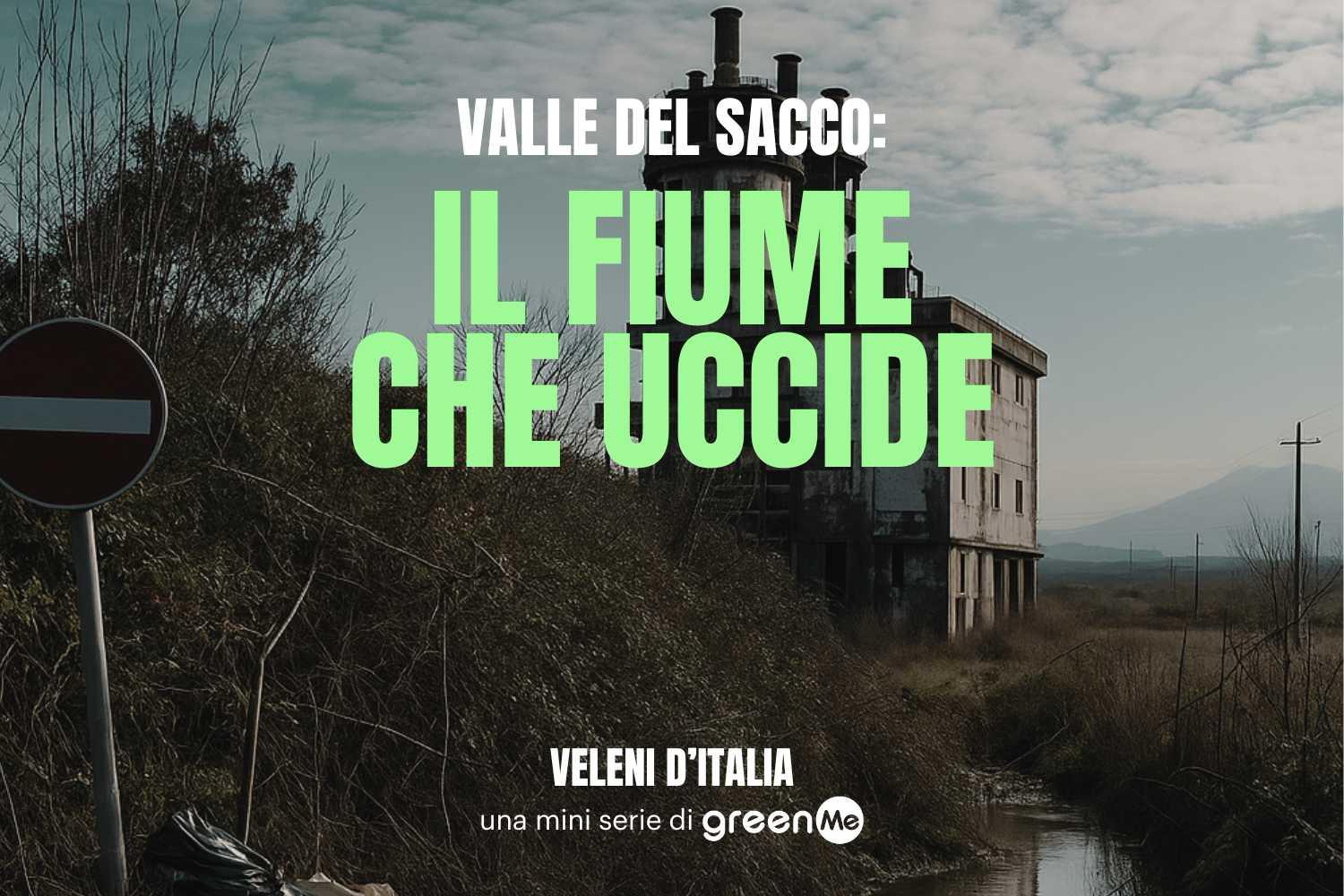
There is a place in Italy that for half a century has been paying the price of industrial development made up of illegal spills into rivers, incinerators, buried waste and asbestos. It is the Sacco Valley, in Lazio, one of the most polluted sites in Italy. In the third episode of “Poisons of Italy” we will retrace the stages of one of the most serious Italian environmental disasters, those in which it is difficult to even find (and condemn) a culprit
As many as 19 municipalities and around 220,000 inhabitants in one of the most compromised areas of Italy from an environmental point of view, declared a Site of National Interest (SIN), i.e. those sites for which the State has recognized that the level of pollution is so serious that it is necessary to intervene with reclamation: it is the Valle del Sacco, between Frosinone and Rome.
Here it all began in the 1960s, when the much-discussed Casse per il Mezzogiorno aimed at an often blind and short-sighted industrialization of Southern Italy, made up of real industrial “poles”, which over the decades turned out to be hotbeds of indiscriminate pollution.
Precisely this has happened here starting from the spills in the Sacco river, which flows along the valley between the Ernici mountains and the Lepini mountains, in southern Lazio, amidst a dense network of water sources and covering an area of approximately seven thousand hectares.
At the end of its course, the Sacco flows into the Liri river and its waters then flow into the Tyrrhenian Sea, with all the pollutants they have collected along the way. It is contaminated for almost the entire length of its course, almost 90 kilometres, and the towns most affected by the toxic substances are Colleferro, Patrica, Supino, Morolo, Ceccano and Falvaterra.
But what exactly happened? And why is it the “Italian Chernobyl”?
The history of the Sacco Valley
In 1962 the “Sacco Valley Industrialization Unit” came to life: it almost seemed like a dream, because the first industries arrived, all private, financed by Italian or foreign groups. But someone already sensed the problem of pollution: then began a story of factories burying barrels of glue, solvents and inks and pouring toxic substances into the river. In 1978, the Cnr of Rome investigated the unhealthy conditions of the workers. But it still remains unmentioned: a problem that is ultimately marginal, if one thinks instead of the “magnificence” of the large industrial groups that ensure hundreds of jobs.
In the following decades, however, complaints began in the press and protests from environmentalists and residents of the area, who increasingly understood the potential danger behind the toxic spills. Reclamations are promoted and millions of euros are allocated by the government.
In 2005 the tragic event that acts as a watershed: in Anagni 25 cows die of poisoning, with swollen bellies and foam from the nose, after drinking water from a tributary of the Sacco river. From that episode the environmental emergency of the Sacco Valley finally acquired greater media coverage. To limit the damage to humans, all contaminated animals were culled and their milk withdrawn from the market.
In 2013 it was discovered that seven years earlier there had been strong indications regarding the illegal dumping of waste in the Sacco river area. The former boss Carmine Schiavone, in fact, had confessed that trucks loaded with toxic chemical agents were leaving from Germany and northern Italy and dumping their contents in the province of Frosinone.
In Colleferro the chemical industry produced DDT using the lindane molecule, now banned. The drums with the residues of β-hexachlorocyclohexane (derivative of lindane) have been buried over the years in some lands not far from the course of the Sacco river. This substance has slowly polluted the waters of the river and has thus contaminated kilometers of territory in the heart of Ciociaria.
All too late, because the population has already been contaminated: the health authorities have found values above the limits in the blood of the inhabitants. On June 23, 2015, the International Agency for Research on Cancer (IARC) classified lindane as a human carcinogen.
As for the health consequences, a high incidence of pleural and bladder cancers in men and uterine and breast cancers in women has been recorded in the area. The report certified this already in 2004 Mortality and hospital admissions of residents in the Sacco Valley of the Epidemiology department of the ASL of Rome E. And the numbers it presented were impressive. The percentage of hospitalizations could have increased up to 250%. There were 200% more leukemia patients in less than 10 years.
Whose fault is it?
In July 2020, the final sentence condemned Carlo Gentile, director of the Caffaro industrial plant in Colleferro from 2001 to 2005. He will serve two years in prison for the crime of unnamed environmental disaster (suspended sentence), compensation for damages to the civil parties and payment of court costs.
In April 2021, the Ministry of Ecological Transition provided an additional 10 million euros for safety measures.
Finally, in October 2021, the Gup of the Rome court ordered the trial of 16 people. The Asi purifiers of Ceccano and Villa Santa Lucia are in the spotlight for the treatment of waste as non-hazardous based on the classification with mirror codes. Various charges were brought for having illicitly organized and managed waste as “non-hazardous”. According to the prosecution, this waste should have been classified as dangerous and this would have allowed “an undue profit consisting of cost savings”.
On 17 June 2022, the final hearing of the second degree of judgment for the environmental disaster in the Sacco Valley was held at the Court of Appeal of Rome: the conviction was confirmed but the crime became statute-barred due to the expiry of the terms as a result of the former Cirielli law. Therefore no culprit was legally ascertained and compensation was cancelled.
