
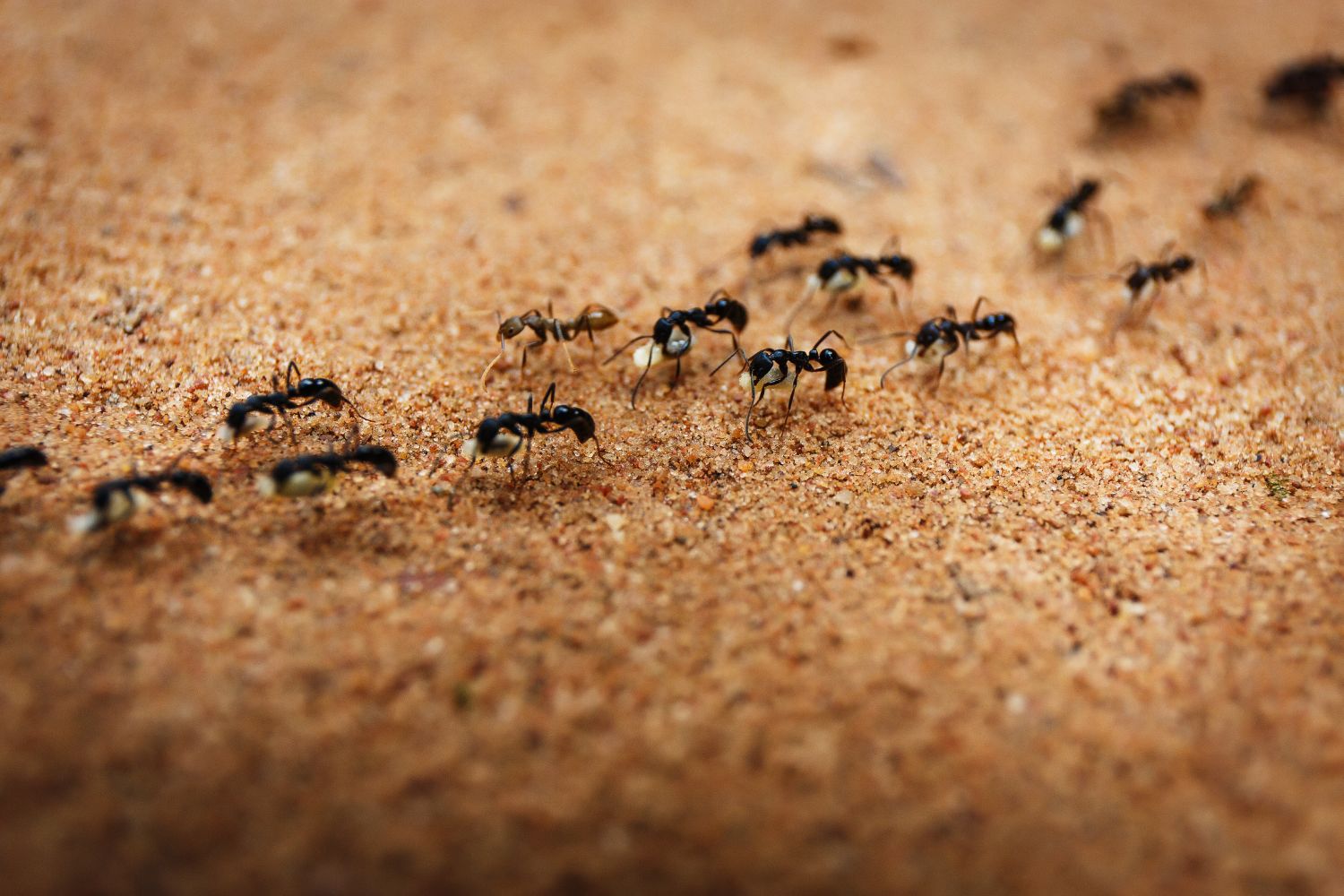
In the animal kingdom, the ability to learn and remember negative experiences is critical to survival. A new study conducted by Dr. Volker Nehring of the University of Freiburg, published in the scientific journal Current Biology, demonstrates that ants also possess this ability. The research, conducted on two populations of Lasius nigerthe common black garden ant, reveals that these social insects are capable of learn from aggressive interactions with ants from other colonies and to change their behavior accordingly.
The study was divided into four distinct experiments, aimed at thoroughly investigating the phenomenon of “bad neighbor effect“, or the tendency of ants to show greater aggression towards nearby colonies.
In the first experiment, the researchers observed the behavior of ants from different colonies, recording the level of aggression shown in encounters between individuals from different colonies. The results confirmed the existence of the bad neighbor effect: the ants were significantly more aggressive towards individuals from neighboring colonieswith a peak of aggression at distances of less than 5 meters.
To understand the basis of this behavior, the researchers conducted three additional experiments in the laboratory. In the second experiment, they exposed groups of ants to a series of controlled encounters with ants from a specific rival colony. The ants that had suffered repeated attacks on the part of these rival ants subsequently showed a significant increase in aggression towards members of that same colony.
“This result,” explains the study, “indicates that ants are capable of associative learning the olfactory labels of non-nestmate colonies and to associate them with negative experiences, such as aggression.”
In the third experiment, the researchers wanted to test whether the ants were able to distinguish between aggressive and passive ants in the same colony. To do this, they rendered some rival ants passive by ablating their antennae, preventing them from attacking. Ants exposed to these passive individuals showed less aggression compared to those who had encountered aggressive ants.
“This shows that the aggression received from an ant acts as an unconditional stimulus that the ant associates with the olfactory label of its enemy,” says Dr. Nehring. “Associative learning therefore plays a crucial role in the formation of recognition models of both nest mates than of non-nestmates”.
Finally, in the fourth experiment, the researchers investigated the duration and intensity of learning, varying the number of meetings and the time intervals between them. The results showed that learning occurs even with just a few close encounters, but that the effect is more robust when the encounters are repeated over the course of several days.
This search opens new perspectives on understanding the intelligence and social complexity of ants. The ability to learn and remember negative experiences, combined with sophisticated chemical communication, allows these insects to optimize their nest defense strategies.
“Associative learning of non-nestmate patterns,” the study concludes, “may help explain different patterns of variation in nestmate recognition, from unpleasant neighbor effects to task- and age-specific variation in aggression. ”
Furthermore, the research raises interesting questions about the role of individuality in the behavior of social insects. “Not all ants are the same,” explains Nehring. “Their individual experiences influence their behavior and contribute to diversity within the colony“.
Ants, therefore, are not that different from us. They too, like humans, are capable of learning from their mistakes and changing their behavior based on past experiences. The ability to “hold a grudge” towards those who attacked them represents further evidence of the surprising complexity of these small social insects.
