
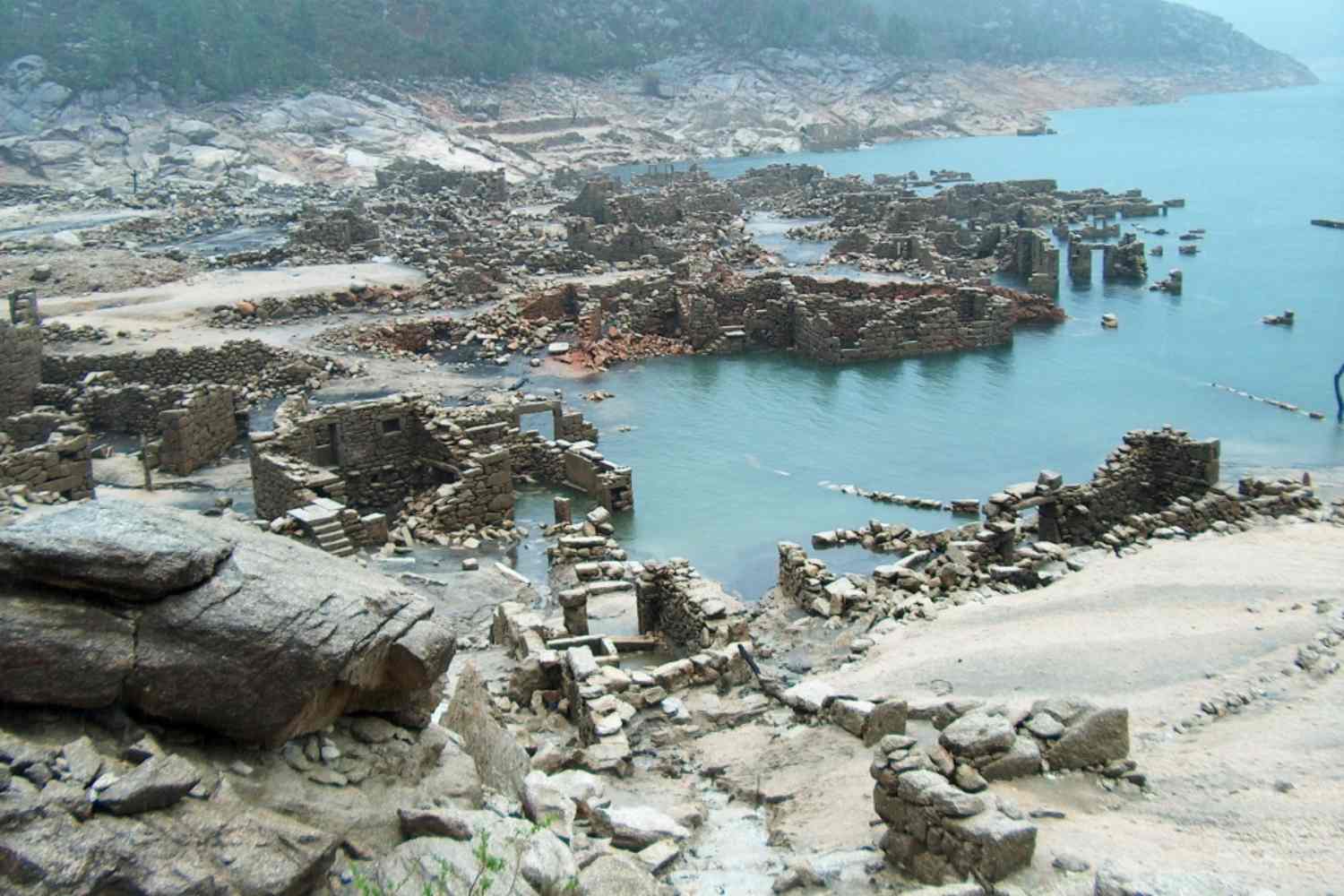
In the north of Portugal, under the quiet waters of the Homem River, lies the ghost village of Vilarinho da Furno. This community, whose origins date back to the Roman era, was sacrificed in the seventies to leave room for a hydroelectric dam. In 1971 the last inhabitants abandoned their homes and, the following year, the village was completely submerged.
Before the wave, the village had about 300 inhabitants distributed in 80 stone houses. Its peculiarity was the “Vezeira” system, a collective organization that regulated the use of lands and pastures fairly among families. Agriculture and breeding were at the center of daily life, while rural traditions marked the rhythm of the community.
View this post on Instagram
With drought the village resurfaces
During periods of drought, the level of the artificial basin is lowered and the village resurfaces, showing visitors the ruins of the houses, the walls and even the streets that once animated it. This suggestive show was worth the nickname “Atlantis of the Iberian Peninsula”, attracting tourists, curious and scholars. Some boats with transparent funds allow today to observe the remains directly from the water.
View this post on Instagram
The museum to honor the memory of the submerged village
The former inhabitants and their descendants did not forget Vilarinho da Furno. Every year they find themselves to honor the memory of their lost village, telling stories and anecdotes of a life that has now disappeared. To preserve its inheritance, the Museum of Vilarinho da Furno, built with the original stones of two houses, was inaugurated in the nearby São Do Campo in 1989. Inside you can admire traditional clothes, agricultural tools and paintings that reconstruct the everyday life of the past.
Visit Vilarinho da Furno
The village is located in the heart of the Peneta-Gerês National Park, a natural area that offers hiking paths, mountain bike paths and camping possibility. Those who wish can explore the area via kayak or boat, admiring the submerged remains when the water is high. The museum, on the other hand, represents a fundamental stop for those who want to know more deeply the history of this community.
View this post on Instagram
Don’t you want to lose our news?
You may also be interested in:
