
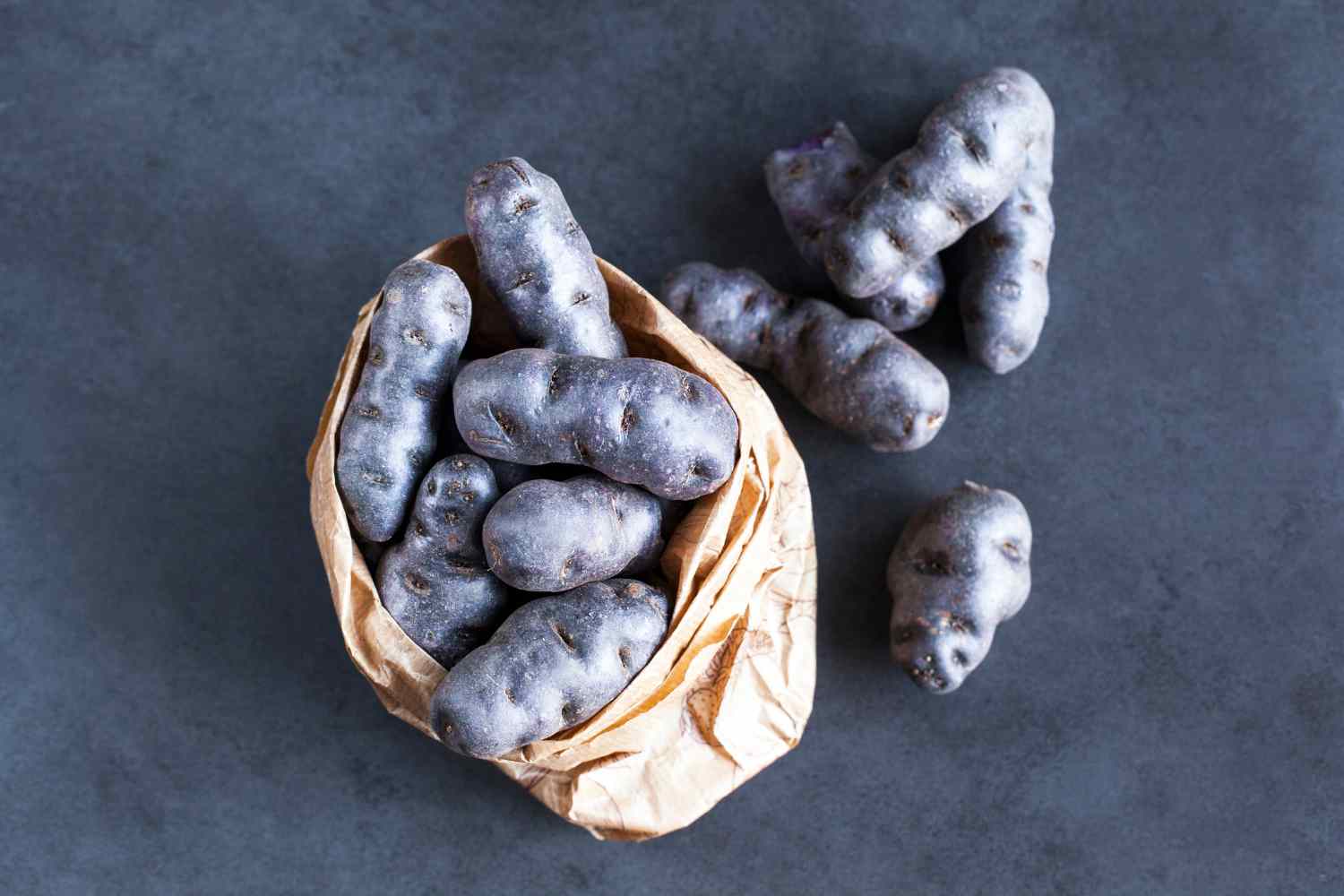
At first glance it might seem like a tropical fruit or a tuber arrived from who knows what Asian market. In reality, the Vitellotte potato – or “Vitelotte” as the French call it – is an ancient variety of potato, cultivated for centuries in Europe and only recently rediscovered due to its unmistakable colour. The intense purple pulp, compact and aromatic, makes it immediately recognisable. Today it has returned to markets and restaurants for its beauty, but also for the nutritional qualities that distinguish it from more common potatoes.
The origins of the Vitellotte potato
Vitellotte belongs to a variety of potatoes originating from South America, like most European tubers. It was introduced to France in the 19th century, where it soon earned a place on noble tables thanks to its unusual color and richer taste. Today it is cultivated in small quantities, often by local producers or farms that work on biodiversity and the recovery of ancient varieties.
It is not an easy potato: it has a lower yield, grows more slowly and harvesting requires attention. But that’s exactly what makes it special. It is a niche product, intended for those looking for an authentic ingredient, not a substitute for something. Its appearance, with the thick skin and the pulp that varies from deep purple to blue, makes it almost look like a natural design object, but the substance is entirely agricultural. It is a rustic, resistant tuber with a recognizable flavour.
The color purple as a sign of quality
Its color is the first thing that strikes you, but also the most important from a nutritional point of view. The purple pigmentation comes from anthocyanins, natural substances from the polyphenol family that play an antioxidant role in the body. These compounds, also present in blueberries and black grapes, are responsible for the body’s ability to counteract oxidative stress, slowing down cellular aging processes.
In terms of nutritional values, Vitellotte is similar to common potatoes: it provides complex carbohydrates, a good dose of potassium and a fair amount of vitamin C. However, the presence of anthocyanins and other phytonutrients makes it more interesting from a health point of view. Some research, although preliminary, suggests that regular consumption of baked purple potatoes may contribute to a slight reduction in blood pressure, probably thanks to the anti-inflammatory role of phenolic compounds.
Of course, we shouldn’t fall into the temptation of considering it a “superfood”. What remains is a potato, a starchy food that must be placed in a balanced context. But compared to white or yellow varieties, Vitellotte offers something more: color, antioxidants and an aromatic profile that makes it more satisfying, even in moderate quantities.
The taste and texture
Anyone who tries it for the first time will immediately notice a difference. Vitellotte has a deeper, slightly sweet flavor, with an aftertaste reminiscent of hazelnut or chestnut. The consistency is fine, dry, and tends to remain compact even after cooking, without falling apart as happens with some floury potatoes.
This balance between internal creaminess and external compactness makes it suitable for refined preparations, but also for simple, home-made dishes. In designer kitchens it is used to give a visual touch to spectacularly colored mashed potatoes and gnocchi; in homes, however, it finds its best expression in the oven, where it shows all its personality.
How to cook Vitellotte potatoes in the oven
Cooking the Vitellotte in the oven is probably the best way to respect it. The dry heat enhances the flavor, preserves the color and creates a thin, crunchy crust that contrasts with the softness inside. It is also the simplest and least invasive technique: there is no need to boil it or peel it first, because the peel itself helps to retain the pigments and maintain the intense pulp.
There is only one trick: dry the potatoes well before baking them. Moisture is the enemy of crunchiness, they can be cooked whole, piercing them lightly with a fork to prevent them from splitting, or cut in half or into chunks if you want to speed up the cooking time. A drizzle of extra virgin olive oil, a pinch of salt and, if you like, a few sprigs of rosemary or thyme are enough to enhance the taste.
The ideal temperature is around 200 degrees. The time varies according to the size of the tubers, but in general 40-50 minutes are sufficient to obtain a tender pulp and a crunchy surface. At the end of cooking, it is worth letting them rest for a few minutes before cutting them, to allow the internal juices to redistribute. The color remains vivid, and the texture compacts without drying out.
If you want a more rustic effect, you can cook the whole veal wrapped in baking paper or foil, as you would with classic baked potatoes. In this way they retain even more internal humidity and the result will be a soft and creamy centre.
How to combine them and use them in the kitchen
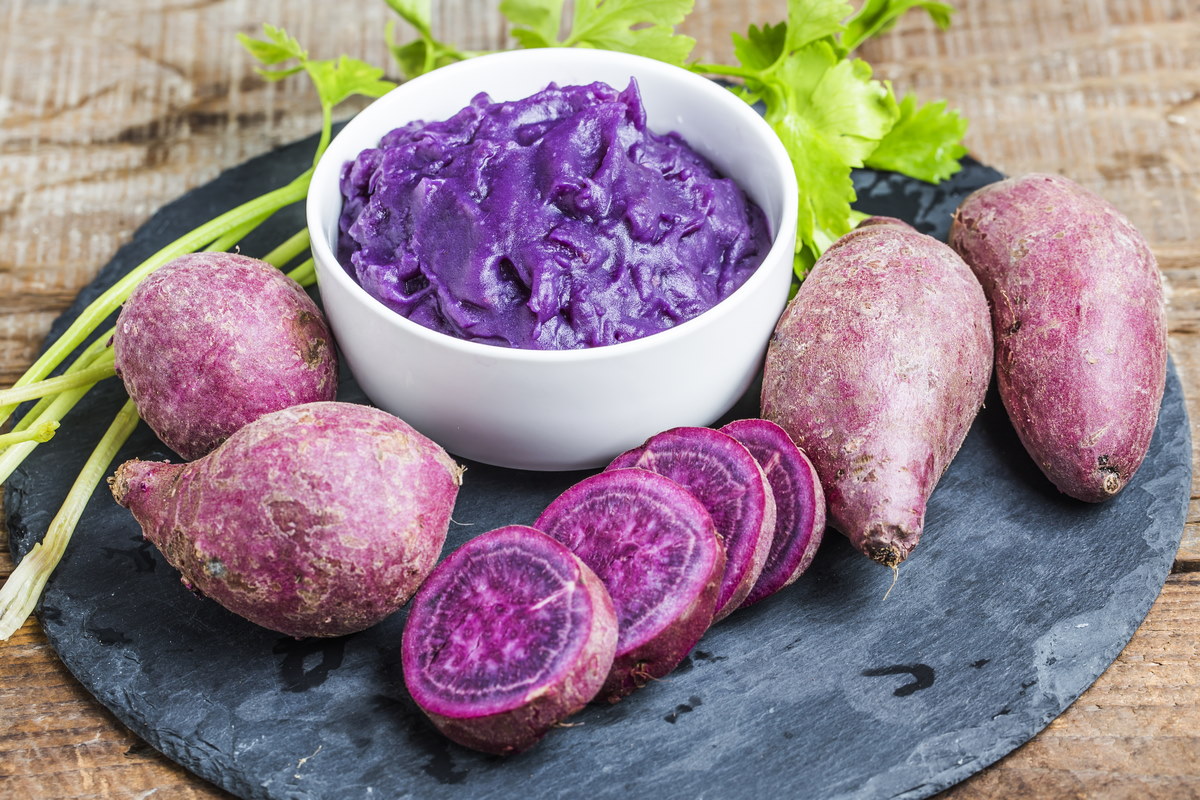
The purple potato goes well with simple dishes and ingredients that do not cover its flavour. Accompanied by all main courses, cheeses, purees, it becomes a spectacular side dish that transforms even a traditional dish into something different. Some chefs use it to prepare gnocchi with an unusual color, or as a base for cold soups and creams.
Cut into cubes and cooked in the oven, it becomes a versatile side dish to serve with warm salads, legumes or eggs. Alternatively, sliced thinly and cooked at low temperature, it turns into crunchy deep purple chips.
Baked Vitellotte potatoes with rosemary and coarse salt
Baking is the most direct way to understand the character of Vitellotte. Strong colour, aroma of earth and rosemary, and a crust that crunches under the fork.
Ingredients for 4 people:
800 g of Vitellotte potatoes, 3 tablespoons of extra virgin olive oil, a sprig of fresh rosemary, coarse salt to taste, black pepper.
Preparation:
Wash the potatoes under running water, rub them well without peeling them. Dry them carefully and cut them in half if they are large. In a bowl, season with oil, salt and a few rosemary needles. Place them on a baking tray lined with baking paper, with the cut side facing down. Cook in a static oven at 200°C for about 40 minutes, until the skin becomes crunchy and the pulp soft.
Serve hot, lightly sprinkled with a pinch of coarse salt and freshly ground pepper. They go well with white meats or baked fish, but are also excellent on their own, with a glass of dry white wine.
Purple mashed potatoes with thyme oil and lemon zest
An elegant, colorful but balanced side dish. Vitellotte puree has a firmer consistency and a nuttier flavor than the traditional one, and the lemon scent serves to balance the sweetness of the tuber.
Ingredients for 4 people:
700 g of Vitellotte potatoes, 100 ml of whole milk, 30 g of butter or 2 tablespoons of extra virgin olive oil, 1 sprig of thyme, zest of half a lemon, salt and pepper.
Preparation:
Wash the potatoes and cook them whole, with their skins on, in salted water for 25–30 minutes. When they are tender, drain and peel them immediately, then mash them with a potato masher while they are still hot. In a saucepan, heat the milk with the butter (or oil) and the thyme, then filter it and add it to the potato mixture. Work the puree with a wooden ladle until you obtain a smooth and creamy consistency. Season with salt and pepper, then add the grated lemon zest.
It is served hot, alongside fish or white meat dishes. If you want a vegan version, replace the milk with a neutral vegetable drink and stir in oil.
Vitellotte potato gnocchi and durum wheat flour
Purple gnocchi are one of those dishes that strike you at first sight, but their strength is in their flavour. The color is not artifice, it is substance: a drier and richer potato, which gives body to the mixture and does not fall apart during cooking.
Ingredients for 4 people:
600 g of Vitellotte potatoes, 150–170 g of durum wheat flour (plus a little for the pastry board), one medium egg, salt.
Preparation:
Cook the whole potatoes in their skins in salted water for about 30 minutes, then peel them and immediately pass them through a potato masher. Let it cool for a few minutes, then add the egg and flour little by little. Knead quickly: Vitellotte tends to release less moisture, so you don’t need too much flour. When the dough is compact and not sticky, form rolls and cut the gnocchi by 2 cm.
Dip them in boiling salted water and drain them as soon as they come to the surface. Season them with melted butter and sage, or with a light cream of cheese and black pepper. The purple color remains vivid and the effect on the plate is surprising.
How much do they cost?
Despite its qualities, the Vitellotte is not an everyday potato. It is more expensive than common varieties and is difficult to find in large-scale distribution. Production is limited, because the plant yields less and requires more care. It is therefore not a “cheap” ingredient, but rather a conscious choice, suitable for those who want to give variety and color to their cuisine.
From a nutritional point of view, it should not be attributed miraculous properties. Anthocyanins are beneficial, but they do not turn the purple potato into a health remedy. It remains a food to be consumed in moderation, especially for those who need to control their carbohydrate intake. It is also important not to overcook: too high temperatures or too long times can lighten the pulp and degrade some heat-sensitive vitamins, such as C.
Have you ever tried purple potatoes, what do you think?
Read also about potatoes:
