
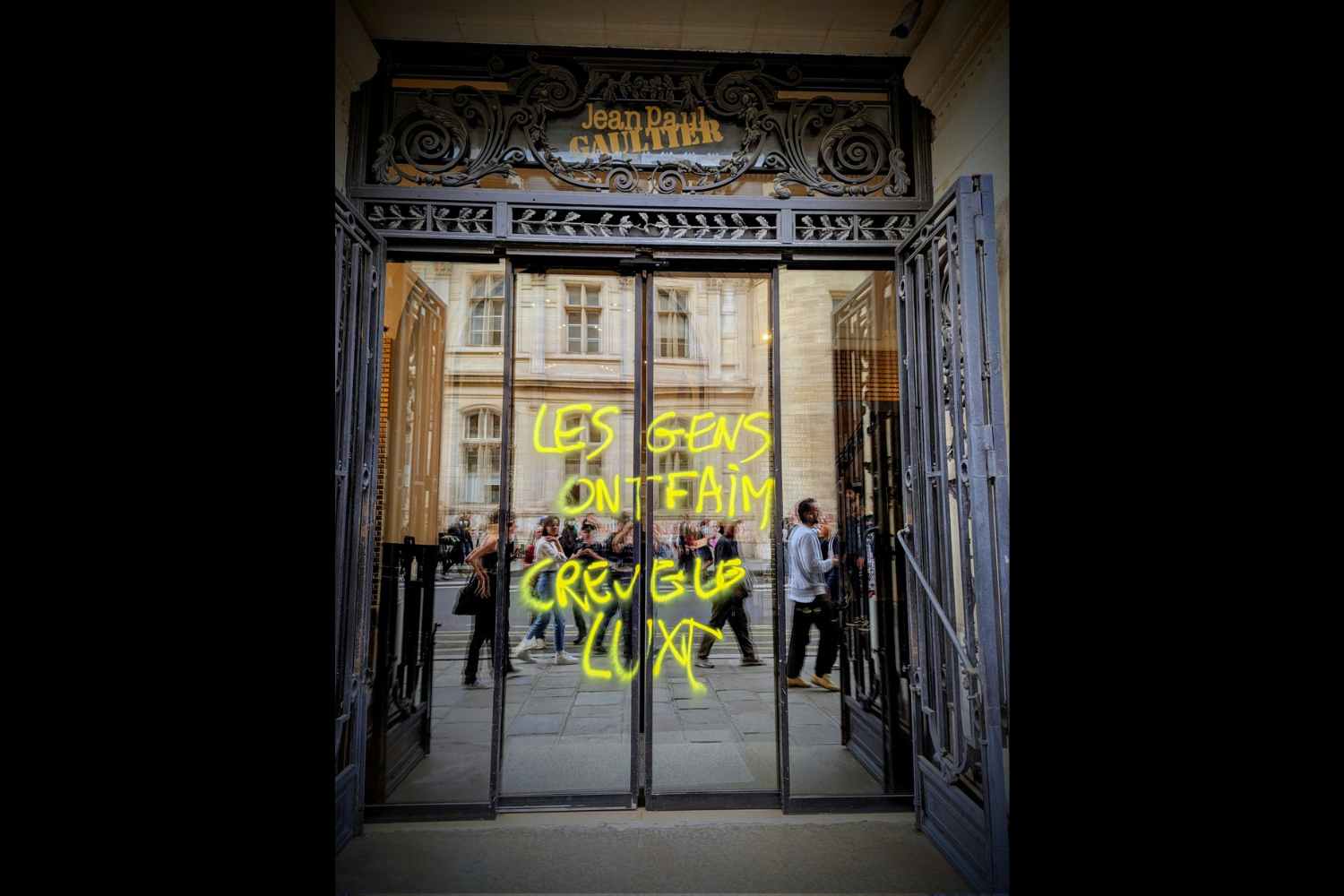
Autostrade blocked by fire tires, improvised barricades with bicycles and bins, stations taken and clashes with the police. Liquidating the “Bloquons Tout” movement as a simple riot, which brought France to its knees, would be a perspective error. Behind the anger that brought almost 200,000 people to the square, faced with 80,000 agents, there is a deep, rooted and generational discontent that aims straight to the heart of the system.
“Les gens ont faim! Crève le luxe.”
Paris. #10septembre #BloquonTout pic.twitter.com/oyoduryzx– Cerveaux not available (@cerveauxnon) September 10, 2025
The fuse: a 44 billion austerity plan
The spark that the country set was the country with the 44 billion euro re -existing plan proposed by the government of the former Premier François Bayrou, then disheartened by Parliament. A packet of austerity perceived as a punishment for citizens: suppression of two holidays, doubling of medical and drastic franchises cuts to public spending. Measures that have infuriated a large slice of the population, by workers in the health sector, who see 6,000 pharmacies at 20,000 at risk, to students.
Beyond the cuts: in the sights Macron and “The Republic of the rich”
But the big target, the one that unites the squares from Paris to Nantes, from Rennes to Montpellier, is not the former prime minister. It is Emmanuel Macron. “It is always the same shit; it is always the same thing, the problem is Macron, not the ministers. If you have to leave,” the union manager of the CGT told the Reuters Fred agency. His are widespread feelings. The slogans against the president and signs such as “La Repubblica dei Richchi” testify to an incurable fracture between a part of the country and what is called “a dysfunctional ruling class and decided on austerity”. A direct anger towards a system accused of not listening, as explained by the university student Thomas in Euronews: “We are angry with the political system and with the fact that the ultra-rounds and companies do not pay enough taxes”.
The face of the protest: a generation that is not there
What makes this movement different, and perhaps more powerful, of the protests of the past such as that of the “yellow vests”, is its personal composition. If in 2018 there was a France in the square that struggled to arrive at the end of the month, today the protagonists are young people. This was noticed by the sociologist Antoine Bristielle of the Jean Jaurès Foundation, explaining that the current protest is moved not only by necessity, but by “a certain vision of the world in which there is more social justice, less inequality and a political system that works differently, better”.
It is the voices of this generation that give the deepest sense of mobilization. Voices like that of Alice Morin, a 21 -year -old student, who at Reuters has declared with disarming lucidity: “Young people are the future, the old generation has left us a world of shit, a shit government. It is up to us to change this situation and dance on the ashes of the old world”. Emma Meugertatchian, 17 years old, student of Sorbonne, echoes her: “We came to make noise. We want them to know that we can no longer, we want another type of government”.
Of course, not everyone approves methods. “I understand anger, but that’s not that we can change things. Why who pay? We are taxpayers,” he told Euronews Nesrine, a project manager contrary to vandalisms. Yet, according to an IPSOS survey, 46% of the French supports movement, finding transversal consent.
Now the ball passes to the new prime minister, Sébastien Lecornu, with the almost impossible task of mending the tear. But the problem is not technical, it is political and social. France that blocks the roads does not ask for a simple budget adjustment, but a change of course. It is a generation that feels betrayed and that, as the name of the movement says, is willing to block everything so as not to see its future blocked.
Don’t you want to lose our news?
You may also be interested in:
