
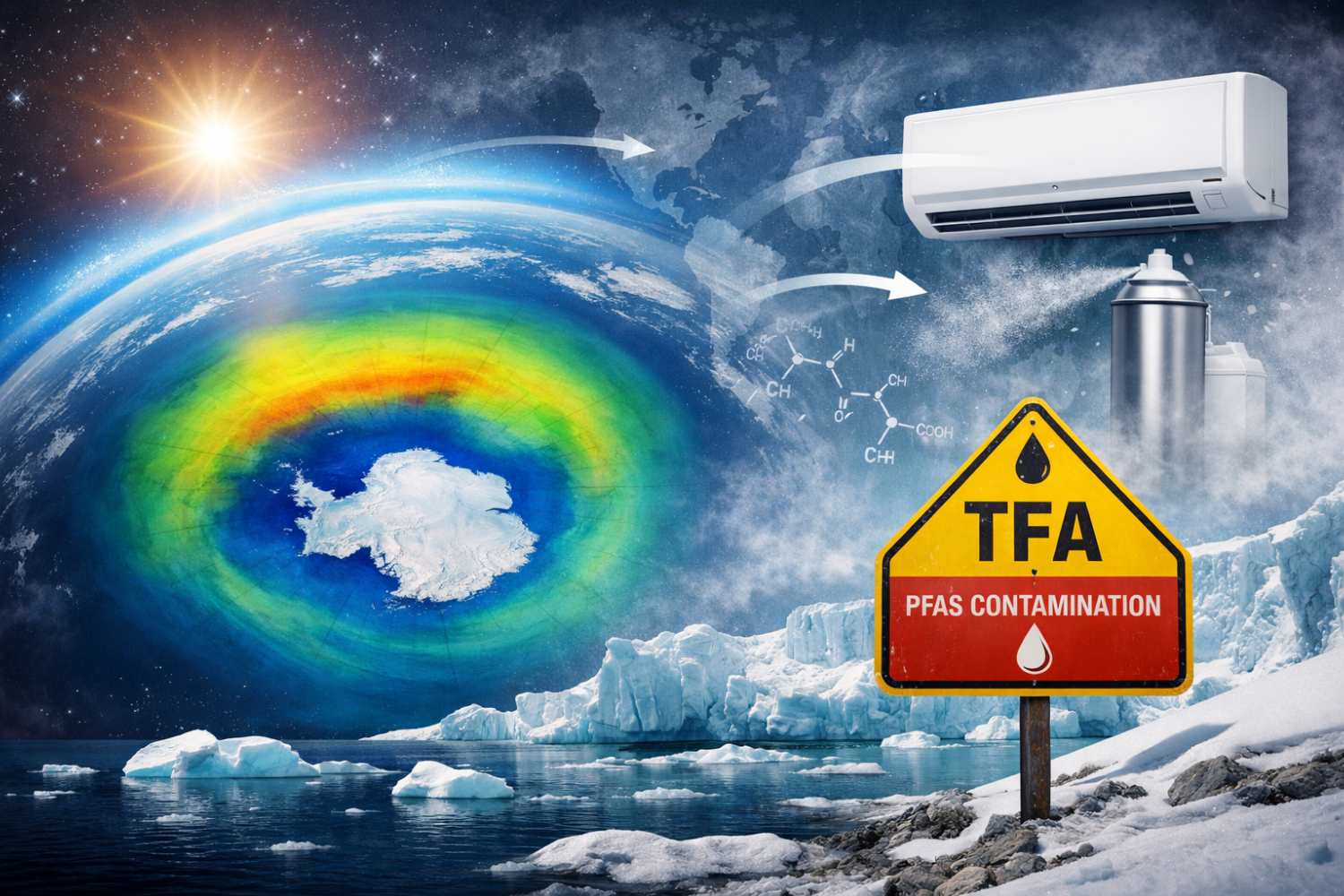
When the world mobilized to save the ozone layer in the 1980s, no one imagined that the solution would bring with it a new environmental problem. Today we find that the gases used to replace ozone-depleting gases are releasing massive amounts of a particular type of PFAS.
A new study published in Geophysical Research Letters reveals that over the last twenty years, levels of trifluoroacetic acid (TFA) have increased more than threefold across the planet. The cause? Precisely those “safe” refrigerant gases that replaced the old chlorofluorocarbons banned by the Montreal Protocol.
What is TFA
TFA belongs to the PFAS family, the so-called “eternal chemical substances” that persist in the environment for very long times. According to researchers atLancaster University and California San Diego, between 2000 and 2022 the amount of TFA deposited on the ground through rain and wind increased from 6,800 tons per year to over 21,800 tons.
This compound is now found everywhere: in water, in human blood, in drinking water, even in the dust of our homes. Studies of Arctic ice show increases of up to ten times compared to the 1970s.
The paradox of refrigerant gases
When the Montreal Protocol banned CFCs, the old refrigerant gases containing chlorine, fluorine and carbon that destroyed the ozone layer, the industry developed apparently safer alternatives: first hydrofluorocarbons (HFCs), then hydrofluoroolefins (HFOs). These gases do not damage ozone, but when they degrade in the atmosphere they produce TFA as a byproduct.
The problem has worsened with the introduction of HFOs, advertised as a low climate impact solution. Among these, HFO-1234yf – widely used in automotive air conditioning – generates TFA ten times faster than previous HFCs.
The study highlights how this type of contamination knows no borders. The TFA produced by the degradation of refrigerant gases travels in the atmosphere and is deposited in every corner of the planet, from industrial metropolises to the most remote polar regions.
The highest concentrations are recorded in tropical areas and in some areas of the northern hemisphere, particularly in China. But not even the Arctic is spared, researchers have also detected significant increases in the Canadian and Svalbard glaciers.
What risks to health and the environment
The European Union classifies TFA as harmful to aquatic organisms and is evaluating potential effects on human fertility and reproduction. Although the precise health impacts are not yet completely clear, its extreme persistence in the environment represents an ongoing and potentially irreversible exposure.
Scientists warn that concentrations in rainwater in some African regions have already exceeded the safety values established for drinking water in Germany.
And now?
Going back to old refrigerants is not a viable option. However, this research presents us with a crucial choice: continue with HFOs while accepting an exponential increase in TFA in the environment, or invest in the development of truly sustainable alternatives.
The researchers highlight the urgency of more extensive monitoring and coordinated international efforts. The transboundary nature of this pollution also raises questions of environmental justice, as regions that contribute the least to emissions still receive significant deposits of TFA.
This story reminds us of an important lesson, namely that environmental solutions must be evaluated in their complexity. Solving a problem without considering the possible consequences can simply displace the damage elsewhere, creating new emergencies for future generations.
