
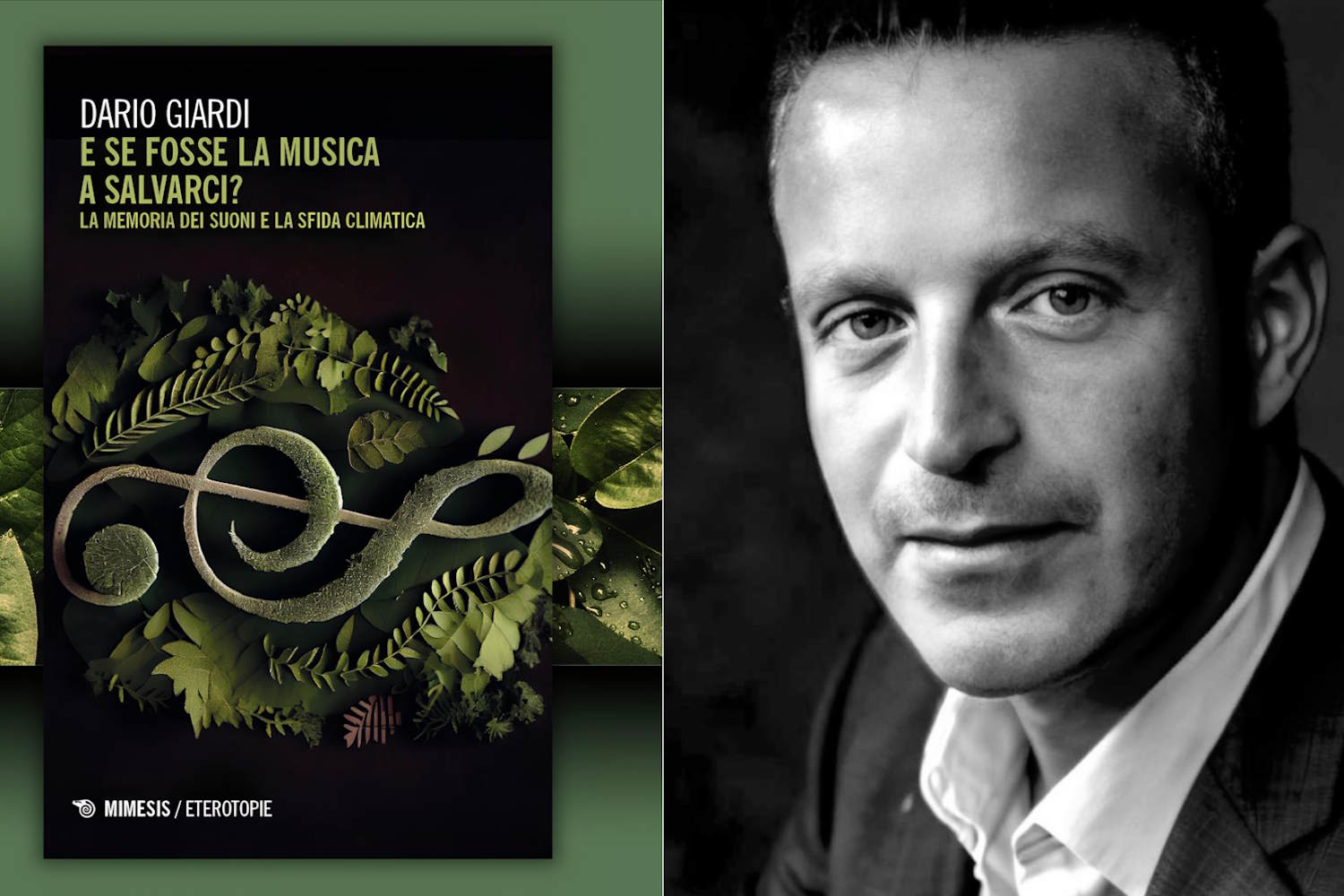
Can music save us from the climate crisis? Not in the most immediate and technical sense of the term, but it can change the way we perceive the world. Therefore, also the way in which we choose to protect it.
It is from this intuition that he starts “What if music saved us? The memory of sounds and the climate challenge” (Mimesis Edizioni) by Dario Giardi, researcher in the field of energy and the environment and composer of ambient and electronic music, an essay that puts two apparently distant universes into dialogue: music and ecology.
The central idea is simple but powerful: learn to listen to the Earth again.
The sound of the climate crisis
In recent decades our relationship with the environment has been mediated above all by numbers, graphs and scientific data. All fundamental tools, but often incapable of generating deep emotional involvement.
Giardi starts right from here: music can become a bridge between science and emotion, transforming complex phenomena into sensory experiences. Techniques such as the “sonification” of climate data allow for example to translate variations in CO₂, melting glaciers or atmospheric changes into sounds and musical compositions.
In his vision, listening to this data makes the climate crisis more tangible and less abstract and music becomes a real catalyst of awareness, capable of transforming eco-anxiety and the sense of impotence into fertile ground for reflection and action.
The concept of “memoryscape”
One of the most interesting contributions of the book is the concept of memoryscapean extension of the better known soundscape (soundscape). If the soundscape describes the set of sounds that characterize a place, the memoryscape represents its sound memory. An authentic living archive of sounds, emotions and identities.
We think of the ringing of bells in a small town, the singing of cicadas in summer or the sound of water in a fountain: all cultural and affective traces, capable of evoking belonging and rootedness.
The problem is that anthropogenic noise, Giardi claims, such as traffic, industries, artificial sounds, is progressively erasing these soundscapes. And when we lose the memoryscape of a place, we also lose a part of our emotional relationship with nature. And without that emotional connection, it becomes much more difficult to protect her.
In his essay, Giardi also shows how sound can also be a concrete tool for activism and mobilization. Music has always accompanied social movements and today it can do the same for the ecological transition. Contemporary artists such as Billie Eilish or groups like The 1975who collaborated with Greta Thunberg, transform their songs into real climate appeals.
At the same time, global events such as the Global Citizen Festival demonstrate how music can unite millions of people around a common cause, overcoming cultural and political barriers.
Sound agriculture and nature that reacts to sound
Sound isn’t just for monitoring ecosystems. In some cases it can even help them regenerate.
The so-called “biosonic agriculture” uses specific frequencies to stimulate the growth of plants and strengthen their resilience to climate stress. Other projects experiment with sound installations that reproduce animal calls to encourage the return of fauna to degraded habitats.
It is still a young field of research, but it suggests an interesting perspective: sound is not just a human language, but an ecological force capable of interacting with life itself.
In short, Dario Giardi’s book brings a very clear message: the climate crisis will not be solved with technologies and regulations alone. We also need a transformation of collective sensitivity and perhaps this transformation can start from a simple and radical gesture at the same time: going back to listening. Because, as Giardi suggests, without a sound memory of the Earth – without its own memoryscape – we risk losing not only nature, but also a fundamental part of our humanity.
