
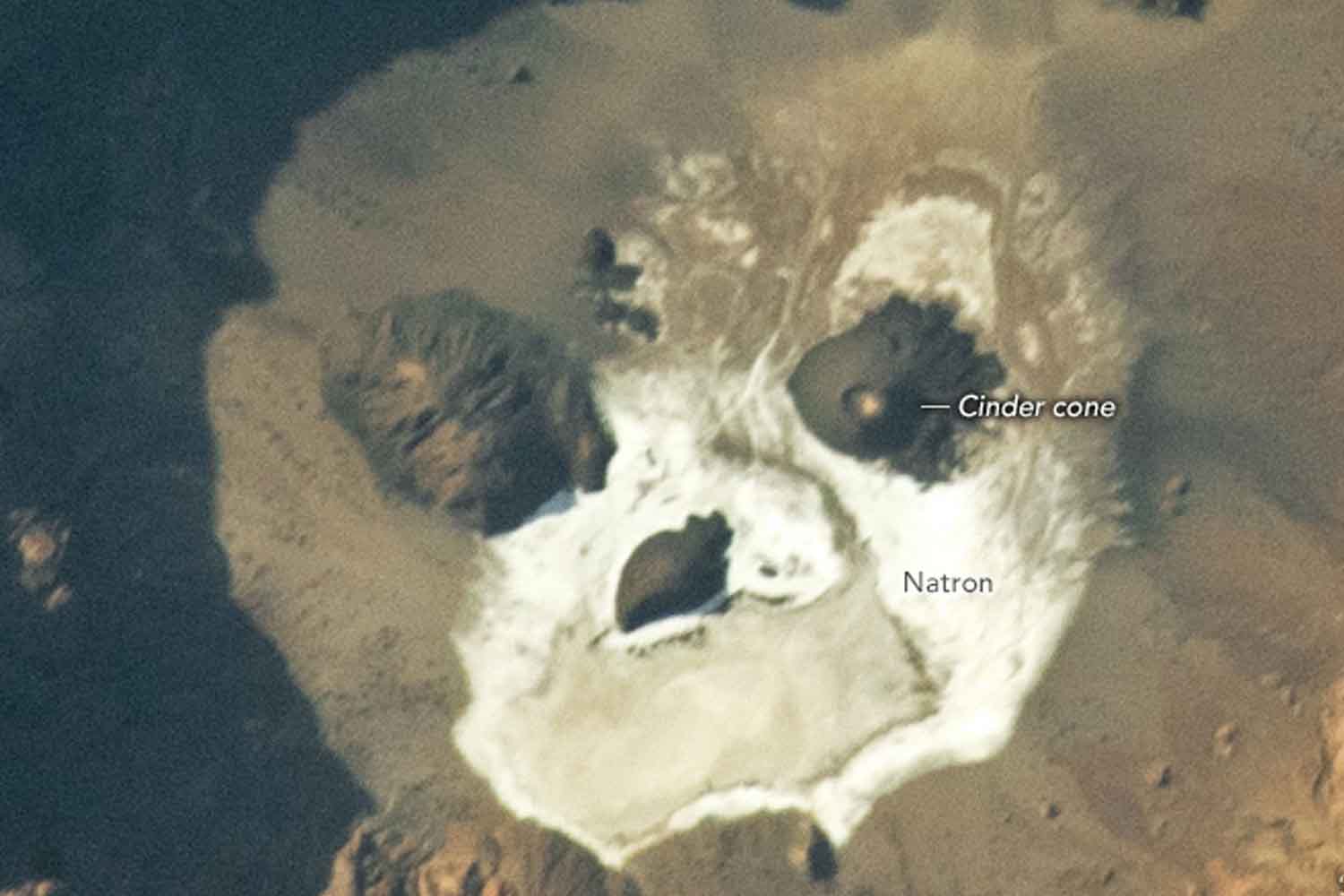
In the heart of the Sahara, one of the most remote and inhospitable regions of our planet, there is an enigma that has made even the astronauts of the international space station. Flying the north of Chad, in the Vulcanic plateau of Tibesti, a strange white form attracted the attention of those who observed the earth of hundreds of kilometers in height: a huge white skullcarved in the rock.
No, it is not a photomontage or an optical illusion created digitally. The “skeletal face” is realand has a name: Trou Au Natrona colossal volcanic caldera of ancient origin, up to 8 kilometers wide and about 1,000 meters deep. It was immortalized by an astronaut on February 12, 2023, with a Nikon D5 camera, in an image that has become viral and published by NASA on the occasion of Halloween.
What makes the Trou Au Natron unique
What makes the vision of this caldera so disturbing and fascinating is the visual effect which, seen from above, It makes her look like a gigantic human skull. The explanation, however, is all scientific:
The result is a very powerful, almost surreal image, a stone skull that scrutinizes the spaceimmersed in one of the most arid and inaccessible landscapes in the world.
What really was in the Trou Au Natron 14,000 years ago
But in addition to the spectacular visual effect, the Trou Au Natron tells a geological story that connects us directly with the climate change of the earth. About 14,000 years agoin the middle of the post-graceful period, that which today appears as a sterile and dazzling expanse was actually A deep glacial lakefueled by a more humid climate or by melting glaciers.
Scholars found obvious traces of this submerged past: algae fossils, diatomee and small molluscs On the bottom of the caldera testify to the presence of a vivid and complex lake ecosystem. Then, over the millennia, the climate changed radically. The waters evaporated, the winds swept away the humidity, and the extreme heat of the Sahara has transformed everything into a ruthless desert.
The Natroncrystallized in a brilliant crust, is what remains of that aquatic past. A silent but evident track, even visible from the space, of a landscape that was.
A landscape today arid, but still inhabited
Despite the desolate aspect, The mountains of Tibesti They still host extraordinarily resistant forms of life today. Golden jackals, desert foxes, gazelles And numerous birds have been able to adapt to the scarcity of water. And man is also present: i Toubouancestral nomadic population, still live in part in these areas, surviving in a delicate balance with the environment.
The Trou Au Natron reminds us that what appears dead, sterile or inhospitable, may have had a past rich in life and meaning.
