
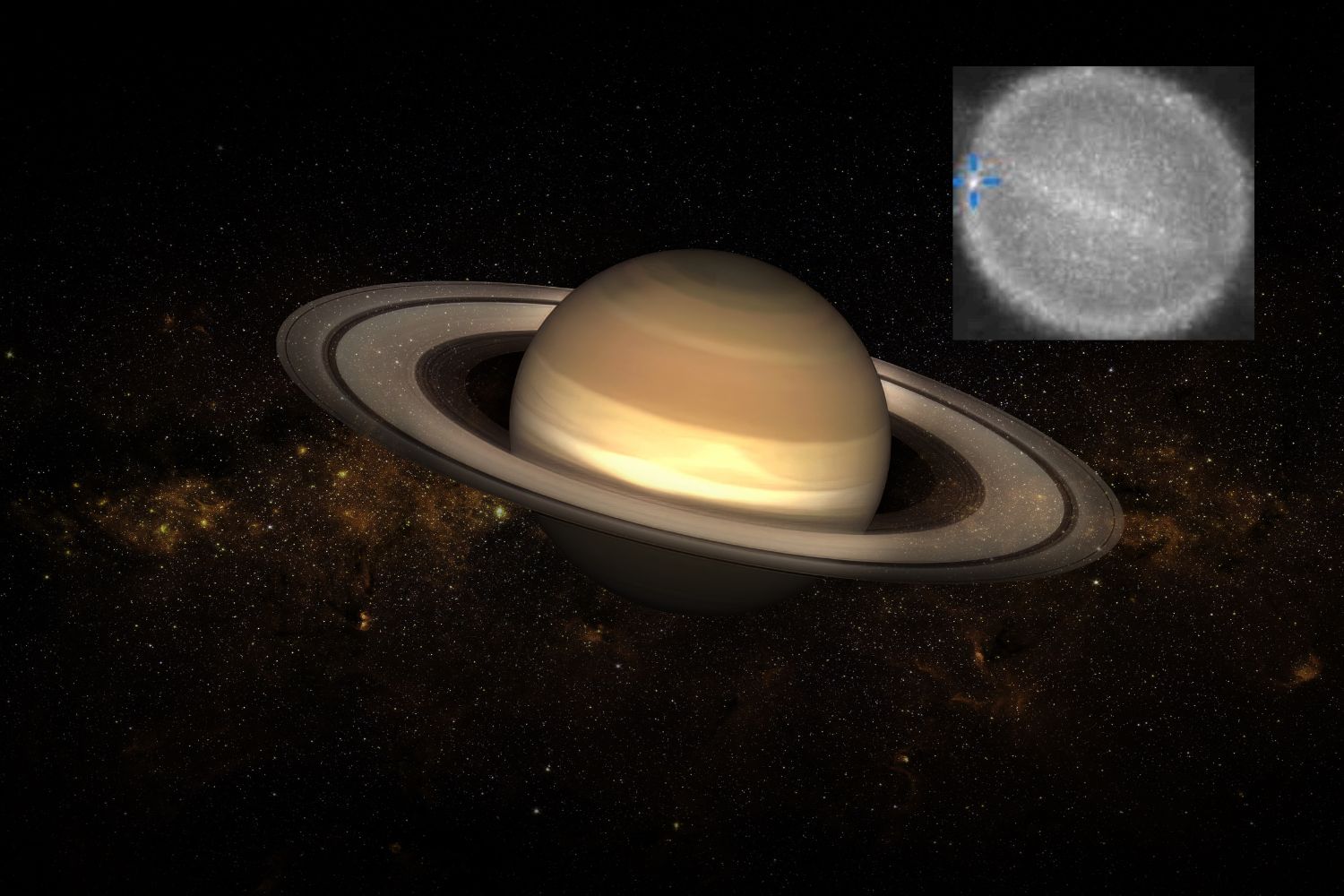
At 11:07 am on Saturday 5 July 2025, a sudden flash appeared on the left edge of Saturn. The phenomenon, which lasted a few moments but intensely bright, was photographed by Mario RanaAmerican astrofilo and NASA collaborator, from his station in Virginia. It may be A small celestial body that hit the atmosphere of the planetand if this hypothesis was confirmed, we would be in front At the first impact on Saturn never immortalized by a camera.
The attention was the attention Planetary Virtual Observatory and Laboratory (PVOL)who immediately launched an appeal aimed at the scientific community and astrophils around the world: anyone who has resumed Saturn between 09:00 and 09:15 UTC of that day is invited to share their observations in order to verify the authenticity of the event and reconstruct their dynamics.
Although Saturn is a gaseous giant known to attract many meteoroids thanks to its huge gravitational field, on this type of planet. Unlike the earth or Mars, where celestial bodies leave visible craters for centuries, The external layers of Saturn are made up of hydrogen and heliumwhich completely absorb the energy of the impact.
This means that even if events of this type occur with a certain frequency – scientists estimate up to 7 or 8 small impacts per year – None of these have ever been observed directly. That’s why the possible confirmation of the flash captured by Mario Rana would constitute an epochal discovery for astrophysics: the first visual and real -time test of an impact on the atmosphere of Saturn.
Suspected Impact Event On Planet Saturn Captured by Marc Delcroix July 5th 2025. Looks like Quite a Substantial Impactor …
Posted by Nightskyhunter On Monday, July 7, 2025
A short but intense lightning
The glow that appeared in photography was also detected by the software Detecta program developed to identify impact events in astronomical videos. The signal is compatible with a light explosion caused by the collision of a small object against the atmosphere of the planet. Similar episodes have already been observed in the past on Jupiter, but Never before on Saturn.
To coordinate the appeal to the scientific community there is Marc DelcroixFrench astrophilo and referent of the Pvvi, who asks anyone who has observed Saturn in that time window of Check your data, photos or videos. Also the professor Leigh Fletcherof the University of Leicester, joined the request, underlining the importance of the collaboration between amateur astronomers and researchers.
Anyone who has useful material can send it directly to Delcroix via email. Every single contribution can be crucial for:
According to previous studies based on the data collected by the Cassini probe, The frequency of impacts on Saturn could be comparable to the terrestrial oneat least for smaller objects. However, The absence of solid surface and the volatile nature of the Saturnian atmosphere make these events practically invisible to our tools.
To give an idea of rarity:
Precisely for this reason, The flash observed on July 5th could change our way of monitoring and understanding the activity near the giants of gaseous of the Solar System. A unique opportunity to refine the observation tools and make the detection of similar events in the future more efficient.
