
Every now and then one of those pieces of news appears on social media that seems too good to be true. An aquatic plant developed in Italy, according to some posts that have gone viral, would be capable of cleaning rivers of microplastics almost alone: it floats on the water and captures plastic particles with its roots, without machinery, without electricity, without complex infrastructures. The name chosen says it all: Pistia Magnifica.
It’s a shame that, when searching for this plant in scientific databases and academic publications, nothing is found. Zero. Pistia Magnifica, as it is described online, does not exist in scientific literature. Yet, the story behind it is real, and in some ways even more interesting than the one circulated on social media.
View this post on Instagram
The real plant behind the myth
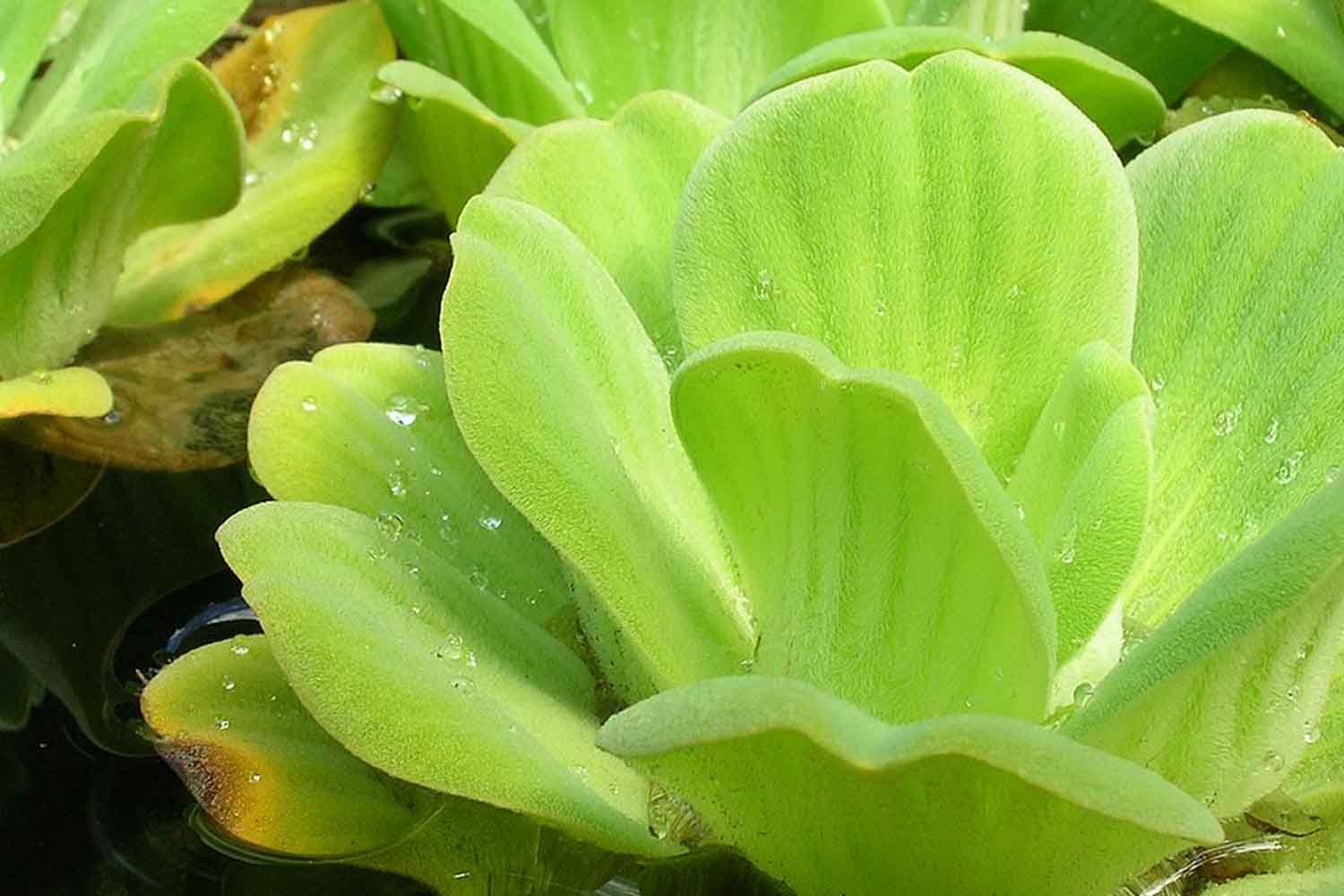
The plant that inspires this story exists and has a precise name: Pistia stratiotes, commonly known as water lettuce. It is a floating plant that grows spontaneously in tropical and subtropical environments and has for years been used in phytopurification systems – natural processes that exploit vegetation to improve water quality.
Just looking at it is enough to understand why it attracts the attention of scientists. The leaves remain on the surface while a dense, filamentous root system develops under the water and functions like a natural network. That network traps sediment and suspended particles, while the microorganisms that live around the plant help degrade or transform various pollutants.
Scientific studies have shown that Pistia stratiotes is able to significantly reduce the concentrations of heavy metals in industrial wastewater – lead, cadmium, mercury, nickel – with efficiencies of up to 80%. From here comes the quite logical intuition that a plant with these characteristics can also do something against microplastics.
Microplastics in Italian rivers are a documented problem
The presence of microplastics in waterways is not a hypothesis: it is a widely measured phenomenon. Rivers are one of the main vectors through which plastic fragments reach lakes and oceans. Synthetic fibers released from washing fabrics, fragments of degraded packaging, industrial particles: everything ends up in urban wastewater and from there into river systems.
A study by the University of Florence published on Science of the Total Environment analyzed microplastics along the entire course of the Arno, from source to mouth, detecting particularly high concentrations in the urban stretch of Florence. The overall estimate is that the river discharges around 30 tonnes of microparticles into the Mediterranean every year, a figure in line with that found on other large European rivers.
The problem is that the very small size of these particles makes them difficult to intercept with traditional filtration systems. Many microplastics simply pass through. For this reason, scientific research is exploring different paths: advanced filtering membranes, bacteria capable of degrading some polymers, physical barriers in waterways and, indeed, natural systems based on aquatic plants.
So-called nature-based solutions, solutions that exploit natural ecological processes, are attracting more and more attention because they could work with very low energy costs. In this context, aquatic plants continue to be studied, although for microplastics specifically the research is still ongoing and has not yet produced definitive results.
The Pistia Magnifica described on social media therefore does not exist. But the idea behind it — using plants and natural systems to retain pollutants and suspended particles — is at the center of real research, where botany, microbiology and environmental engineering are trying to understand to what extent vegetation can contribute to filtering what our systems are still unable to stop.
You might also be interested in:
