
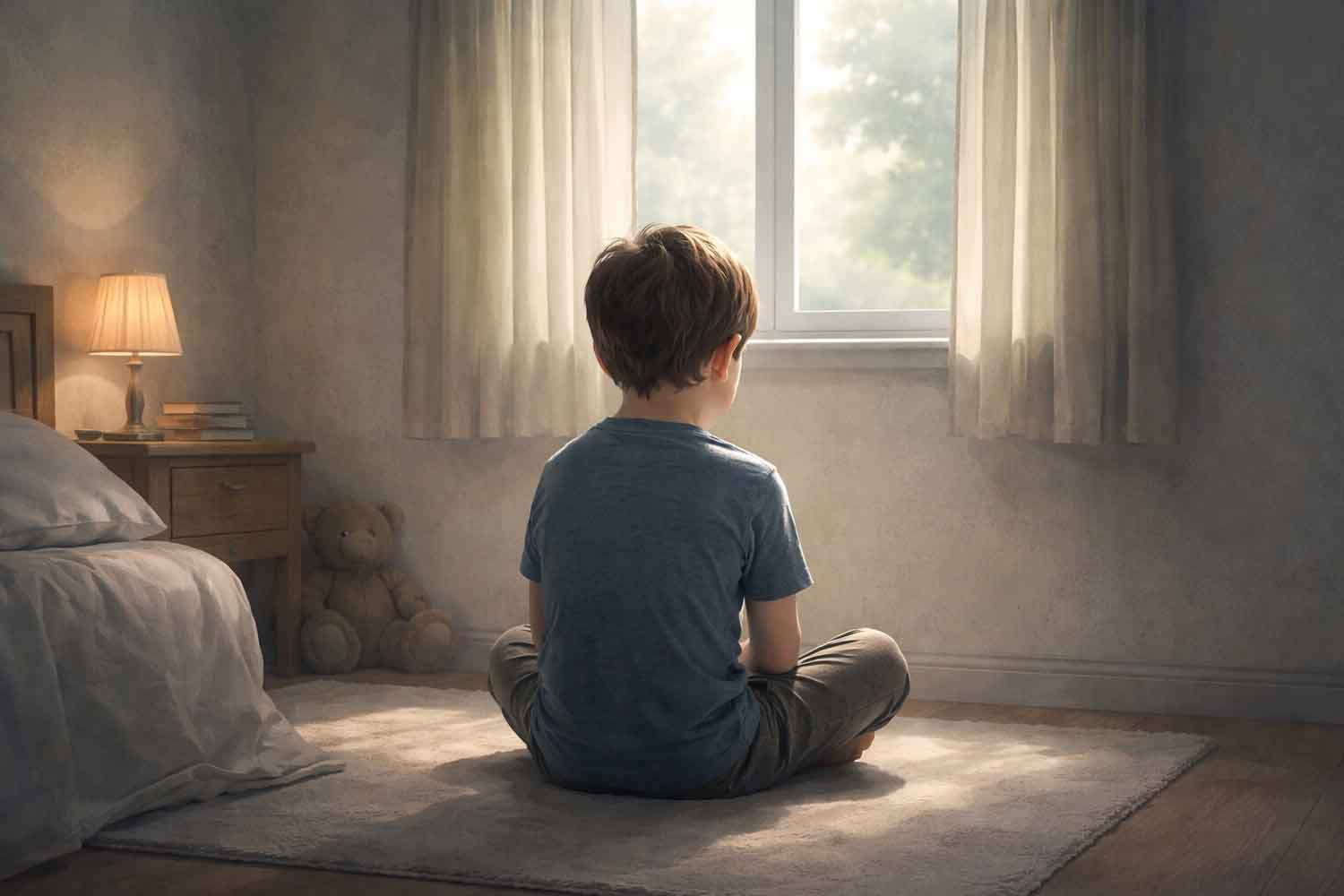
There is one thing that children’s brains do very well, perhaps too well: they learn from the environment. Not from great lessons, not from well-crafted speeches, but from the air you breathe every day. From the tone of voice, from the unpredictable reactions, from that subtle feeling of having to be careful even when there doesn’t seem to be a specific reason.
Research by the Center on the Developing Child of Harvard University they explain that toxic childhood stress arises right here: not from exceptional events, but from the daily repetition of an insecure emotional climate, made up of constant criticism, judgement, unspoken tension. The brain, faced with all this, is not offended. It gets organized.
When the brain turns on the alarm and forgets how to turn it off
There is a refined system in the body that serves to protect us: it is the one that manages the response to stress. In normal situations it is activated, helps us react and then goes back to rest. In children exposed to constant criticism, however, this system remains turned on for too long. Like an anti-theft alarm that also sounds when a cat passes by.
The infant brain does not distinguish between a physical and an emotional threat. A humiliating reproach, a contemptuous tone, the unpredictability of an adult can be interpreted as real dangers. Thus the axis that regulates stress comes into operation, with the constant release of cortisol. The problem is not the stress itself, but its continuity. When this becomes normal, the body loses the ability to return to a calm state.
This means growing up with a nervous system that never really relaxes. Even in quiet moments there remains an underlying tension, a sort of “expecting the worst”. This is where stress becomes toxic.
One of the hardest things to accept is that the brain does not passively undergo these experiences. It changes to survive. The areas that serve to monitor danger become more active, faster. Those that help regulate emotions and feel safe have a harder time developing.
It is not a metaphor: we are talking about neuronal connections, circuits that become stronger and others that remain more fragile. A child who grows up under constant criticism soon learns to read every detail, every micro-signal. Becomes hyperattentive, often very sensitive. From the outside he may seem mature, responsible, “good”. Inside, however, the brain works tirelessly.
Over time this structure becomes stable. As adults it can translate into difficulty relaxing, trusting, and not taking everything personally. Not because we lack strength, but because the nervous system has been trained for defense, not security.
The body follows the brain, even years later
There is a passage that often surprises: toxic childhood stress does not remain confined to the mind. The body registers it. Always high stress hormones, more active inflammatory systems, a biological balance that struggles to stabilize. It’s one reason why research links early emotional experiences not only to problems with anxiety or depression, but also to physical ailments that emerge later.
It’s not that the body “takes revenge”. It’s just that he never stopped protecting himself. He lives as if danger could return at any moment, even when life has changed.
Talking about childhood toxic stress does not mean pointing the finger at anyone, nor turning childhood into an accused trial. Rather, it serves to shift the gaze: from behavior to context, from apparent fragility to adaptation strategies.
Children’s brains do exactly what they need to do to survive. The problem is when that arrangement becomes permanent. Recognizing it is not rhetoric, it is awareness. And it is often the first step to stop asking yourself “why am I like this” and start saying to yourself “now I understand”.
You might also be interested in:
