
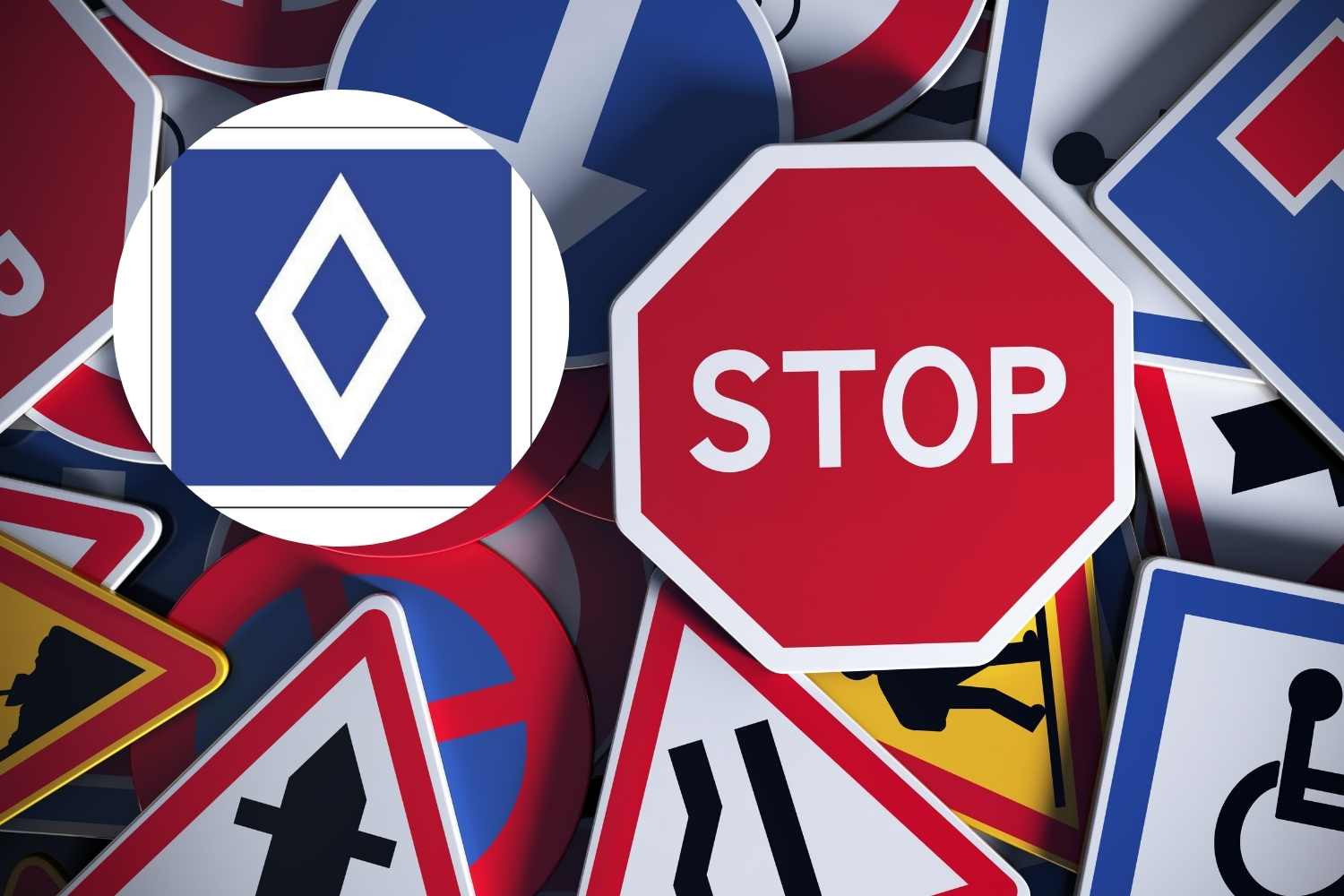
On French roads, and increasingly in Germany and Spain, a new motorway sign has appeared that many Italian motorists traveling have encountered without understanding its meaning: a white diamond on a blue background, devoid of both writing and pictograms.
The symbol indicates a lane reserved for carpooling, i.e. vehicles carrying at least two people on board, including the driver, who decide to share the same vehicle to travel the same route, a very common practice when commuting from home to work, a method which makes savings and sustainability the cornerstones. The idea comes from the United States, where the so-called High Occupancy Vehicle lanes (HOV) have existed for decades, preferential lanes on highways reserved for those sharing the vehicle. Europe has borrowed the concept – and partly also the symbol – adapting it to its own urban decongestion and emissions reduction policies.
Who can circulate
The permitted categories vary slightly from country to country, even if the underlying structure is uniform. Vehicles with at least two occupants, public transport (buses and taxis, even empty ones), and in some cases completely electric or hydrogen vehicles – in France identified by the Crit’Air 0 environmental sticker – circulate in the lanes with the white diamond. Motorcycles follow the same rule as cars, so they cannot access without a passenger on the seat. Heavy vehicles and goods transport vehicles are excluded unless otherwise indicated on the supplementary panel.
The lane may be active permanently or only during certain time slots, often rush hour or periods of peak pollution. When the diamond is turned off or crossed out, the lane becomes accessible to everyone again.
Controls and sanctions
The verification system is technologically advanced: thermal cameras and intelligent sensors detect body heat and count the people inside the passenger compartment, distinguishing the human presence from objects or animals. The controls also work at night and in conditions of poor visibility.
In France, the carpooling lane on the périphérique parisien was activated in March 2025, and since then infringements can be contested with a report. The fixed fine provided for by the French highway code is 135 euros. In Spain, where the rules have been tightened since 2026 – with the exclusion of electric vehicles traveling alone – the fine reaches up to 200 euros.
The situation in Italy
The Italian Highway Code does not yet provide for this signage, and Italy, for now, is observing the evolution of the situation. The data, however, suggests that the ground is not completely inert, given that according to the National Observatory on Corporate Carpooling 2026, created by Jojob Real Time Carpooling, over 795,000 shared trips were made in 2025, with an increase of 11.3% compared to 2023, which avoided the emission of over 1.6 million kg of CO2. The most active regions are Piedmont, Puglia, Lombardy, Emilia-Romagna and Lazio.
