
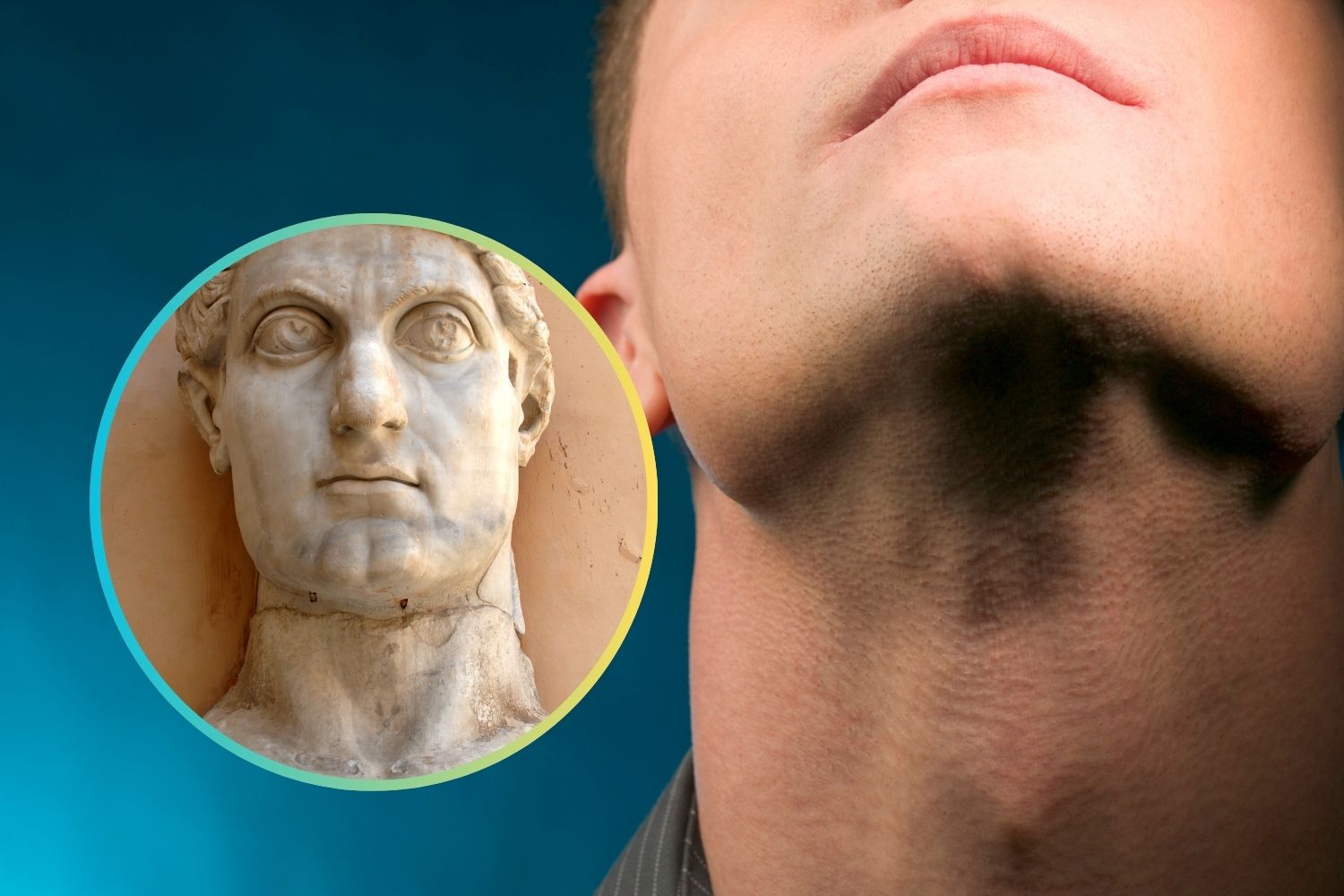
There are details of our body that we take for granted because we see them every day in the mirror, yet they hold very long stories, made up of millions of years of silent transformations. The chin is one of those details. It is there, under the lips, it defines the profile, contributes to the expression, supports the very idea of the human face. And above all it belongs only to us.
Chimpanzees and gorillas do not have it. Neanderthals and Denisovans lacked it. Of all known hominin species, only Homo sapiens has that little bony protrusion at the front of the jaw. For decades the explanation seemed intuitive: if it exists, it will have a precise function. Perhaps it serves to strengthen the jaw during chewing, perhaps it supports the articulation of language, perhaps it improves the structural stability of the face.
New research published in PLOS One proposes a completely different reading, and does so with disarming simplicity. The chin may not have been born to perform any specific task. It may be the inevitable result of other evolutionary changes that have reshaped our skull.
The chin as a side effect of evolution
The idea comes from a group of scholars led by Noreen von Cramon-Taubadel of the University at Buffalo. Their starting point overturns the traditional approach. In evolutionary biology there is an almost automatic tendency to attribute a function to every distinctive characteristic, especially when that characteristic makes a species unique.
The researchers chose to take another route and tested what is called the neutrality hypothesis, that is, the possibility that the chin developed without being the subject of direct natural selection. To understand this perspective you need a fascinating word, borrowed from architecture: spandrel.
The spandrel is the triangular space that forms between two arches that support a dome. It inevitably appears when the structure takes shape. It is not born with its own purpose, it emerges as a geometric consequence of the whole. Biologist Stephen Jay Gould used this term to describe those evolutionary traits that appear as byproducts of other structural changes.
The human chin might just fall into this category. An inevitable consequence, rather than an adaptation planned by natural selection.
Smaller teeth, shorter face, changing geometries
To test this hypothesis, the team analyzed nine features of the jaw comparing humans and great apes. Attention was focused on the area of the mandibular symphysis, the region that allows the presence of the chin.
The results tell an interesting story. Only three of the nine traits examined show clear signs of direct natural selection. The other six appear to be influenced indirectly or do not show traces of specific selective pressure. Taken together, it suggests that the chin does not bear the imprint of a trait precisely shaped to enhance survival.
During the evolution of hominins, there was a progressive reduction in the size of the teeth, particularly incisors and canines, accompanied by a shortening of the lower part of the face. The jaw has shrunk, the geometry of the skull has changed, the entire facial structure has taken on different proportions.
In this new arrangement, the protrusion we now call the chin may have emerged as a structural result of these changes. An inevitable configuration generated by the combination of bones, volumes and alignments different from the past.
The chronological data adds a significant element. The chin appears exclusively in modern humans. The evolutionary pressures that favored the reduction of the face and teeth continued to act throughout much of the history of hominins, to the point of producing this distinctive feature.
A detail that tells how evolution works
This discovery offers a valuable starting point for rethinking the way we imagine evolution. The idea of a process that sculpts every detail with the aim of perfecting the species leaves room for a more dynamic vision, made up of cumulative transformations, balances that shift, structures that adapt and generate new forms along the way.
The chin becomes the symbol of this continuous movement. A small element of our profile that tells a story of reductions, remodeling and geometric consequences. Looking at it in the mirror takes on a different meaning when you know that it may have arisen as a side effect of a face changing proportions.
Inside that bony protrusion, millions of years of evolution intertwine, teeth that become smaller, jaws that shorten, environmental pressures and structural transformations. The result is a trait that makes us immediately recognizable as a species.
The human chin speaks of an evolution that proceeds through complex adaptations and which, along the way, also generates unexpected outcomes. Every now and then nature designs something that emerges while everything else is reorganizing itself. And under our lips remains the silent trace of this very long story.
You might also be interested in:
