
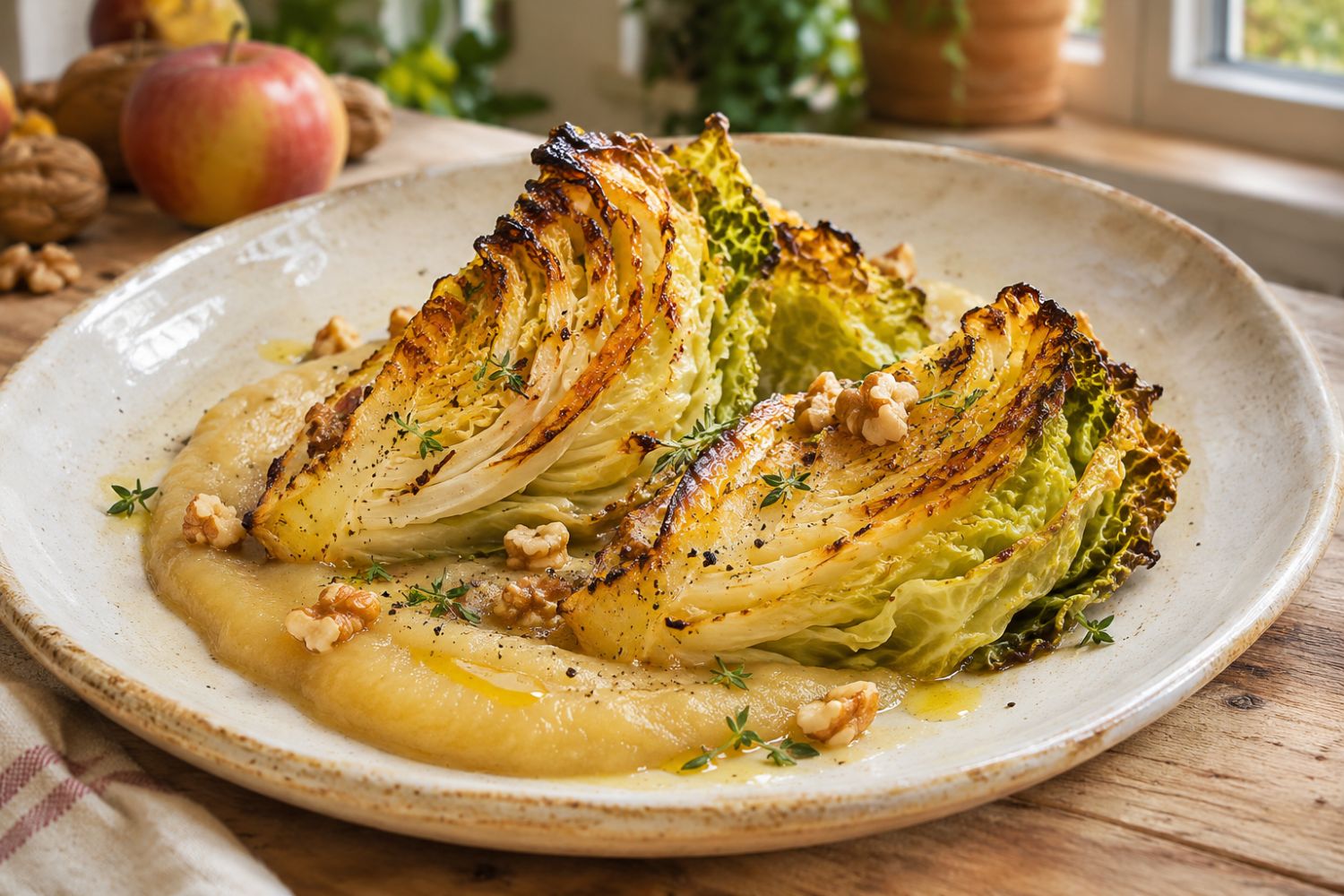
Cabbage is one of those vegetables that often end up in the cart at the market out of a sense of duty, it’s cheap, it’s in season, it’s good for you. But then the time comes to cook it and the imagination stops at the usual two possibilities: stewed in a pan or in a soup. With that characteristic cabbage smell that invades the kitchen and doesn’t go away so easily.
Yet all you have to do is change your cooking method to find yourself faced with something completely different. Roasted cabbage, with its charred edges and still tender heart, accompanied by a slightly acidic apple puree, is one of those combinations that seems strange until you taste it.
And November is probably the best time to try it, when the cabbage is nice and firm and the apples still have that crunchiness that makes it pleasant even to eat them without anything.
Because cabbage and apples go so well together
If you think about it, it’s not such a bizarre pairing, in Central European cuisines, cabbage and apples have shared the same pot for generations. The reason is simple: they correct each other.
The cabbage, especially when roasted, develops sweet, almost nutty notes, while the outer parts take on an intense and slightly toasted flavour. The apples add a hint of acidity that lightens the flavor of the cabbage and makes each bite less monotonous. It’s a bit like what happens when you add a few drops of lemon to a particularly rich dish: suddenly everything takes on more character.
The secret, however, is not to transform the apples into a compote that is too sweet; you need a soft, fresh puree with a slight sour note. Better to choose varieties such as Granny Smith or Renetta, avoiding the very sugary ones.
How to prepare roasted cabbage with apple puree
To prepare this dish for four people, all you need is a medium-sized cabbage, three apples, extra virgin olive oil, a lemon, salt, pepper and a few sprigs of thyme. If there are nuts in the pantry, keep them handy: in the end they make the difference.
Start by turning on the oven at 200°C in static mode, in the meantime remove only the external leaves of the cabbage if they are damaged, wash it and cut it into six or eight segments, depending on the size.
Do not remove the core completely, it is precisely that central part that holds the leaves together during cooking. Without it, you risk ending up with a tray of scattered pieces, some burnt and some still raw.
Place the segments on a baking tray lined with baking paper, brush them generously with extra virgin olive oil and add salt and pepper. Try not to overlap them: the cabbage needs space to roast, otherwise the moisture it releases will cause it to steam.
Bake for about 30-40 minutes, gently turning the segments halfway through cooking. The times depend on the thickness: the central part must become tender, while the external leaves can take on a golden brown color, with some darker and crunchier edges.
While the cabbage is cooking, take care of the apples, peel them, remove the core and cut them into cubes. Place them in a saucepan with three or four tablespoons of water, a pinch of salt and a few drops of lemon juice. Cover and leave to cook over low heat for about ten minutes, or until the pulp flakes easily under a fork.
At this point you can mash them with a fork, if you like a rustic consistency, or blend them to obtain a smoother cream. Taste before adding more lemon: some apples are already sufficiently acidic. The puree should be thick enough to stay on the plate without spreading like a sauce.
The little mistake that can ruin everything
The most common temptation is to add water to the pan when the cabbage begins to darken. It seems like a good idea to prevent it from burning, but in this way you lose a good part of the result: the leaves become soft and the flavor approaches that of boiled cabbage.
If the edges brown too much while the center is still hard, lower the temperature slightly and continue cooking. If necessary, protect the most exposed parts with aluminum foil.
Also be careful with the puree, if you use apples that are too sweet and cook them for a long time, you risk getting a cream that is more reminiscent of a dessert than an accompaniment for the vegetables. A pinch of salt and a few drops of lemon can rebalance it.
The final touch that makes the dish even more interesting
When the cabbage is ready, spread a couple of spoonfuls of apple puree on the bottom of the plates and place a roasted segment on top. Add a few leaves of fresh thyme and a handful of coarsely chopped walnuts, perhaps toasted for a couple of minutes in a dry pan.
Walnuts are optional, but they bring that crunchy note that the central part of the cabbage lacks. And their slightly bitter flavor goes particularly well with the sweetness of cooked apples.
For an even stronger contrast, you can add a few drops of apple cider vinegar to the puree, without exaggerating.
The result is a dish that can work as a side dish for an autumn dinner, but also as a vegetable main course, perhaps accompanied by crispy baked chickpeas and a slice of toasted wholemeal bread.
And if you have a wedge of cabbage left over, the next day you can heat it in a pan with a drizzle of oil: the edges become even crispier.
