
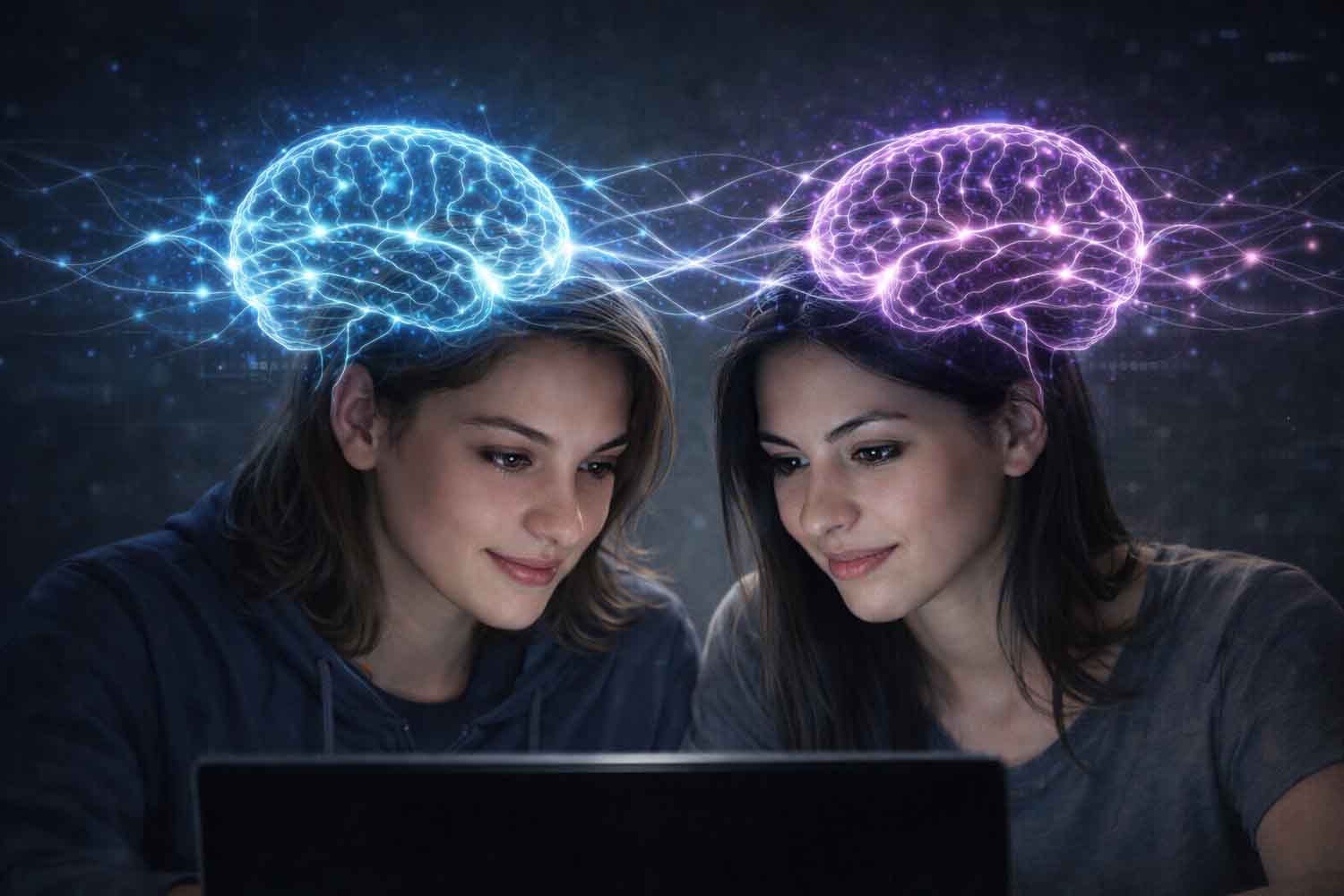
There’s a precise moment when you realize you’ve found a truly like-minded person. You’re watching something together, like a movie, a silly Instagram video, a scene from real life, and before anyone even says a word, you find yourself reacting in exactly the same way, at the same time, with the same intensity. That feeling has a popular name: being on the same page. And now it also has a scientific explanation.
In 2018, researchers at Dartmouth College published a study on Nature Communications built on a sample of 279 university students whose social relationship network was precisely reconstructed. Of these, 42 participated in neuroimaging sessions, watching a series of videos while functional magnetic resonance imaging recorded their brain activity in real time. What emerged says something about deep friendships that goes far beyond the psychology of relationships.
When friends observe the same event, the brain reacts similarly
Close friends showed much more similar neural responses than pairs of strangers. And the similarity decreased proportionally with social distance: best friends in first place, then friends of friends, then people without any connection, where the correlation was decidedly weaker. The brain areas involved in this convergence concern attention, the interpretation of stimuli and the processing of meaning, i.e. the very mechanisms with which the brain decides what to look at, how to read it and what weight to give it.
The technical term for this phenomenon is neural similarityand describes the tendency of some people to develop similar brain patterns when processing the same content. According to researchers, this affinity could explain why certain friendships arise with an almost inexplicable naturalness: when two people perceive and interpret reality in a similar way, understanding each other requires less effort, and building something lasting becomes much simpler.
There is one question that the study leaves open, and it is the most interesting one. Do we become friends because our brains already work in a similar way and we recognize each other almost instinctively, like two instruments tuned to the same note? Or is it the acquaintance, the sharing of experiences over time, that slowly shapes this neural alignment? Scientific data demonstrates the connection, without establishing which of the two processes comes first. And it is precisely this ambiguity that makes the discovery even more fascinating, because ultimately it applies in both directions.
It is worth being precise about one thing: the similarity in brain responses remains far from any idea of telepathy or supernatural connection. What happens is more subtle: two people can react to the same stimuli in a very similar way because over time they have developed comparable cognitive and emotional patterns, a similar way of looking, evaluating, feeling. When two friends are said to be on the same page, it is usually meant as a gentle metaphor.
The data from this study suggests that that metaphor describes something biologically real, something that the brain registers and carries with it. And perhaps this is precisely why with the right people there is no need to explain everything. They have already experienced it together with you, inside them, without you having said anything.
You might also be interested in:
