
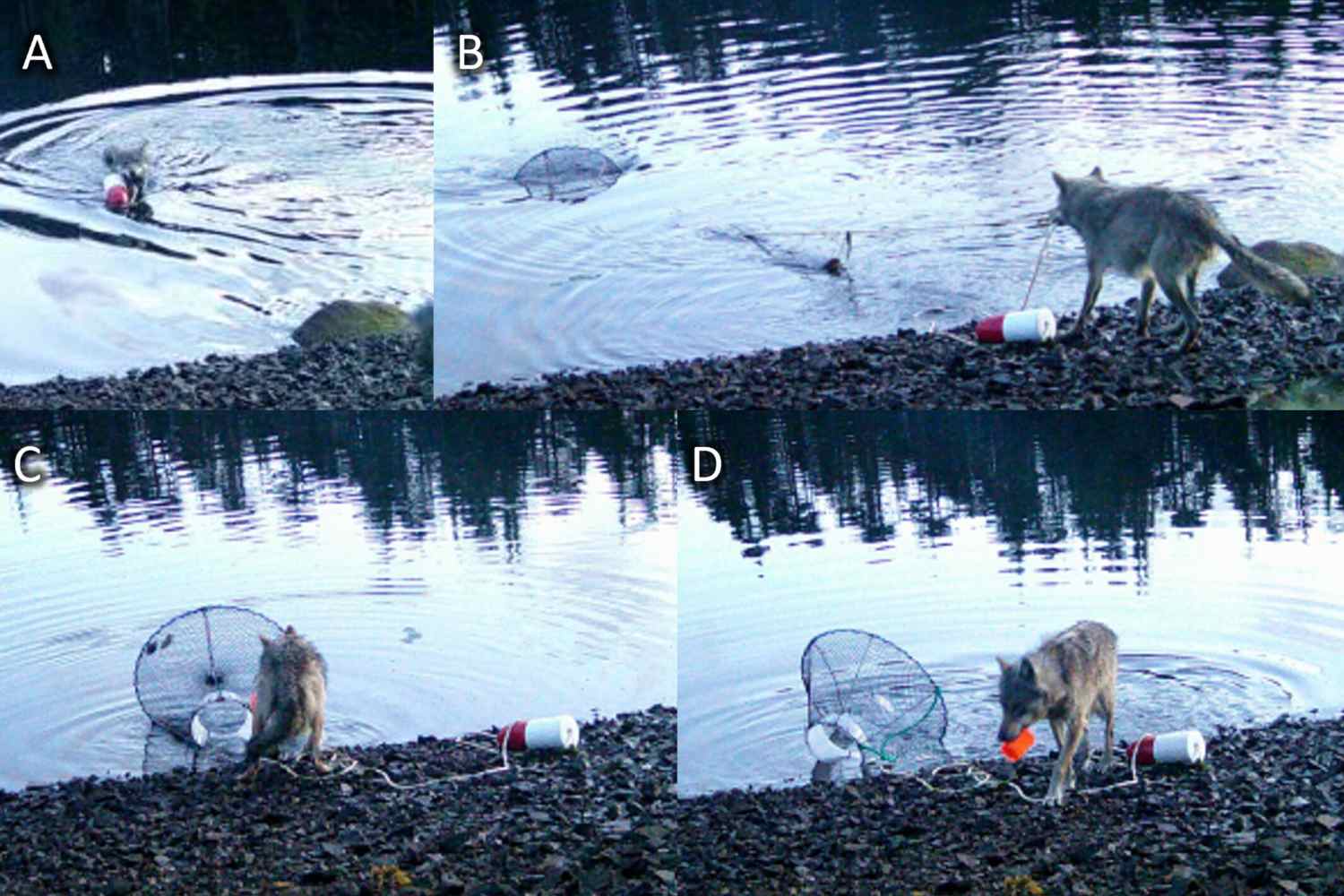
A recent study published in Ecology and Evolution brought to light a surprising episode involving wild wolves in British Columbia. For the first time, researchers monitoring local wildlife have documented a wolf using a tool-like strategy to obtain food.
Thanks to a series of cameras positioned along the coast of the Haíɫzaqv Nation, it was possible to observe a sea dog grabbing a float tied to the crab trap, dragging it to shore and then pulling the rope until the entire structure emerged from the seabed. Once the trap was lifted, the animal had access to the food inside, with a behavior that was as ingenious as it was unexpected.
View this post on Instagram
A cognitive evolution
Scientists were initially convinced that the damage found on the traps – used to contain the spread of the European green crab, an invasive species – was caused by marine mammals. They didn’t imagine that it could be the wolves that reached traps placed in deeper water.
The images, however, completely overturned the hypotheses: not only did a wolf manage to bring the trap back to shore, but a second specimen was filmed while replicating the exact same action. This detail suggested to researchers possible social learning, that is, the ability of animals to observe, imitate and internalize complex behavior.
Sea wolves, an ecotype of the gray wolf known for its diet heavily tied to marine resources, live along the coast of British Columbia and are already considered a fascinating example of ecological adaptation. However, trap recovery represents an even higher level of ingenuity.
The researchers hypothesize that the behavior may have arisen from gradual learning: first with traps exposed during low tide, then with partially submerged traps, until the association between float, line and food content is reached. A sort of cognitive evolution step by step.
The phenomenon pushed the team to dedicate new cameras to continuously monitor the traps, in order to understand how many times and with what variations the wolves repeat this activity. The discovery not only expands knowledge on the cognitive abilities of wolves, but opens new reflections on how wild animals interact with human-made objects. For scientists, this episode represents only the beginning: a clue to how much more wolves can reveal in terms of intelligence, adaptation and innovative behaviors.
You might also be interested in:
