
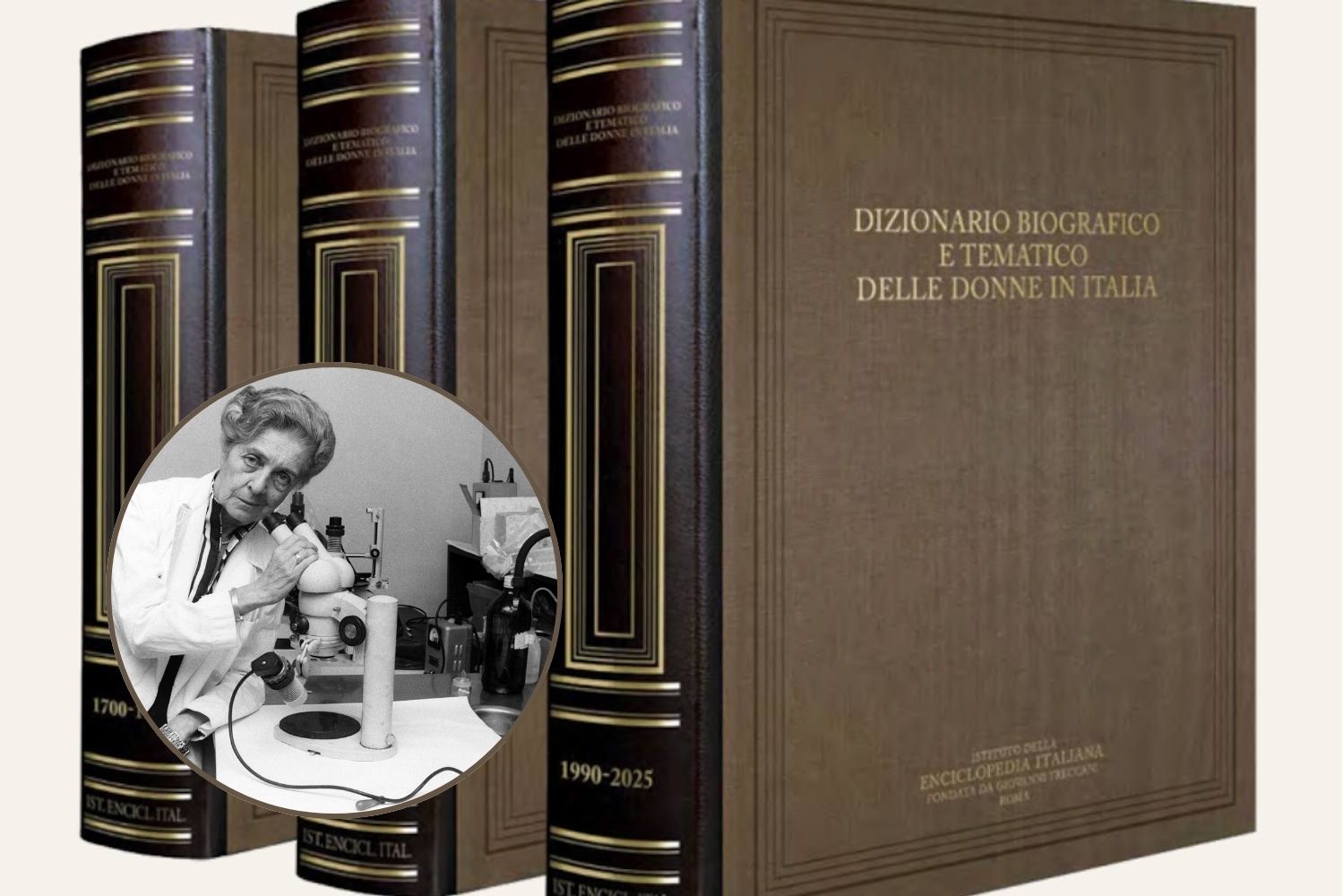
From Nilde Iotti to Grazia Deledda, passing through Maria Montessori and Mia Martini: 650 biographies, over a thousand period photos, 2,500 pages for three wonderful volumes.
It’s the Biographical and thematic dictionary of women in Italythe new great work created by the Treccani Italian Encyclopedia Institute, an encyclopedia entirely dedicated to the hundreds of Italian women often forgotten, or completely ignored, who contributed to the growth of the country and in the most varied fields.
Lives intertwined with experiences, examples for the new generations, pioneers in sectors dominated by men, from the eighteenth century to the present day.
The Biographical and Thematic Dictionary of Women in Italy was created with the aim of restoring visibility to a historical plot that has often remained on the margins, building individual and collective paths that have had a profound impact on the civil, cultural and social life of the country. At the center of the work is individuality as historical responsibility: each voice returns a unique experience with rigor and attention to the context, we read in the note.
The project, directed by the Italian scholar and cultural historian Emma Giammattei, was born with a specific objective: to bring to light female figures who for centuries remained on the margins of the official historical narrative.
The work is dedicated to the scientist and Nobel Prize winner Rita Levi-Montalcini, who was president of Treccani from 1993 to 1998, and is part of a broader path of the Institute on the themes of female representation and equality, also supported by the podcast Matilda effect.
Filling a gap in historical memory
The idea for the work matured after the conclusion, in 2020, of Biographical dictionary of Italiansone of Treccani’s main encyclopedic works. A piece of data that emerged at the end of the project highlighted a clear imbalance: only 4% of the entries were dedicated to female figures.
A phenomenon that does not only concern Italy, but which characterizes many great international historical repertoires. In the meantime, however, in recent decades studies on women’s history and gender issues have experienced significant development, making it necessary to systematize this vast wealth of research.
The new Dictionary was therefore also born as a response to this need: to reconstruct the national historical memory more completely, through the narrative method. The biographies are not simple reference cards, but detailed stories of the protagonists’ lives, constructed through thematic sections and contextual reconstructions.
Furthermore, alongside individual profiles, the Dictionary also includes thematic essays that cross some crucial moments in the history of women in Italy, from the first female emancipation movements in the eighteenth century to the transformation of social roles in the twentieth century to persistent gender inequalities.
Among the criteria that guided the selection of biographies there is also the idea of borders: women capable of overcoming cultural, social or disciplinary barriers. A significant example is that of the Italian Women’s Industries, a network born in 1903 thanks to the collaboration between entrepreneurs, activists and philanthropists. The initiative had the aim of promoting female work and improving the economic conditions of female workers, starting from the artisanal production of lace.
The cooperative managed 24 laboratories distributed throughout Italy and also opened sales points in the United States and in several European cities, demonstrating a surprising female entrepreneurial ability already at the beginning of the twentieth century.
The Biographical and thematic dictionary of women in Italyfinally, it is not thought of as a closed project. In addition to the three volumes, a digital platform is planned which will allow updates and new inclusions over time.
The objective is to transform the work into a dynamic space of knowledge, capable of continuing to tell the stories of women and their role in the construction of Italian society.
