
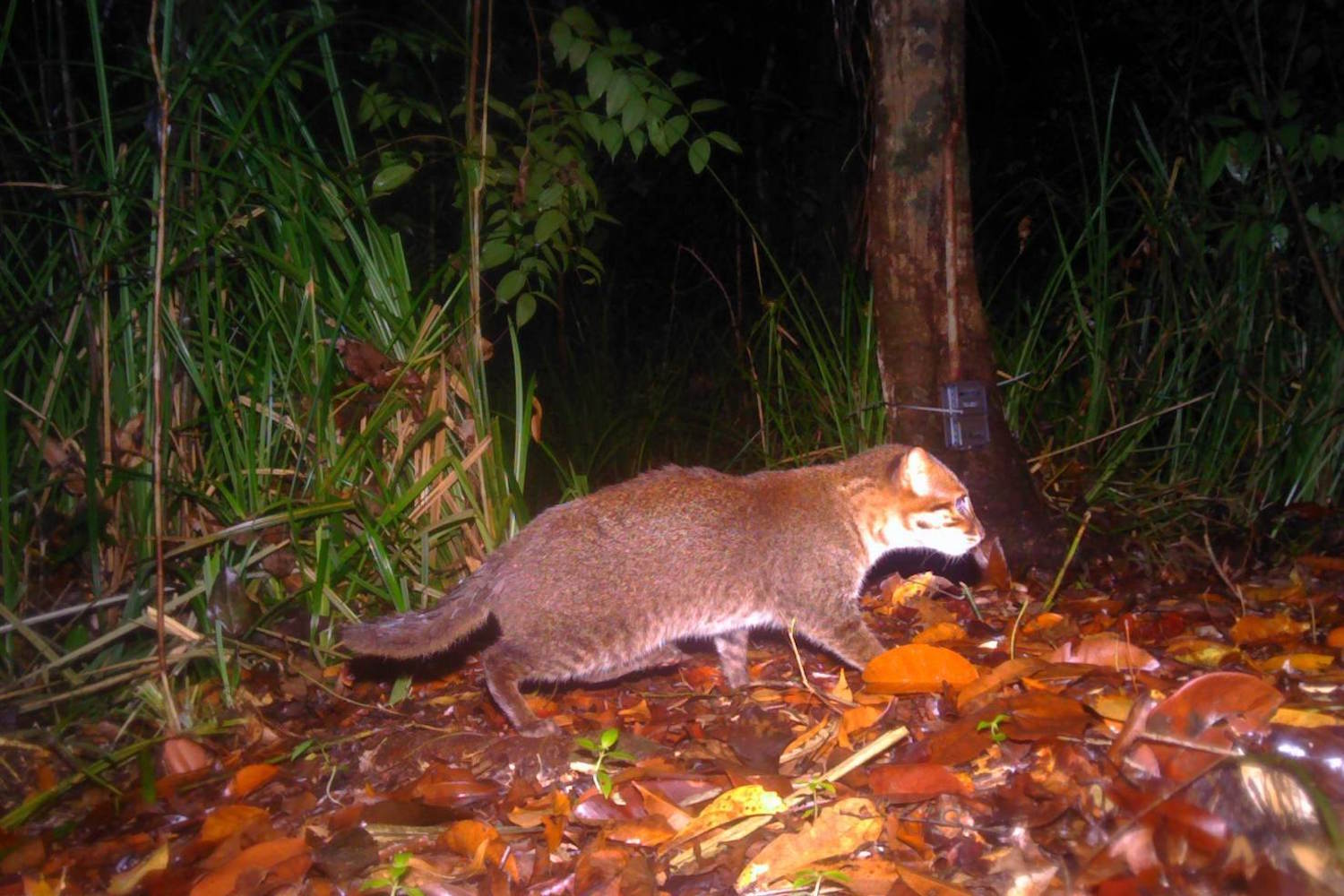
The flat-headed cat has returned to Thailand after almost 30 years: a research team led by Department of National Parks, Wildlife and Plant Conservation Thai has in fact demonstrated the return of the species to the country, in 2014 it was listed by theInternational Union for Conservation of Nature (IUCN) as “endangered”, estimating its population at around 2,500 individuals worldwide.
Excellent news for environmentalists – the Department’s experts write on their Facebook page – The Department confirms the return of the “flat-headed cat” to the Toedang peat bog forest after almost 30 years of absence. Crucial evidence of natural reproduction has been found
In fact, the researchers also managed to photograph a cat of this species traveling with her kittens, crucial evidence that confirms that the flat-headed cat reproduces and lives safely in the peat bog forest of Toedang.
As IUCN experts write, the flat-headed cat is characterized by a long, narrow head and flattened forehead, and has small, rounded ears well placed on the sides of the head, as well as noticeably large and close-set eyes that provide maximum binocular vision, suggesting nocturnal activity.
Its tail is short, measuring only about a quarter of the length of its head and body, and is covered in thick fur, while the hairs are tipped with white, giving its fur a silvery appearance, and its chin, muzzle, and belly are white.
The species is part of the genus Prionailurus based on genetic analysis, but, until further morphological and molecular data on the flat-headed cat are available, the species is considered monotypic.
This recent discovery lights up hope for a species considered very close to extinction. And it is not an isolated case: researchers have in fact used remote camera traps in Princess Sirindhorn Wildlife Sanctuary in 2024 and 2025, proving that flat-headed cats are still present in Thailandwhere they considered themselves now disappeared.
Researchers rediscovered the cats using remote camera traps in Princess Sirindhorn Wildlife Sanctuary in Thailand in 2024 and 2025. In 2024, in particular, thirteen sightings of the flat-headed cat were recorded, and in 2025 sixteen.
This is the highest frequency of sightings reported in any other area of the world where this species is found (…). This discovery is therefore a powerful testimony to the success of ongoing conservation and protection efforts in this area
Pantheraan organization for the protection of felines, announced the discovery together with the Department of National Parks, Wildlife and Plant Conservation Thai today 26 December, when among other things the Annual Wildlife Protection Day in Thailand.
