
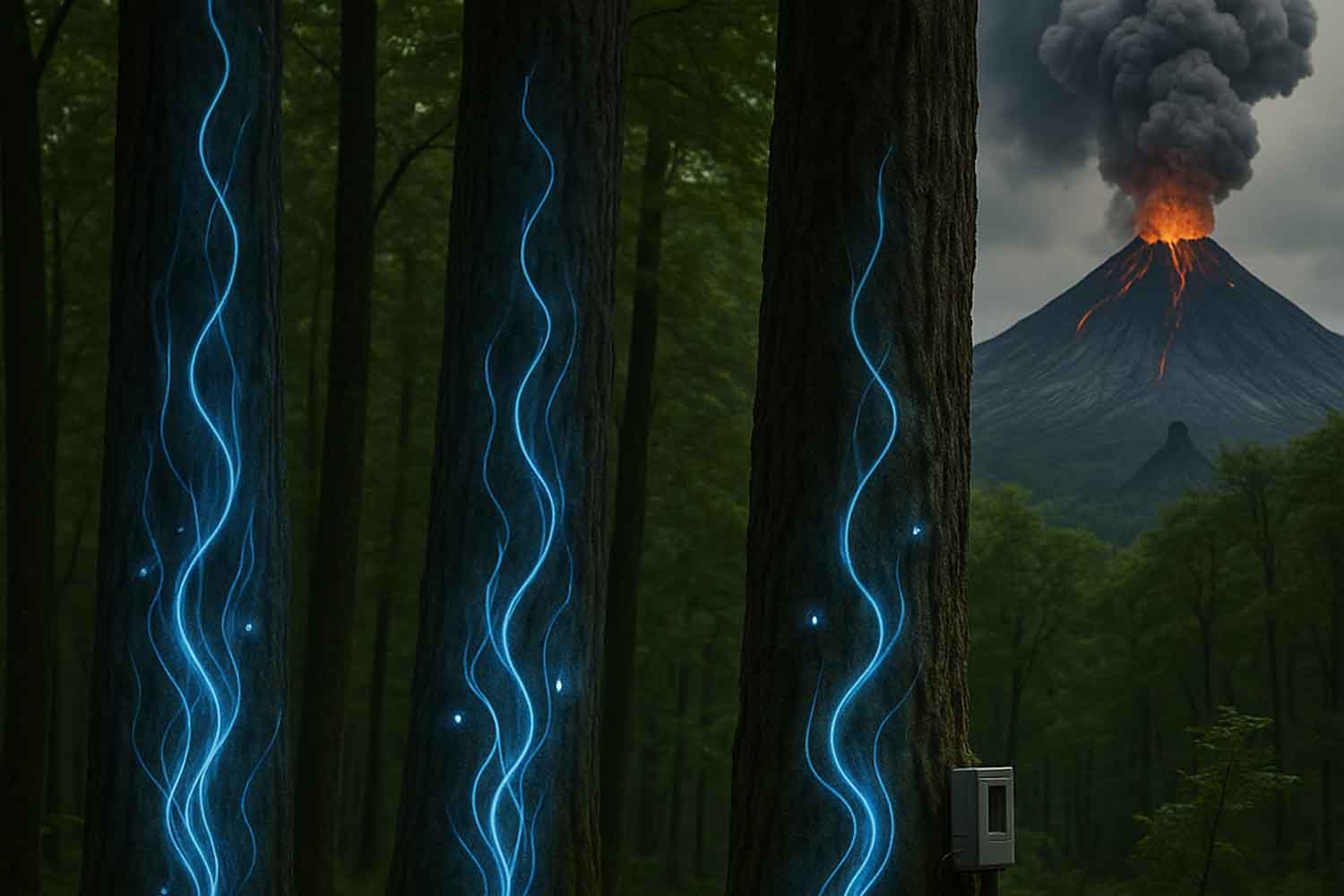
We are used to thinking that only seismographs, gas detectors or sophisticated instruments installed near the volcanoes are predicting. At most animals. But today, nature tells us a different story. The trees tell it. Yes, just them: green sentriessilent but careful, capable of report well in advance What happens in the heart of the earth.
According to two recent studies, Plants that grow near the active volcanoes respond surprisingly to underground changes preceding an eruption. Color variations in the leaves, drop in photosynthesis, changes in the temperature of the hair: all this can represent an early alarm signalclearly visible from above thanks to drones and satellites.
The hair is tinged with bright green and change temperature
One of the two studies comes from University of Houstonwhich analyzed the activity of theEtnain Sicily, through the comparison between satellite data and carbon dioxide surveys (CO₂). The team observed that When magma begins to tracereleases greater quantities of CO₂ in the soil and in the atmosphere. This gas is absorbed by the vegetation, temporarily stimulating photosynthesis: the leaves become more green, healthier, visible in the NDVI data (Normalized Difference Vegetation Index).
Over two years, the researchers identified 16 peaks in the levels of Co₂ and Ndviall connected to magma movements under the surface. In some cases, these signals have been detected also remotely from the main faultssuggesting that the effect can extend well beyond the hot visible areas.
The other research, however, comes from France, and is signed by scientists of theInrae (Institut National de Recherche Pour L’Agriculture, the Food Et The Environnement) and theUniversity Clermont Auvergne. Posted on Frontiers in Ecology and the Environmentthe study uses drones with thermal sensors and multi -spaces To monitor the hair of the trees near the volcanoes. The researchers identified Signs of physiological stressas changes in the temperature of the leaves and reduction of photosynthesis, weeks before an eruption.
A new natural alert system
These biological signals could turn into A new form of environmental monitoringvery precious in contexts where Traditional seismic detection systems are not available or accessible. Nicole Guinn, volcanologist and main author of the Etna study, underlines that these signals can be detected without any work on the field: enough A satellite in orbit or a drone in flight.
Also the project Avuelo (Airborne Validation Unified Experiment: Land to Ocean), promoted by Nasa And Smithsonian Institutionmoves in this direction. In Costa Rica and Panama, a group of scientists is analyzing the behavior of the vegetation around the tropical volcanoes, looking for confirmations to the link between gas emissions and trees reactions. It is a collaboration that combines volcanology, climatology and technology to create New natural prevention models.
The climatologist Josh Fisher, of Chapman Universitypart of the Avuelo team, it says it clearly: “Studying how trees react to the volcanic co₂ also helps us to understand How they will behave in the future, in an increasingly saturated world of carbon dioxide“.
The trees, our most precious allies
In a changing world, in which the climatic crisis is intertwined with extreme and unpredictable events, Trees are not only beings to be protected, but also resources to listen to. Their physiological reactions – invisible to the naked but well legible eye from above – can offer us crucial information ,.
This new frontier of natural science invites us to Put the dialogue with the environment back to the center. To consider vegetation as an active part of prevention ,. And perhaps, just listening to the breath of the trees, we will be able to save ourselves from what turns up in the heart of our planet.
