
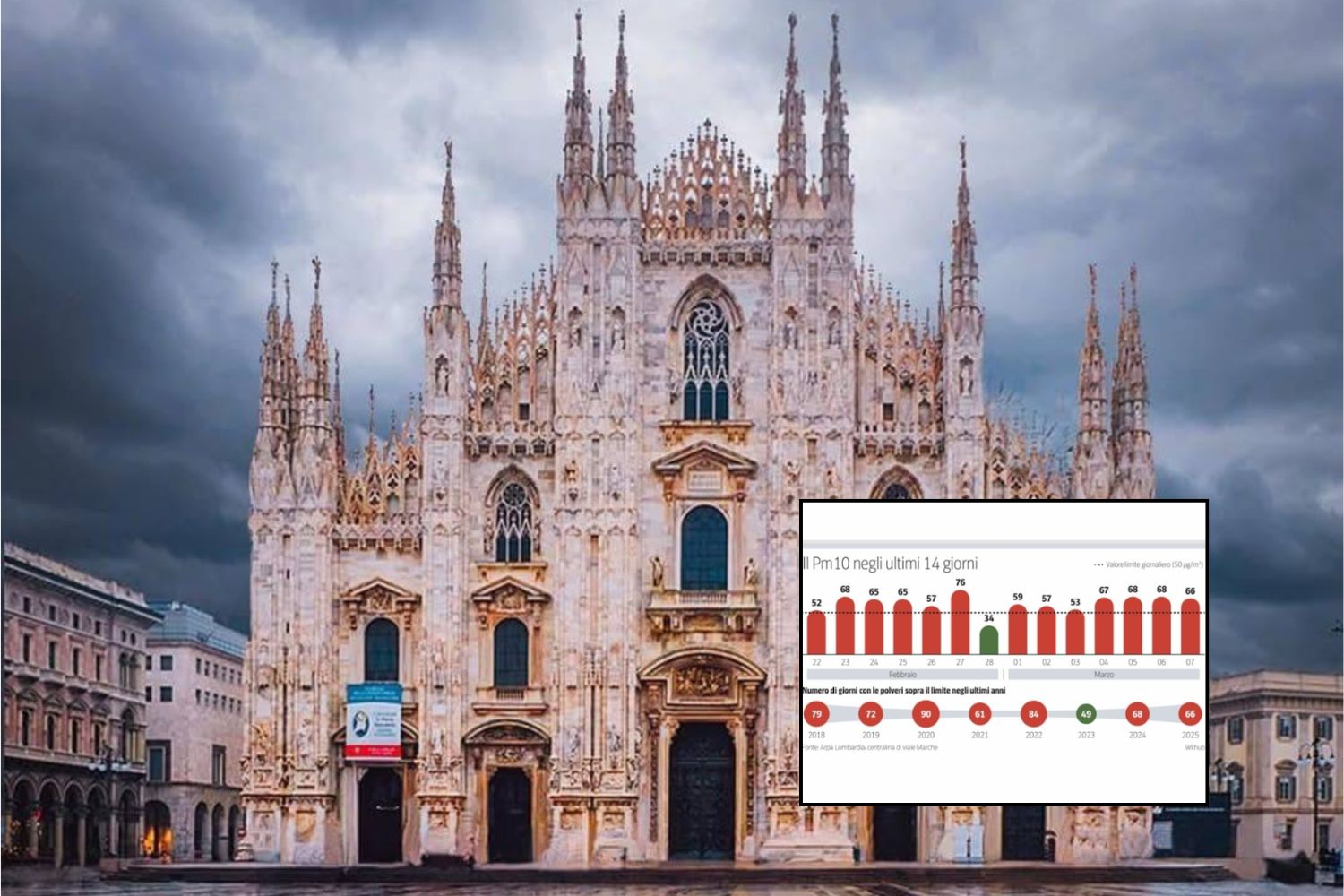
In Milan the annual limit for exceeding fine particles was already reached at the beginning of March. In fact, up to 7 March 2026, 35 days were recorded above the PM10 threshold, i.e. the maximum number allowed within a year by the European legislation still in force.
In practice, since the beginning of the year, more than one day out of two, the city’s air has been illegal.
These are the data that arrive from the ARPA Lombardia air quality monitoring network, in particular from the control unit in Viale Marche, one of the reference points for measuring pollution in the Lombardy capital. A number that takes on a symbolic value: the maximum limit of exceedances allowed in an entire year was reached when spring had not yet begun.
The new European limits will be even more severe
The situation becomes even more worrying if we look at the new objectives set by the European Union to improve air quality.
The new European directive on air quality, which Italy will have to implement by 2026, provides for more restrictive limits for fine particles. Among the main innovations is the reduction of the maximum number of days of exceeding PM10, which will drop to 18 per year.
There is the possibility of a derogation for up to ten years, but only if states demonstrate that they have adopted all possible measures to reduce air pollution.
Smog and health
Fine particles are among the most dangerous air pollutants for human health. There are now numerous scientific studies that have linked prolonged exposure to high levels of PM10 and PM2.5 to an increased risk of respiratory and cardiovascular diseases and chronic inflammation.
The most vulnerable categories are generally:
Over the last two decades, the average concentration of fine particles in Lombardy and the Po Valley has progressively decreased thanks to various policies to contain emissions.
However, the levels still remain above the thresholds considered safe for health.
The comparison with recent years demonstrates this. As of March 7:
An increase that brings attention to air pollution in the Po Valley, one of the European areas most exposed to the problem.
Vehicle traffic remains among the main sources of fine particles in large cities. According to ISTAT data, the motorization rate continues to grow in Milan: in 2022 there were 519 cars per 1000 inhabitants, compared to the 513 recorded in previous years.
A fact that fuels the debate on the urban policies necessary to reduce emissions, from strengthening public transport to reducing the use of private cars.
In the meantime, with the annual limit of exceedances already reached in the first months of the year, the problem of air quality returns to the center of attention: an issue that concerns not only the environment, but above all the health of those who live in cities.
Sources: Arpa Lombardia / ISDE
