
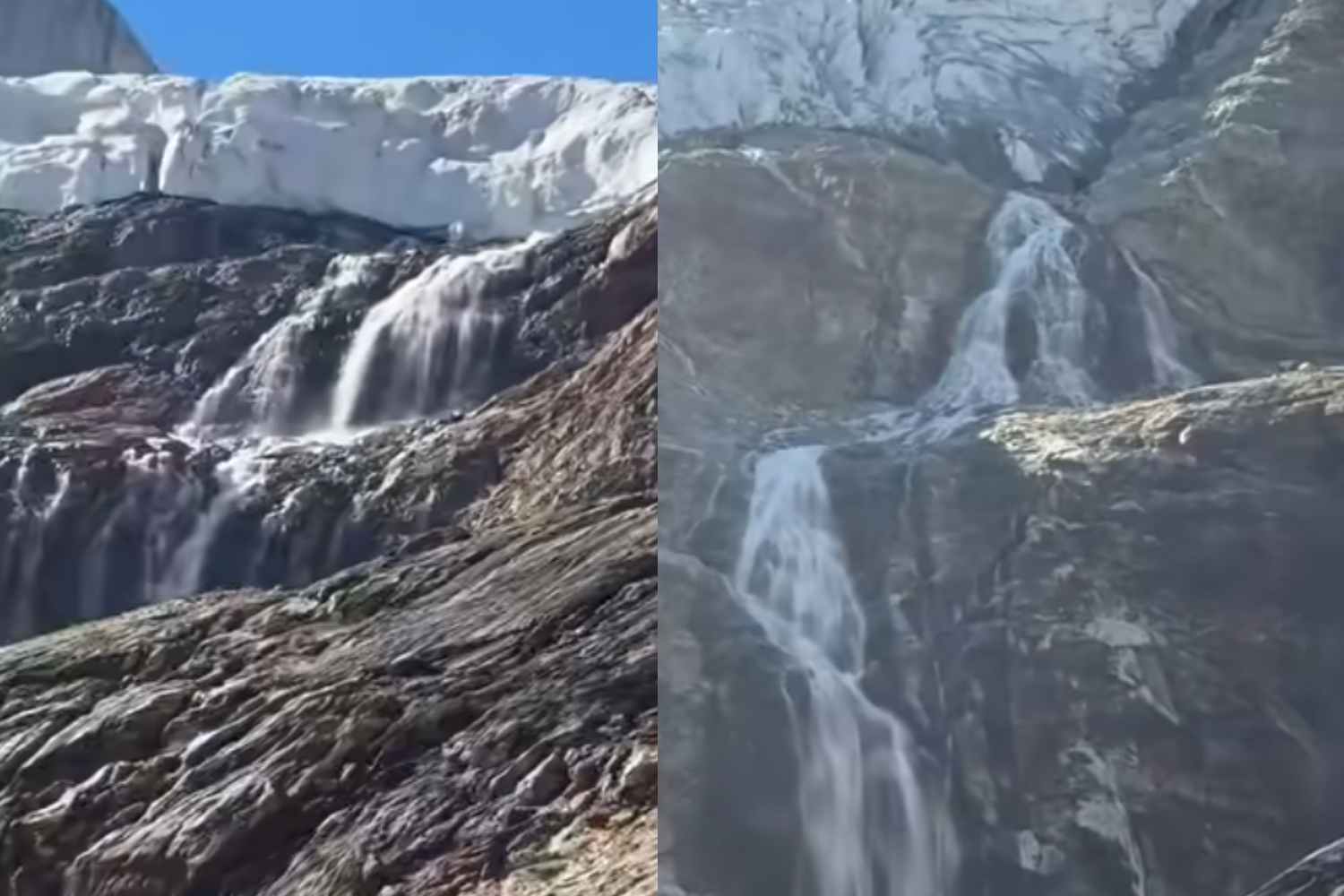
The video published on the Facebook page Meteo Valle d’Aosta is impressive: at 2,700 meters, at the foot of the Tsa de Tsan glacier, the water flows in rivers under the ice and falls into improvised waterfalls. It is the effect of an anomalous heat wave that, in the middle of August, is bringing more typical temperatures of the mountain average even on the Alpine peaks.
Rivers of water from the glacier in Valpelline – 8 August 2025
Impressive these images from Alta Valpelline, at the foot of the Tsa de Tsan glacier, near the Aosta refuge at 2700 m: 20 degrees and waterfalls of water leaving the glacier for the merger caused by the large heat.
Thanks to our correspondent Matteo Malingambi for these dramatic images
Posted by Weather Valle d’Aosta on Sunday, August 10, 2025
According to the Valle d’Aosta weather surveys, just yesterday the Mercury column touched 20 ° C at 2,700 meters, while on the glacier of the Plateau Rosa, at 3,500 meters, there were values between +5.9 ° C and +12.6 ° C, in the face of seasonal averages between -1.8 ° C and +3.8 ° C.
“Yesterday’s temperatures at 3,500 meters correspond to those that normally expected in August at 2,500 meters” – explain as a meteo Valle d’Aosta.
The phenomenon is amplified by the rise of the zero zero – the share at which the temperature remains at 0 ° C – which on 11 August has reached 5,200 meters, while for today, August 12, it is scheduled to be between 4,800 and 4,500 meters.
A heat that does not spare any quota
The functional center of the Valle d’Aosta region has issued a yellow alert for high temperatures, valid in the valley floor and in the central valley. It is a meteorological event that exposes snow and ice to a rapid dissolution, with consequences on the water balance, on the stability of the slopes and on the accessibility to high mountain routes.
In many Alpine locations, exceptional values have been reached: +24.9 ° C in Cervinia (2000 m), +26.3 ° C in Chamis (1815 m) and peaks of 30 ° C in some valleys around 1500 meters above sea level.
Visible effects and future risks
The most evident impact is observed on glaciers, where the merger accelerates the formation of torrent and temporary lakes. In the video released by Valle d’Aosta weather, the waters of the Tsa de Tsan run under the glacial surface, digging tunnels and collapsing in rock jumps. Phenomena that testify to a loss of glacial mass which, once started, is difficult to reverse.
Experts report that this phase of anomalous heat could continue until 18-20 August, with temperatures at high altitude above 8-10 degrees. The persistence of high temperatures, combined with the absence of significant rainfall, risks further compromising the seal of the residual snow mantle.
The extreme heat episodes at high altitude are no longer sporadic and question the survival of many Alpine glaciers. In addition to reducing water reserves for the dry seasons, the rapid merger can generate landslides, sudden full and modify the high mountain habitats.
Don’t you want to lose our news?
