
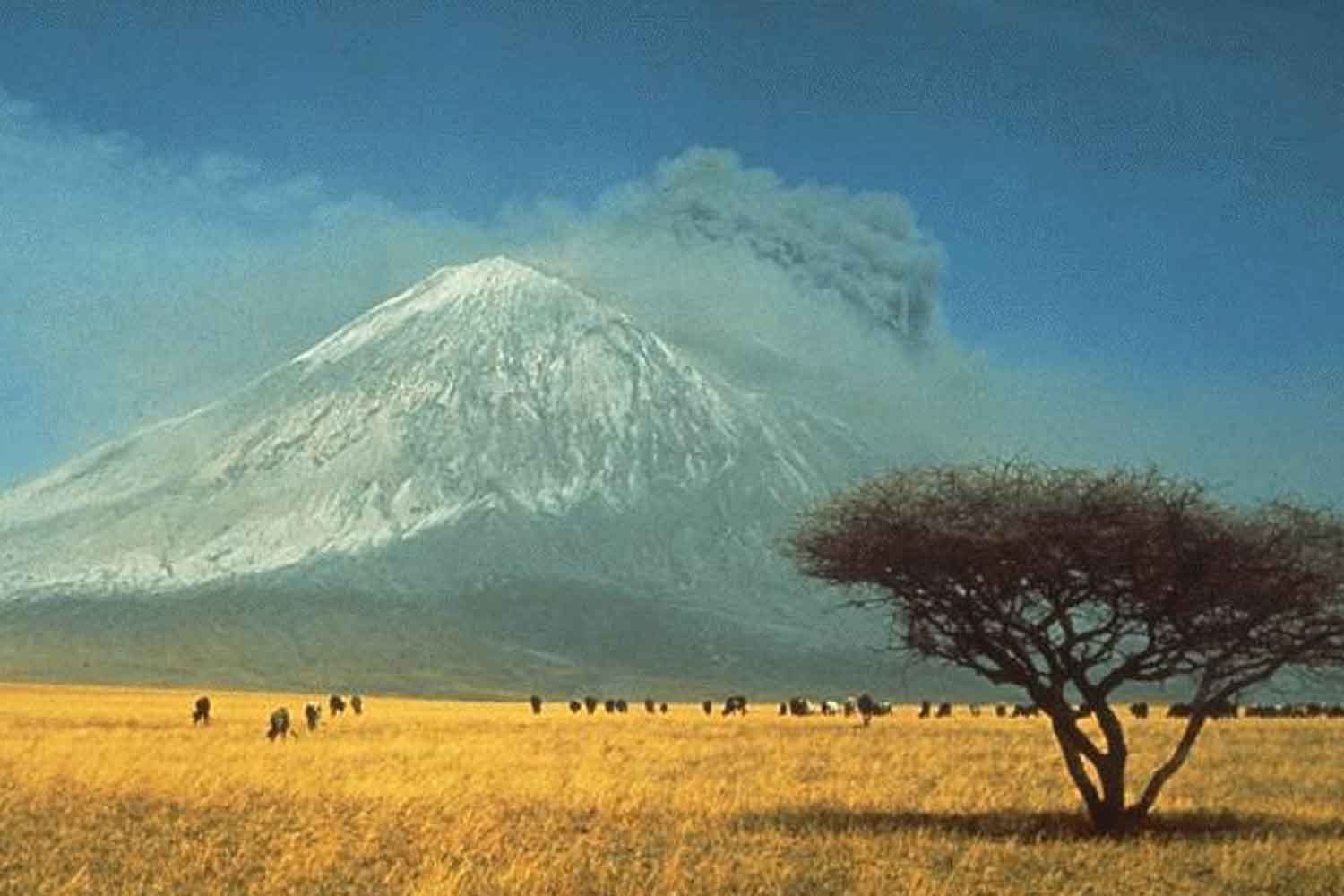
The lava comes out black, shiny and surprisingly fluid. Then a few hours pass, the humidity arrives and a white patina begins to appear on the surface. In the space of a day or two, a flow from Ol Doinyo Lengai, in northern Tanzania, can take on the appearance of something that would seem to have very little to do with a volcano: snow.
Snow, of course, is not. Producing that transformation is the chemistry of a lava so unusual that it makes this 2,962 meter stratovolcano a case with virtually no company. The Smithsonian Institution’s Global Volcanism Program describes it as the only volcano known to have erupted carbonatites in historical times.
A 500 degree lava that looks like black mud during the day
Calling it “cold” lava requires a certain elasticity: we are still talking about around 500-600 °C. It remains a very effective way for a human being to get very serious burns. For a magma, however, it is an unusually low temperature: many silicate lavas erupt around or above a thousand degrees. During a 1988 expedition to Ol Doinyo Lengai, temperatures of approximately 495 to 544°C were measured, as reported by the Smithsonian Global Volcanism Program.
The difference lies in the composition. Most of the lavas we know are rich in silicates. Here, instead, natrocarbonatite dominates, a lava very rich in sodium, potassium and calcium carbonates. Characteristic minerals include nyerereite and gregoryite. The analyzes of the Ol Doinyo Lengai lavas show an exceptional composition, with very little silica compared to the most common volcanic magmas, as also documented in petrological studies dedicated to the volcano’s natrocarbonatites.
It is precisely this composition that allows the magma to erupt at much lower temperatures and gives it an extremely low viscosity. The flows can therefore move rapidly and, in daylight, appear black or dark brown, more similar in appearance to very fluid mud than to the classic tongue of orange lava. The US Geological Survey also recounted this characteristic by defining Ol Doinyo Lengai as the “coolest” lava in the world, inevitably playing on the double English meaning of the word.
Why black lava turns white
The transition from black to white begins almost immediately after the eruption. And here simple cooling is not enough to explain what we see.
Natrocarbonatite minerals are very reactive when they encounter water and atmospheric moisture. Studies on the mineralogical transformations of the Ol Doinyo Lengai lavas have observed that just a few hours after the eruption the black surface can begin to alter, with the formation of clear and dusty deposits of new carbonates. Rain and water further accelerate the process. The phenomenon was studied directly through mineralogical analyzes of fresh and altered natrocarbonatites.
Field observations make the change quite visible. In June 1988 the freshly erupted flows were black; in the following hours and days they began to show increasingly lighter surfaces.
There is therefore no universal chronometer that transforms all the lava white after a precise number of hours: humidity, rain, exposure and conditions of the flow change the speed of the reactions.
As time passes, the transformation continues. The original carbonates still react with water and the atmosphere, giving rise to secondary minerals and increasingly friable, pale and dusty surfaces. The result is white, gray and cracked crusts that give the top that almost lunar appearance.
For the Maasai it is the “Mountain of God”
The geological exception also has another meaning. Ol Doinyo Lengai means “Mountain of God” in the Maa language and is a sacred place for the Maasai communities in the area.
The volcano is located in the East African Rift, just south of Lake Natron, within the Ngorongoro-Lengai UNESCO Global Geopark. UNESCO also highlights both its geological exceptionality and its cultural value for local communities.
The record, therefore, is more precise than it might seem in a spectacular video: Ol Doinyo Lengai does not simply produce “strange white lava”. The newly erupted lava is dark, exceptionally low in silica and rich in carbonates; the white comes later, when the alteration begins in contact with the environment.
The peak may seem snow-capped, but frost has nothing to do with it. Under that white are the transformed remains of lava that came out of the volcano at hundreds of degrees. A snowfall that is decidedly not advisable to take in hand.
