
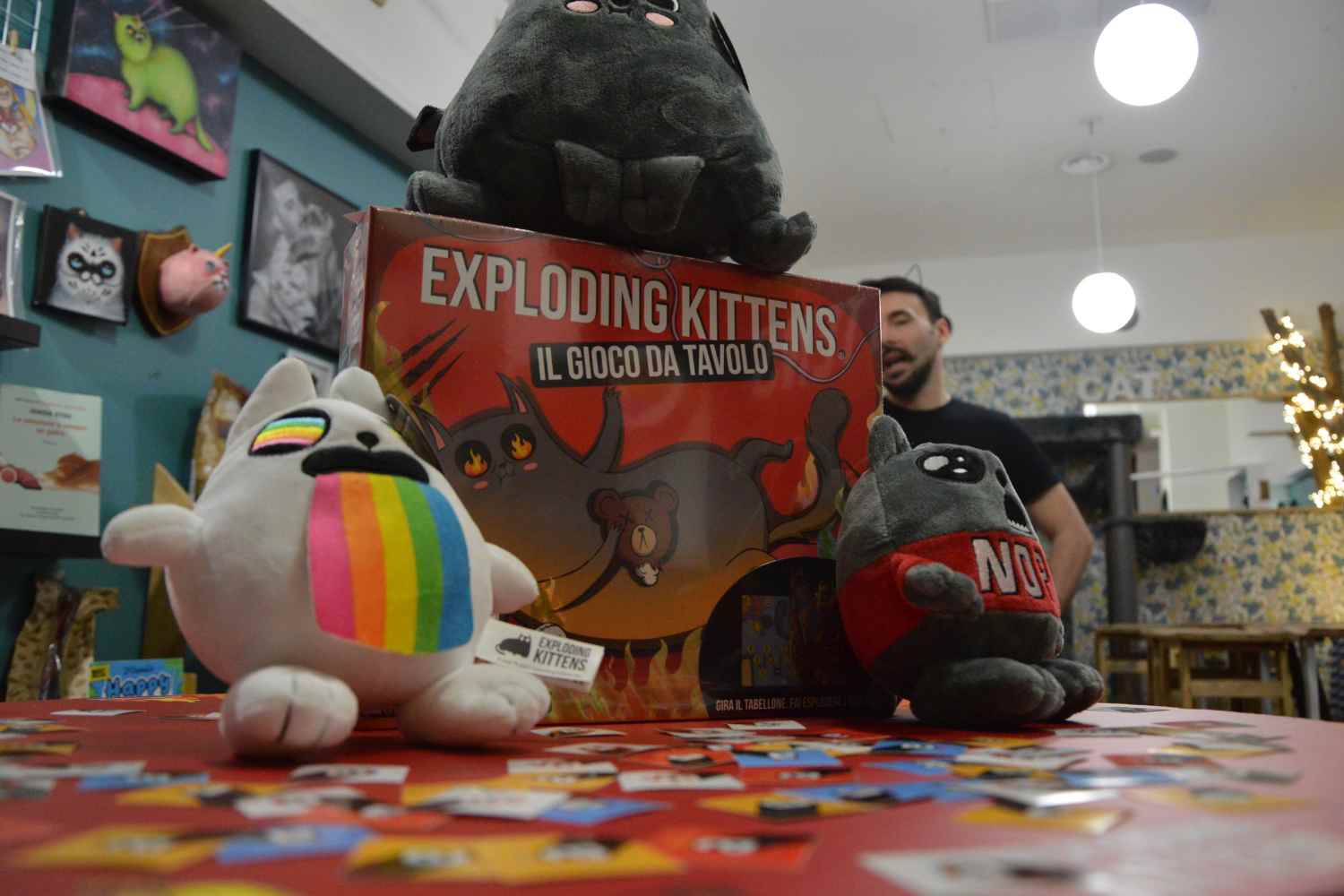
There are board games that you buy, play three times and end up in a drawer. And then there are games that stay on the table, that someone takes out every time there are people in the house, that end up being passed around as birthday presents because you already know they’ll work.
Exploding Kittens, ten years after its release and with 35 million copies sold worldwide, is firmly in the second category. Distributed in Italy by Asmodee, the group that brings some of the most important titles in the board game market to our country, it has remained one of the best-selling and most gifted products despite the constant release of new titles and the profound change that has occurred in the sector in the last decade. It’s worth understanding why.
The rules are explained as you shuffle the deck
The first reason Exploding Kittens works at any dinner party is the simplest: you don’t have to explain anything. The game has 56 cards, five of which explode if you draw them, and a card called Defuse that saves your life if you have it in your hand at the right time. One card is drawn per turn, the last survivor wins. End. The rest of the deck contains cards that allow you to look at the next three cards, skip your turn, or shuffle everything around hoping to shift the problem to someone else. In two minutes of explanation everyone has understood enough to start playing, and the first moves teach the rest on their own. This isn’t a minor detail: it’s the difference between a game that you take out and one that stays in the box because no one wants to read the manual.
You’re not optimizing, you’re sabotaging
The strategy part of Exploding Kittens doesn’t resemble the strategy of classic board games, and this is one of the reasons why it manages to engage people who don’t normally play. You’re not building something, you’re not managing resources, you’re not planning long-term moves. You’re trying to make the problem of drawing a bomb become someone else’s problem, preferably the one who just made you miss your turn. The central dynamic of the game is procrastination, and it works because every player at the table knows exactly what the others are doing and enjoys it. There’s nothing to learn formally, you just have to understand who you’re looking at across the table and decide how much to trust.
A match lasts 15 minutes, and is never the last
The most common problem with long board games is that the first loser waits silently for the others to finish, looking at their phone and trying to appear interested. Exploding Kittens has solved this problem at its root: a game lasts about fifteen minutes, whoever explodes before the others doesn’t wait long enough to get bored, and when the game ends the natural reaction is to start again. Often with a specific desire to make up for someone specific. The brevity isn’t a limitation of the game, it’s a design choice that turns each game into an episode of a longer evening instead of the only thing that happens. This is what makes it suitable for very different contexts, from family dinner to evenings with friends who haven’t seen each other for months.
Asmodee – Exploding Kittens – Playing Cards, Board Game and Party Game, 2-5 Players, 7+ Years, 15 min, Italian Edition
Losing is the best moment of the game
In almost all competitive games, defeat is something to go through silently. You lose at chess, shake hands and start again. You lose at Risk after three hours and wait for the others to finish trying not to show how sorry you are. Traditional game design treats defeat as a necessary side effect, something that must exist for victory to exist, but which should ideally make as little noise as possible.
Exploding Kittens works exactly the opposite. The moment someone catches the exploding cat is the high point of the game, not its interruption. Everyone turns towards the one who has drawn, a scream or a laugh or both together, and the one who has just left the game almost always laughs louder than everyone else. Part of this is down to the illustrations of Matthew Inman, the cartoonist behind the webcomic The Oatmeal, who drew each explosion so grotesquely and surreally that it’s impossible to react with displeasure. When you see the card, you laugh before you even realize you’re out. But there’s also a structural reason: short games turn defeat into a narrative driver rather than an end point. You didn’t leave the game, you entered the story of the evening.
The games that last are the ones that produce stories
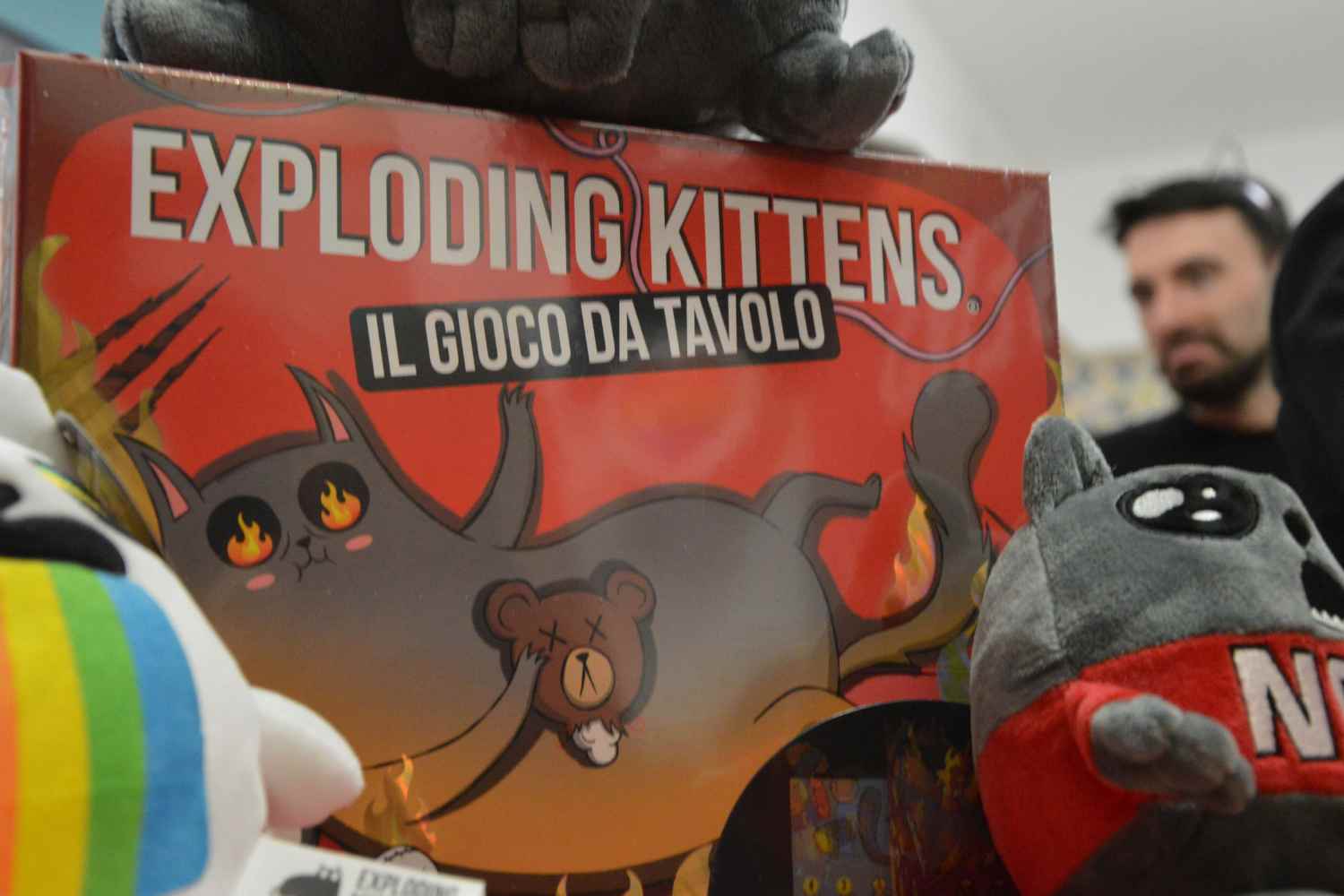
The deeper reason why Exploding Kittens is still here after ten years is not the quality of the game design, although that matters. It’s that it produces anecdotes. The games that people continue to buy, give away and take out years later tend to be the ones they remember not for who won, but for what happened. That Defuse used at the wrong time, that game in which someone shuffled the deck thinking they were smart and caught the bomb in the next round, that evening in which no one could stop and we ended up playing until two. These are the things that remain, and Exploding Kittens produces them with a consistency that few other games manage to have.
It did not become a classic in the museum sense of the term, it did not end up in the collections of those who study the history of game design. It has remained a social tool, the type of object that is taken on holiday and given as a gift without needing to know the tastes of the person receiving it, because it works on almost everyone. Which is probably the hardest thing for a board game to be, and the reason it’s still worth taking it out tonight, tomorrow, or on Easter Monday if it rains.
