
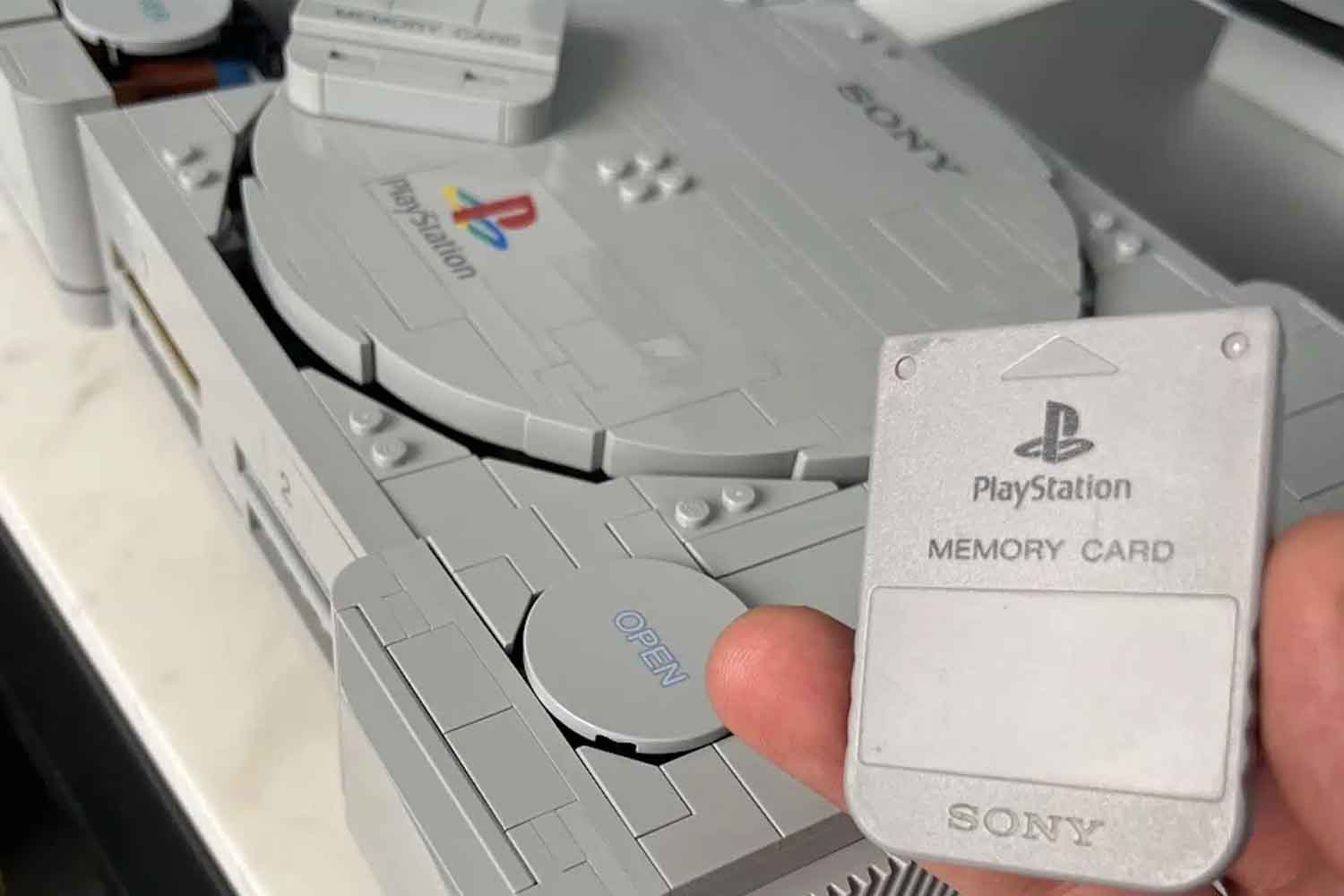
The Power button is there. The CD door as well. It’s a shame that the PlayStation built with LEGO bricks, although similar to the original, doesn’t allow you to play. A group of Swiss developers has decided to remedy this with BrickStation, an electronic kit designed to transform the replica of the first Sony console into a machine capable of starting video games from the nineties. The project, developed by the Substance Labs team, already has a prototype and a pre-launch page on Kickstarter. For now, however, we must be content with the creators’ demonstrations: commercial production has yet to begin.
The idea was born from the arrival on the market of the PlayStation LEGO 72306, available from 4 October 2026 at the price of 159.99 euros. The set includes 1,911 pieces and reproduces the first PlayStation almost in full scale, with its characteristic gray casing, the controller and two small dioramas inspired by Gran Turismo And Bee Escape. An object designed to be built and displayed. Someone, evidently, found it difficult to resist the temptation to press that Power button and expect something more.
How BrickStation works and why you shouldn’t modify LEGOs
BrickStation uses one of the spaces already present in the original construction. The electronic module takes the place of the side housing dedicated to the diorama Bee Escapefitting into the structure without requiring cutting, glue or permanent modifications. Installation should take about five minutes, according to the designers. If one day you decide to go back to the simple replica for display, it would be enough to remove the device and put the original pieces back in their place.
Inside the module there is space for a Raspberry Pi Zero 2 W, a small computer used to run games through emulation software. In essence, the system reproduces the operation of the old PlayStation without using the original Sony circuits. The image is transmitted to the television via an HDMI connection, while to play you can use USB or Bluetooth wireless controllers, including modern DualSense compatible ones.
The project also includes support for two players and the original PS1 Memory Cards, allowing you to recover saves stored on old memory cards. For those who grew up with those little gray tiles, finding a game saved twenty-five years ago could be even more interesting than the game itself.
The Power button really works, but the CD player has a little secret
The designers paid special attention to turning on the console. The Power button of the LEGO construction, normally a simple mechanical element, is connected to the electronic system via a magnet and a magnetic sensor. By pressing it, BrickStation starts up and the green LED lights up.
A small speaker and vibration motor also reproduce the noise of the old PlayStation’s CD player, including that distinctive buzz that accompanied starting games. However, there is an important difference compared to the original console. The CD player visible under the LEGO lid remains decorative. Inserting a disc into the slot will not start the game.
To use your own PS1 discs, the team plans to connect an external CD-ROM drive via USB. The device should allow you to copy game data to a microSD card, from which you can later launch the title through the emulator. The same microSD support will be able to host compatible games and their digital saves. The actual compatibility with the different titles will however have to be verified on the final product.
The attention to detail also extends to the number of bricks. Some BrickStation builds feature 83 additional LEGO pieces, bringing the build total from 1,911 to 1,994. A reference to 1994, the year in which the first PlayStation was marketed in Japan.
From Game Boy to PlayStation: the BrickBoy precedent
For Substance Labs this is the second foray into the world of consoles built with bricks. The group had already developed BrickBoy, a kit designed to transform the LEGO replica of the Nintendo Game Boy into a functioning portable console, complete with screen, buttons and electronic components.
The financing campaign raised over one million euros, involving more than 5,600 supporters. With BrickStation the principle remains similar, but the construction of the PlayStation offers more space for the electronics and allows the components to be concentrated in a single module.
The team also explained that they started working on the project before the LEGO set even hit stores. Once the final construction was obtained, the developers adapted the prototype to the spaces actually available. An advantage compared to the previous project, in which the installation of the components was more complex.
How much will BrickStation cost and when will it arrive on Kickstarter
For the moment BrickStation does not have an official price nor a confirmed marketing date. The developers are preparing a Kickstarter campaign, with the aim of starting fundraising by the end of 2026. There are offers dedicated to the first supporters, but amounts, available configurations and delivery times will have to be communicated at launch.
The cost of the LEGO construction must also be considered, which is sold separately for 159.99 euros. BrickStation is a stand-alone accessory and does not include the original set, commercial video games, or Sony’s copyrighted BIOS software. The project is also not officially affiliated with or authorized by LEGO or Sony. As with any product financed through crowdfunding, the transition from prototype to production involves time and risks that backers must evaluate.
Once completed, the LEGO PlayStation can therefore become something different from the usual collector’s item: a console to connect to the television, with games loaded on the microSD and even old Memory Cards. The button to turn it on is already in place. Now all that’s missing is the final kit.
View this post on Instagram
