
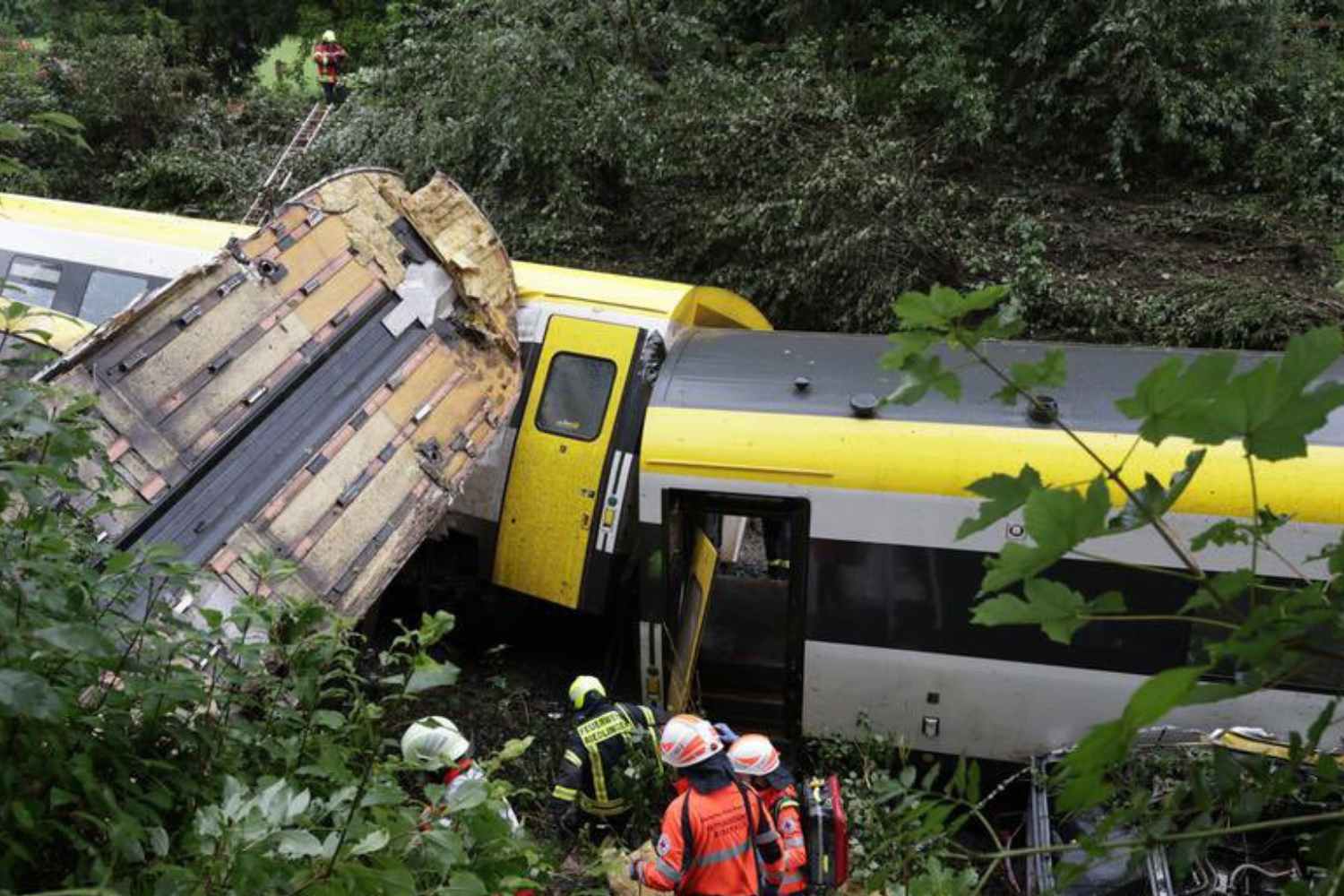
Sunday 27 July, 6:10 pm. A regional train directed to the German town of Ulm, with a hundred passengers on board, derails in the deep south of Germany, near Riedlingenin Baden-Württemberg. Two wagons overturn, three people die – among them the driver and another employee of the Deutsche Bahn – And over forty remain injured, twenty -five seriously. The balance is tragic and alarming, like the cause: a landslide caused by strong rains that have destabilized the ground along the tracks. It is yet another sign of how the climatic crisis He is also undermining daily security, affecting infrastructure and lives.
Passenger Train Derails in Germany: 3 Dead, Over 50 Injured
A Tragic Train Derailment Occurred in the Western German State of Baden-Würtfemberg, Near The French Border.
The Passenger Train was Carrying Around 100 People When it Came Off The Tracks. According to preliminary … pic.twitter.com/yxudQDN6GU
– Visegrád 24 (@visegrad24) July 28, 2025
According to the official reconstructions of the German police and the Minister of the Interior of the Baden-Württemberg, Thomas Stroblthe intense rain-30-40 millimeters in a few hours-saturated the ground, making a sewage well overflow. The waters, reads the main German newspaper Bild, eroded the embankment on which the railway line rested, sneaking the earth just as the convoy passed. There is no evidence of “external interference” or human errors, only the nature that has given up crashing.
The infrastructures under climatic pressure
The Riedlingen accident is not an isolated case. In recent years, the intensification of extreme weather events has had an increasing impact on European transport networks. The increase in temperatures and intense rainfall is multiplying episodes of landslides, landslides, flooding and road and railway interruptions.
In Germany, already in 2021, theFlood in the Hrtal region caused Over 180 dead and damages for billions of euros. The railway infrastructure is particularly vulnerable: second Deutsche Bahnmore than 40% of the routes crosses areas considered at hydrogeological risk. However, monitoring and early alert systems are not yet fully adapted to the acceleration of climate change.
A disaster that questions systemic responsibilities
After the accident, the authorities spoke openly of “unpredictable natural event”. But how much is it still acceptable to speak of unpredictability, when such phenomena multiply with a frequency that until a few years ago was unthinkable? The question is far from technical. These are also choices, and above all, political and managerial: infrastructure maintenance, climatic risk mapping, investment in safety and adaptation.
Deutsche Bahn, while declaring significant investments in climatic resilience, has been under observation for some time for the delays in the adjustments of the lines and for the slowness of the responses to extreme events. According to a report published in 2024 by the Federal Office for Civil Protection, many railway lines in forest or hilly areas still lack anti-French barriers and enhanced drainage systems.
Climate and inequalities: who really pays the price
The Riedlingen accident affects an essential service, used by workers and families. This is not only economic or environmental damage, but also social. The people involved – as the report on Bild underlines, which reports testimonies of survivors and rescuers – were commuters returning home. “They just wanted to go home,” holds the newspaper.
Germany, like the rest of Europe, is called to urgently face the challenge of climatic adaptation. Extreme events are now a structural component of our present. Ignoring them or treating them as exceptions means exposing themselves to new disasters. We need a more courageous planning: local safety, resilient infrastructures, constant monitoring and concrete investments in prevention.
Also at European level, the funds Next Generation EU and the ESG directives (Environmental, Social and Governance) emphasize sustainability and climatic risk management. But too often, between bureaucracy and inaction, the projects remain on paper. In the meantime, the effects of the climatic crisis do not wait.
