
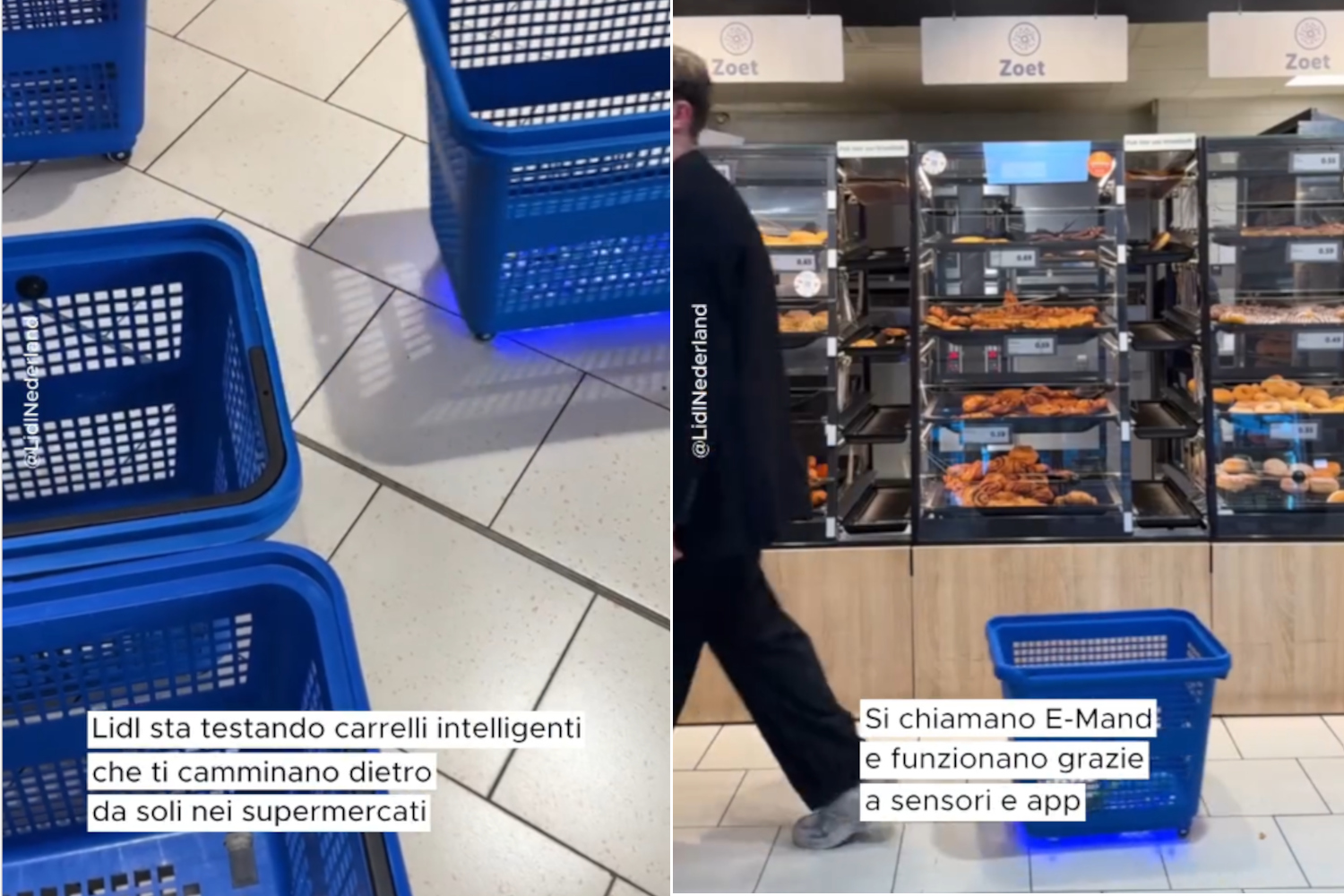
Lidl is testing the E-Mand Smart Carts in his Northern Europe supermarkets, autonomous shopping trolleys with artificial intelligence. These devices, thanks to a system of advanced sensors, are able to follow the customer between the shelves without any physical contact. Simply download an app and activate the trolley through a personal code and you’re done.
The cart, once connected to the application, begins to follow the customer at close range, circumventing obstacles and moving easily among other buyers. The system creates a real map of the environment, making the purchase experience more fluid and less stressful. The goal is to offer free hands, less effort and greater speed.
Innovation yes, but at what price?
Lidl is not alone in this race for intelligent spending. In fact, many realities are testing intelligent trolleys that are transformed into smart assistants or that recognize the products taken from the shelves and calculate the total expenditure in real time, completely eliminating the passage to the cashier.
But pay attention to costs. The large scale adoption of these trolleys is in fact not obstacles. The cost for each unit is between $ 5,000 and 10,000 dollars, against less than 100 of a traditional trolley. To this are added maintenance costs, software updates and technical support.
However, the advantages are not only for customers: it is estimated that supermarkets could increase earnings up to 18% per customer thanks to a more comfortable and faster purchase experience. For now it is only a test, but if everything goes according to the plans, we could soon see these intelligent trolleys even in Italian supermarkets.
But were we really needed?
Of course, so far everything is very curious. But it is spontaneous to ask: they really needed? Yes, it’s true, at first glance it seems a futuristic and also comfortable gimmick. But behind the charm of innovation there is the risk of investing energies, funds and attention in not very sustainable and not very useful solutions. While the world of large retailers fills the ecological transition mouth, reduction of human consumption and values, the chosen direction often appears contradictory.
A cart that follows you, in fact, does not solve a real problem. Indeed, it opens new ones: increase in energy consumption, technological obsolescence, dependence on apps and personal devices, not to mention the environmental cost of the production and maintenance of these systems. Not to mention the thinnest collateral effect: a further isolation of consumers, increasingly guided by automatisms and less and less stimulated to real interaction.
In an era in which we talk about conscious expense, short supply chain, local products, introducing technologies that recall more a video game that a daily gesture risks being only another superfluous gadget disguised as progress. In short, the question is not if the expense of the future will follow us alone. The real question is: what future do we really want to chase?
View this post on Instagram
Don’t you want to lose our news?
You may also be interested in:
