
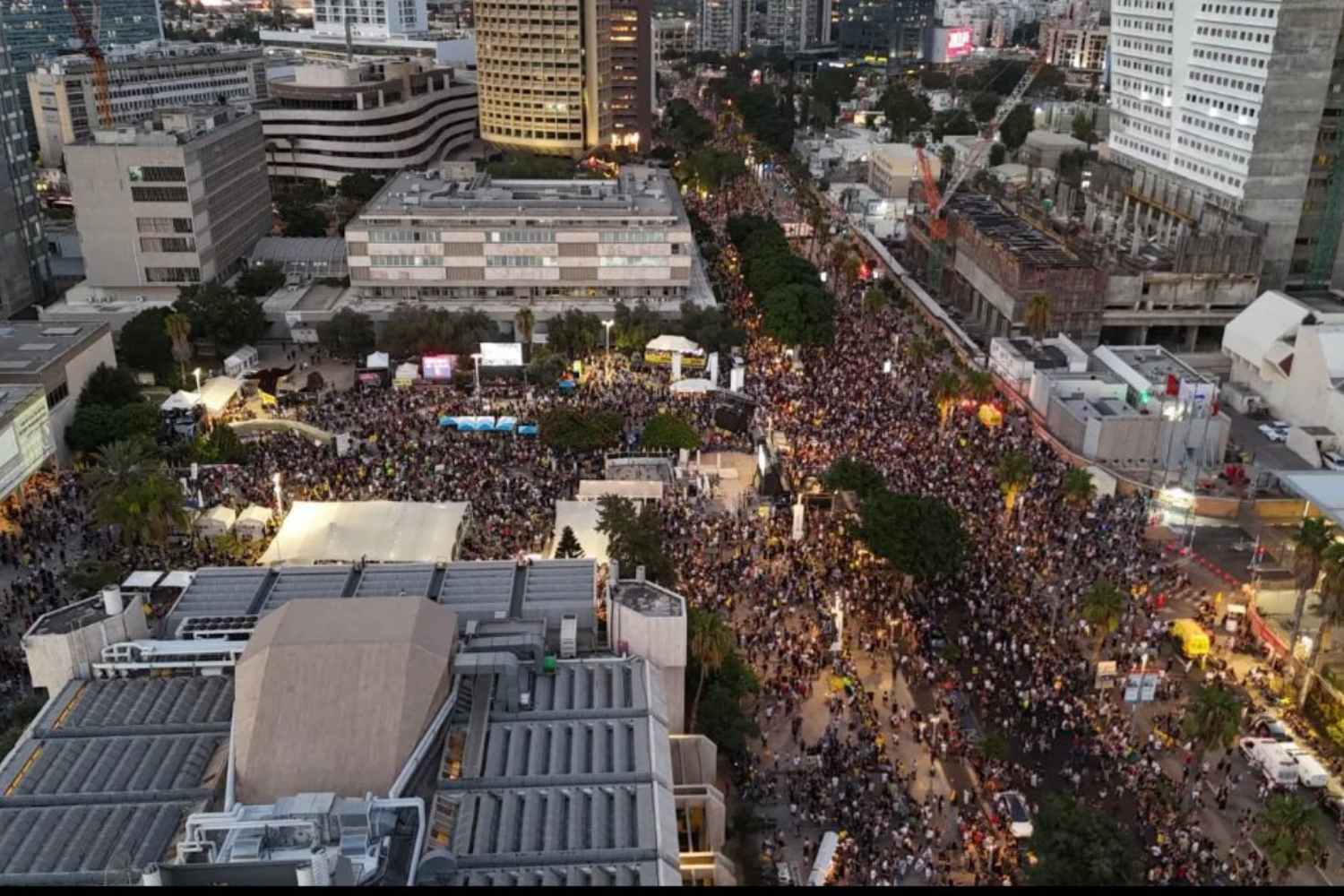
On August 17, in Israel the protest has grown now by hour. The organizers speak of one million demonstrators across the country and 500,000 only in the so -called hostage square in Tel Aviv. The Times of Israel reports it, citing the forum of the hostage families: “The entire people of Israel wants the release of all the hostages and the end of the war”.
The day was marked by road blocks, failed to cross and clashes with the police: 38 the total arrests communicated by the police (19 only to Tel Aviv). In many cases, the reservists who fought after the Hamas attacks on 7 October also took to the street: in a document mentioned by the Israeli media they asked to “do not further expand the conflict” and to “conclude an agreement to issue the hostages”. That “nobody should be left behind” resonates beyond the sides in the 681st day from the beginning of the war.
Wow. Who Knew There Were So Many “Hamas Supporters” in Israel. 300,000 Protesting in Tel Aviv Right Now, After 2.5 Million Gathered Around the Country Toray. Imagine A Day-Long Protest with 80 Million People in the Us Wise. Let Life Win. pic.twitter.com/nge7DSNS0Y
– Ami Dar (@Amidar) August 17, 2025
On the other hand there is the government. Prime Minister Benjamin Netanyahu has branded the mobilization as a gift to the enemy: “Those who today ask for the end of the war are not only stiffening the position of Hamas and delaying the release of our hostages, but are also ensuring that the horrors of October 7 will repeat themselves and that we will have to fight an endless war”. The media of Tel Aviv report it. On the same line the Minister of Finance Bezalel Smotrich, according to which the events “play the game of Hamas”.
In the meantime, Gaza continues to die in Gaza. Al-Jazeera counted 57 victims in a single day, 38 of which they were lined up to receive humanitarian aid. Numbers that do not say everything but are enough to remember that the humanitarian crisis is not a frame, it is part of the scene and this tragic story. And this is where the fracture in Israeli society is consumed: can we aim for the military destruction of Hamas and, together, bring the prisoners home?
According to an analysis collected by the New York Times, many experts believe that the two objectives are difficult to compatible. Yohanan Plesner, president of the Israel Democracy Institute, summarizes the point thus: trying to reach them together, almost two years after the attack on October 7, 2023, “is no longer valid”. The military road only risks lengthening the times and endangering the life of the hostages; The only realistic way to free them remains negotiating. During an event in Tel Aviv, Arbel Yehud said: “The only way to bring them back is through an agreement, all at once, without games”.
The news also returns a political paradox: the more the popularity of the premier descends, the more its dependence on the far -right parties that keep it standing and which refuse the idea of a respite increases. Thus, however imposing, protests risk weighing less than coalition vetoes. It affects the distance between the sea of flags and government calculations.
Within this distance there is the most “domestic” part of history, the one that concerns us up close also from Italy. A society that breaks on the war is a company that breaks on work, school, care, prices. It is the hidden side of the conflict: in the long run it weighs on the most fragile families and on those who have less voice. When roads and services stop, the same are always losing: those who run to work, who lives the day, who assists a relative.
Then there is an ethical element that concerns everyone, regardless of belonging: the protection of civilians. The news of the 38 people killed while waiting for help cannot pass without a trace. It is not a statistics, it is yet another alarm bell on how operations are conducted and how fragile the line between military goal is and damage to non -fighters. If those who are in the queue for a lot of flour is not safe, the breaking point is close.
A clear message comes from the squares: the priorities are people. “The responsibility to bring them home is yours,” the family repeat by contacting Netanyahu. As a backlight, the idea that the strength of a country is also in listening to those who remain behind.
Don’t you want to lose our news?
