
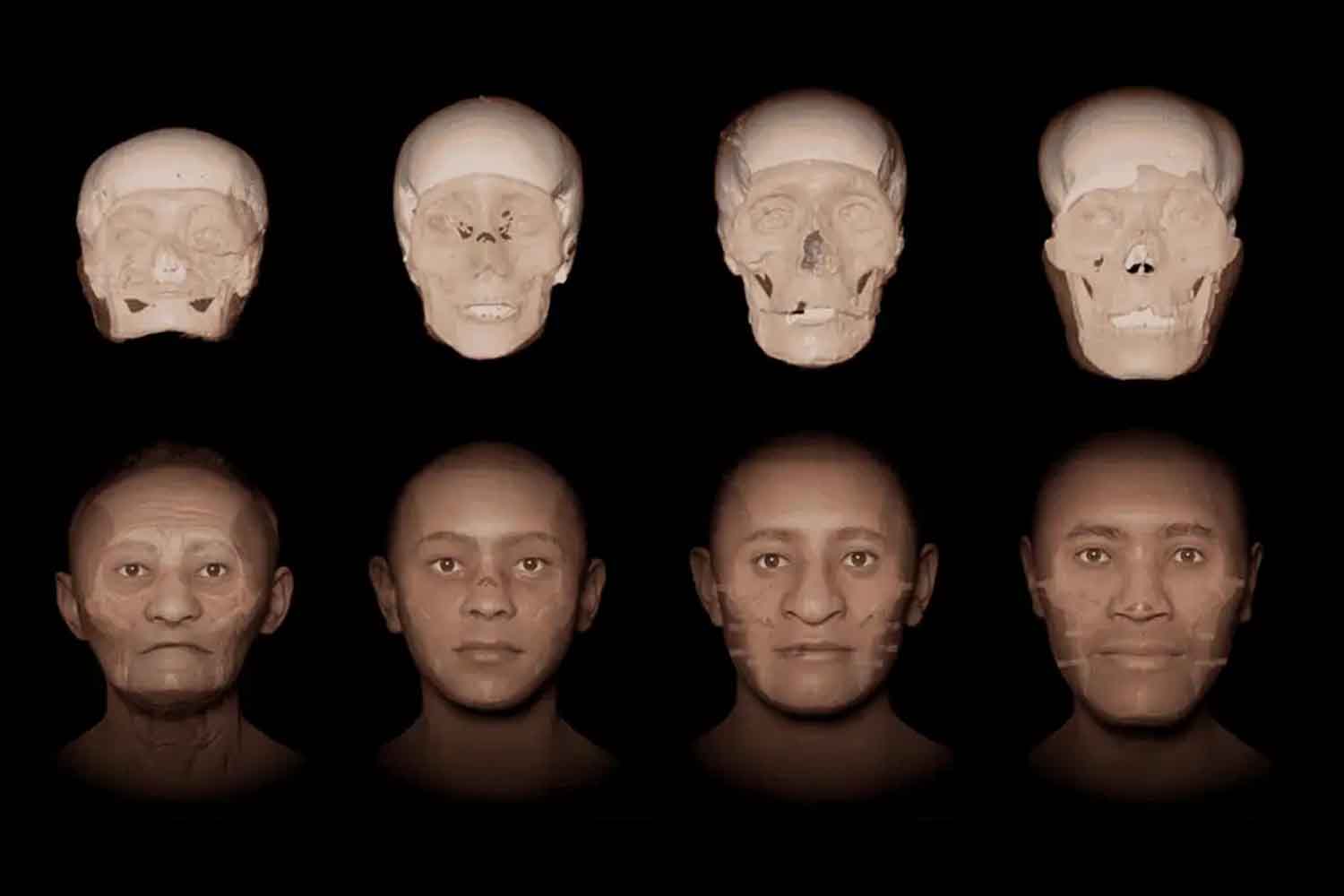
For centuries, four Colombian mummies They kept their mystery behind funeral masks merged directly on their skulls. Buried between 1216 and 1797 in the eastern Cordillera of the Colombian Andes, these mummies were found with wax masks, resin, clay and corn, modeled with such precision as to perfectly reproduce the features of the face. Today, after more than half a millennium, their faces return to show themselves thanks to a project of three -dimensional digital reconstruction.
Scientists of Face Lab At Liverpool John Moores University, led by the researcher Jessica Liu, they digitally “disassembled” the masks, managing to obtain extraordinarily realistic images of what could be the original somatic traits of the deceased. Among the reconstructed figures: a child, an elderly woman and two young men.
The digital reconstruction of the Colombian mummies reveals faces never seen before
The process began with the TC (computerized tomography) scan of the mummies, which allowed to obtain 3D models of the skulls hidden under the masks. From there, the researchers proceeded to Forensic facial reconstructiondigitally adding layers of muscles, soft fabrics and leather. For the two men, modern anthropometric data of Colombian adults were used in order to calculate the depth of the fabrics. In the case of the child, more layers of fat have been added to make the face fuller, while the elderly woman has been modeled by hand, since there are no reliable datasets for that age group or for children.
The nose has also been reconstructed starting from the nasal bones, comparing them with a digital archive of compatible forms. Once the basic structure of the face has been established, the team has added realistic details such as eyelashes, freckles, wrinkles, skin porestrying to respect the ethnicity and the typical aspect of the inhabitants of the Colombian region of the time as much as possible.
All reconstructions have a neutral expression, just to maintain a scientific and not spectacularized approach.
Colombian funeral masks are unique in the world
According to the Colombian historian Felipe Cárdenas-Arroyothe masked masks are an exceptional example of crafts and anatomical knowledge. “They are objects of an extraordinary quality, and at the moment they represent the only specimens known in Colombia,” he said. The masks, often decorated with beads or gold inserts, testify to the importance that this culture attributed to the maintenance of identity even after death.
Unfortunately, many of the original tombs have been looted, destroying much of the archaeological context useful for their interpretation. However, the Mummified remains, however, offered a precious window on an unfortunate civilization. And thanks to the digital forensic technologytoday it is possible to approach those people as never before.
The presentation of the reconstructions took place during the XI World Congress on studies on mummies in Cusco, Peru: a symbolic place for the pre -Columbian heritage, and a perfect setting for a project that combines past, science and respect.
Liu herself, although fascinated by the work done, invites to prudence:
These images want to offer an idea of how these people could appear, but exact portraits should not be considered. They are representations mediated by data, art and scientific hypotheses.
