
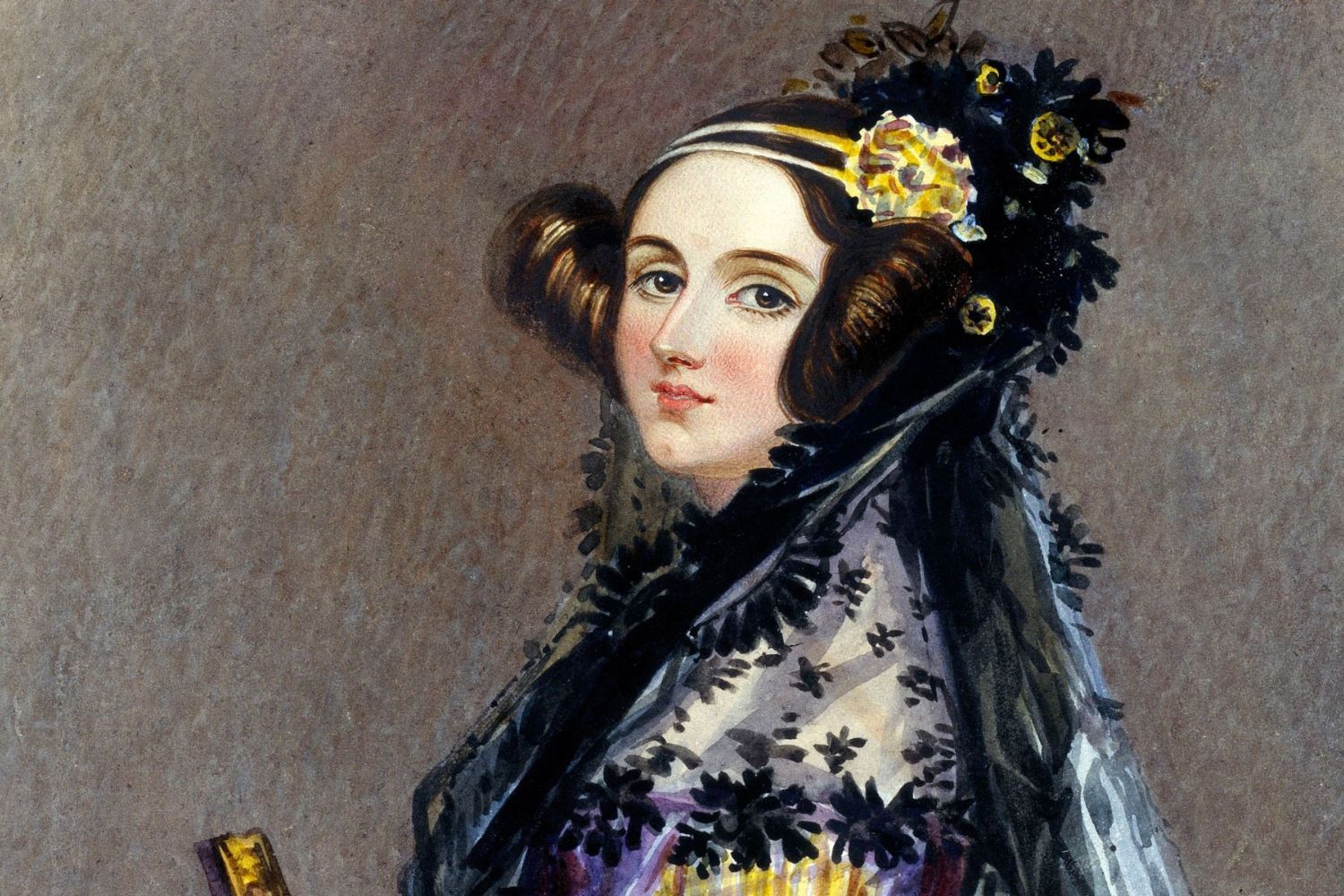
Ada Augusta King, known as Ada Lovelace, is an extraordinary figure in the history of mathematics and computing. Born in 1815 as the only legitimate daughter of the famous poet Lord Byron and the mathematician Anne Isabella Milbanke, she inherited from her mother a natural predisposition for numbers and a burning passion for mathematical sciences.
Her fame is mainly linked to her close collaboration with Charles Babbage, considered the father of computers, who nicknamed her “enchantress of numbers” for her exceptional abilities. Their most significant work involved the development of the analytical engine, considered a precursor to modern computers. In particular, Babbage entrusted her with the important task of translating into English the studies of the Italian mathematician Luigi Menabrea (future Italian Prime Minister from 1867 to 1869) relating precisely to this innovative machine. In just 36 years of her life (she was born on 10 December 1815 and died in 1852), Ada became one of the most famous women in England and throughout Europe thanks to her passion and undisputed talent for mathematics.
But there is a but: many of Ada Lovelace’s works were initially published under a pseudonym or under the name of fellow man Charles Babbage.
Ada Lovelace’s achievements
Lovelace, in 1843, translated an article written by the Italian mathematician and engineer Menabrea, (1842; “Elements of Charles Babbage’s Analytical Engine”). His detailed and elaborate annotations (particularly his description of how the proposed Analytical Engine project could be programmed to calculate Bernoulli numbers) were considered excellent:
The analytical machine – it was said – weaves algebraic patterns, just like the Jacquard loom weaves flowers and leaves.
But Ada also added several notes and notes to the translation, giving rise to her great ability to predict many future computer applications, including an algorithm for calculating Bernoulli numbers. That algorithm is now recognized as the first computer program in history. Furthermore, it was from Ada’s work that Alan Turing drew inspiration to build the first modern computer.
The birth of Ada Lovelace Day
It almost goes without saying that Ada’s efforts were ignored for a long time. Only in 1979 did the US Department of Defense honor his memory and his work by calling “Ada” a programming language.
Ada Lovelace Day (ALD) is then celebrated on the second Tuesday of October each year, an international celebration of women’s achievements in science, technology, engineering and mathematics (STEM). Born in 2009 from an intuition of activist Suw Charman-Anderson, its mission is to “raise the profile of women in STEM”.
