
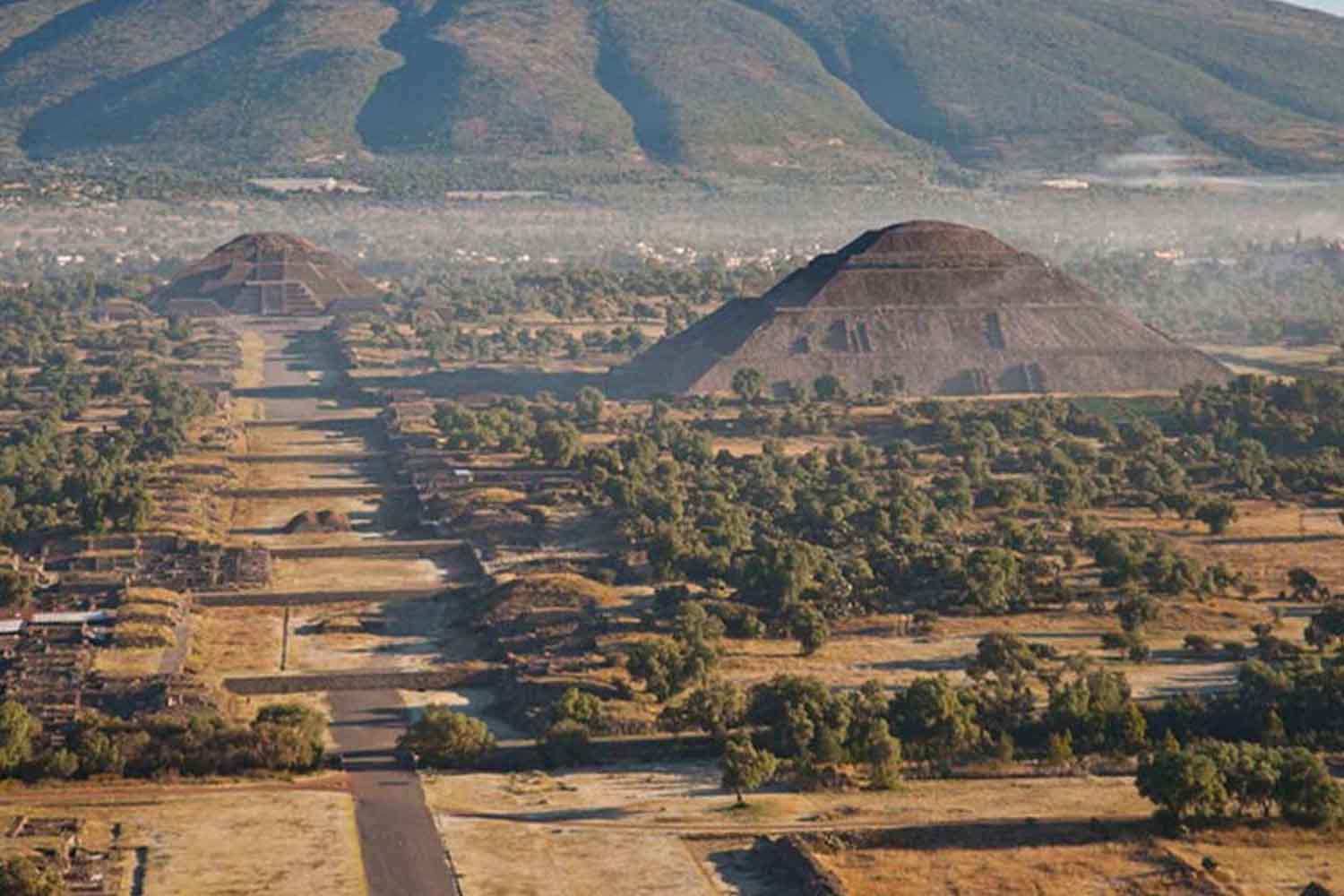
Who has visited at least once Teotihuacanin the heart of central Mexico, knows the visual power of its monumental pyramidsof the long stone avenuesof the murals still alive in colours. Yet, behind the majesty of this archaeological site, it remains a question still open: what language did its inhabitants speak?
A new study byUniversity of Copenhagenpublished in the magazine Current Anthropologytry to give an answer. The two researchers, Christopher Helmke And Magnus Pharaoh Hansenargue that i symbols visible on murals and ceramics they are not just graphic or decorative elements. After careful analysis, they believe that it is structured linguistic signs, similar to writing systems already known in Mesoamerica, such as that of the Maya. And, according to their interpretation, those symbols would contain traces of an ancient language, belonging to the Uto-Aztec group of languagesthat is, the same family to which the Nahuatlstill spoken today in several regions of Mexico.
The researchers explained that if this hypothesis is confirmed, they may also have shed light on one of the most complex puzzles in Mesoamerican archaeology: the linguistic and cultural identity of the inhabitants of Teotihuacan.
Teotihuacan, the voiceless city, may finally be telling its story
Founded around 100 BCTeotihuacan enjoyed a heyday for over six centuries and counting up to 125,000 inhabitants. The city’s influence extended far beyond the Valley of Mexico, and for this reason, scholars have often called it the “Rome of the Americas”.
Unlike the Maya or gods Aztecshowever, the inhabitants of Teotihuacan. The symbols that decorate the buildings and objects of the city – depictions of jaguars, birds, geometric figures – they have long been considered religious or aesthetic symbolsdevoid of real linguistic content.
Helmke and Pharao Hansen instead observed that these signs they share key elements with other Mesoamerican writing systemsincluding the use of logograms (signs representing words) and del rebus principlein which images are combined to create complex sounds or concepts.
In their study, the two researchers also introduce the concept of “double spelling”: this would be a technique used by scribes to reinforce a meaning or a sound through the repetition or juxtaposition of similar symbols. According to what they say, this characteristic would suggest that the system was much more sophisticated than previously thoughtAnd firmly rooted in a spoken language.
The real novelty of the study concerns the language that hides behind those symbols. The two authors explain that, according to their analyses, it would be a very ancient variant of an Uto-Aztec languagenot documented in written form but returned through linguistic reconstruction work. This idiom, they say, could be a direct ancestor of Nahuatlthe language spoken by the Aztecs, but also of cora and of thehuicholstill in use in some regions of western Mexico.
Pharao Hansen pointed out that no one, until now, had attempted to interpret these signs using a language consistent with the historical period of Teotihuacannor had it ever been demonstrated that some logograms had a phonetic value applicable in different contexts. Their method, therefore, would consist in reconstructing the lost language based on historical and linguistic dataand then apply it to the deciphering of symbols.
Helmke clarified that reading these texts using modern language would be misleadingjust how wrong it would be try to interpret ancient Scandinavian runes with today’s Danish. For this, the two scholars have adopted an approach closer to the original context, which they define “linguistic archaeology”.
New hypotheses about the Aztecs: what if they were the direct descendants of the Teotihuacans?
Until now it has always been believed that Nahuatl speakers – like the Aztecs – arrived in the Valley of Mexico region after the end of Teotihuacanoccupying a now abandoned territory. This new research, however, challenges that idea.
According to Helmke and Pharao Hansen, there would be one linguistic continuity between Teotihuacan and subsequent Nahua cultures. If the hypothesis turns out to be correct, the Aztecs did not arrive “later”, but were direct heirs of the Teotihuacan civilizationand Nahuatl may have developed from that lost language.
This perspective would change radically the historical vision of the Mesoamerican areashifting the point of origin of one of the most widespread native languages centuries behind what was previously thought.
The researchers admit that the material available is still limited. The written texts are short, often isolated, and difficult to compare with each other. It would be essential, they explain, to find the same symbols used in multiple contexts, to further strengthen the hypothesis.
The study has already attracted great interest in the academic community. The two researchers said they wanted organize workshops and interdisciplinary collaborationsinvolving scholars of epigraphy, historical linguistics and archaeology.
According to what they explain, the goal is not so much to offer a definitive truth, but propose a working method that it could be adopted and expanded by other expertsto arrive at a more solid understanding of the Teotihuacan script.
While recognizing that much of the system still remains to be decipheredthey point out that this could be one of the most promising keys to directly access the voice of the ancient Teotihuacans – a voice that has remained silent for centuries, and which could now be heard again.
