
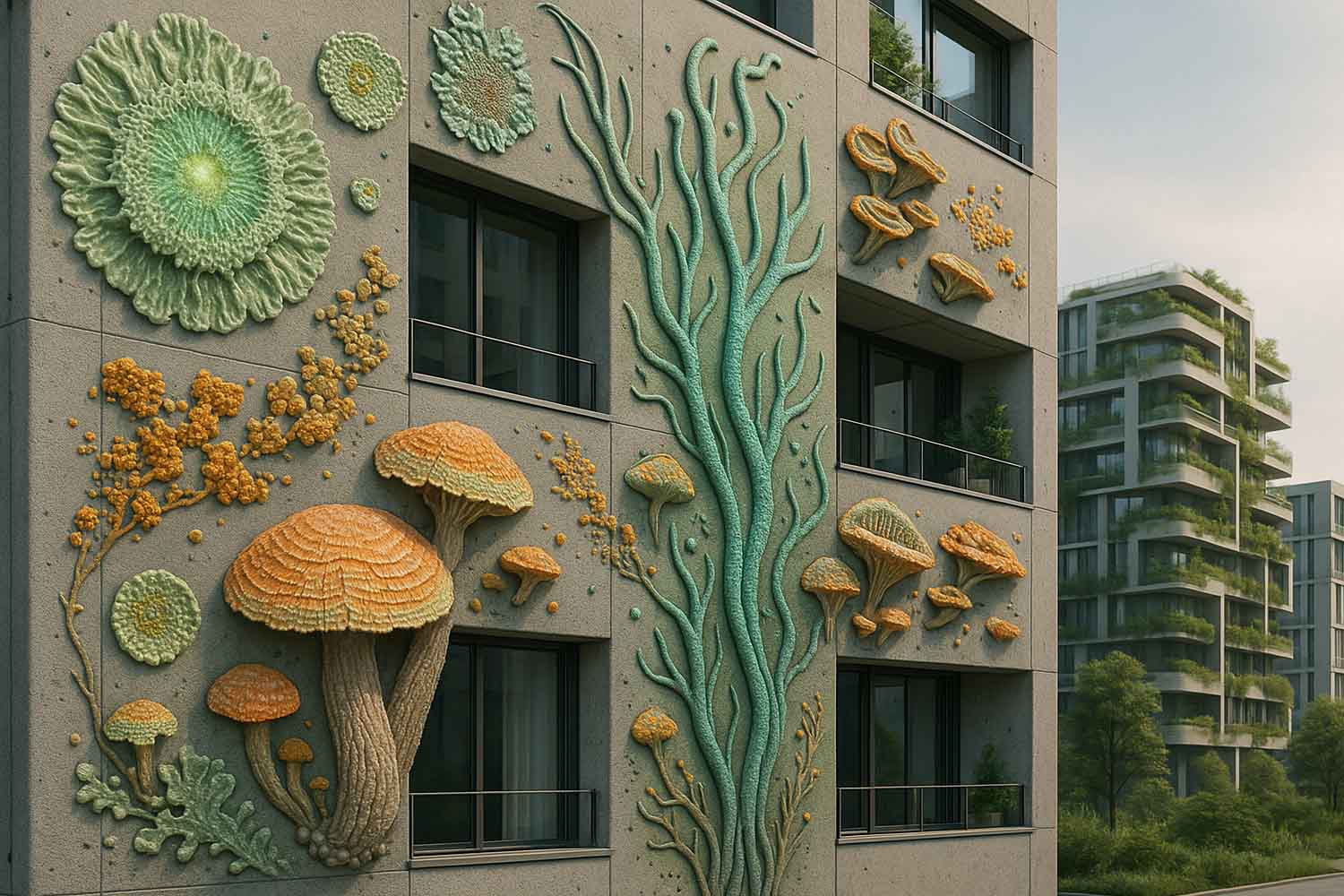
Walls that react to heat, repair themselves and clean the air? It is not a science fiction idea, but a technology currently being tested. A group of European researchers, thanks to the REMEDY project, is transforming the walls of buildings into living surfaces, using inks composed of microorganisms. The goal is clear: integrate life into building materials, making buildings an active part of the environment.
In practice, these are real “living tattoos”, created by printing a mixture of bacteria, fungi and algae on walls and roofs. These organisms live on the surface of buildings, where they can absorb CO₂, report any structural damage, resist pathogens and – in some cases – even emit light.
Every year, millions of square meters of new facades and roofs are built or renovated. In the European Union alone, over the next 25 years, we are talking about over 9.4 billion square meters. If even just a part of these surfaces were converted into bioactive areas, the potential would be enormous.
This is supported by Tom Ellis, professor at Imperial College London, one of the coordinators of the project:
We have a lot of unused surface available, which could become useful for generating energy, monitoring the environment, making buildings more intelligent.
In other words, the walls of our homes will no longer have to be just passive protection. They can become natural sensors, anti-pollution filters, barriers against harmful bacteria and much more.
A concrete example? Lichens that change color when temperatures rise too high, signaling that the building is experiencing thermal stress. Or microbes that react to the presence of harmful gases, recording the variations and – in the future – acting to counteract them.
How microbial tattoos on walls work
The idea is simple to explain, but complicated to implement. The researchers use a modified version of inkjet printing, similar to what we use to print a document. Only instead of ink, there are live, carefully selected microorganisms.
Microbes cannot be used at random. Scientific teams from the University of Ljubljana and the Polytechnic University of Graz are testing precise combinations of bacteria, fungi and algae capable of living together, resisting sun and rain, and performing specific functions such as self-healing surface cracks, absorbing carbon dioxide, or even releasing oxygen.
As Carole Planchette, involved in the project, explains, work is also being done on luminous formulations: in the future, walls could light up thanks to bioluminescence. A fascinating and very low impact alternative to artificial lighting.
From panel tests to complete facades: what to expect in the coming years
For now, the technology is being tested on smaller panels, such as roof tiles or cladding surfaces. It is difficult to think of printing microorganisms on the entire facade of a skyscraper, at least for now. But starting from small surfaces, it will be possible to carry out concrete experiments in real environments, observing how these “living tattoos” react to the seasons, to pollution, to the wear and tear of time.
Unlike a solar panel or an HVAC system, these systems grow and adapt: they do not need to be replaced periodically and do not take up new space. They use what already exists.
According to Ellis:
In fifty years, every new building will have to actively contribute to the well-being of the environment. And living materials like these will be an important part of the change.
In recent years, we have seen the emergence of green roofs, vertical gardens and building materials made from mushrooms or recycled waste. But with “living tattoos”, nature is not just an aesthetic or functional addition: it becomes an integral part of the architecture.
And this approach could become fundamental in an era in which cities emit more than 70% of global CO₂ and the construction sector has an enormous environmental burden. It is not just a question of design or aesthetics, but of environmental survival.
If this technology were to establish itself, we could really find ourselves living in buildings that breathe, take care of themselves and protect our health and that of the planet. A fascinating, concrete and – finally – close idea.
Don’t want to miss our news?
You might also be interested in:
