
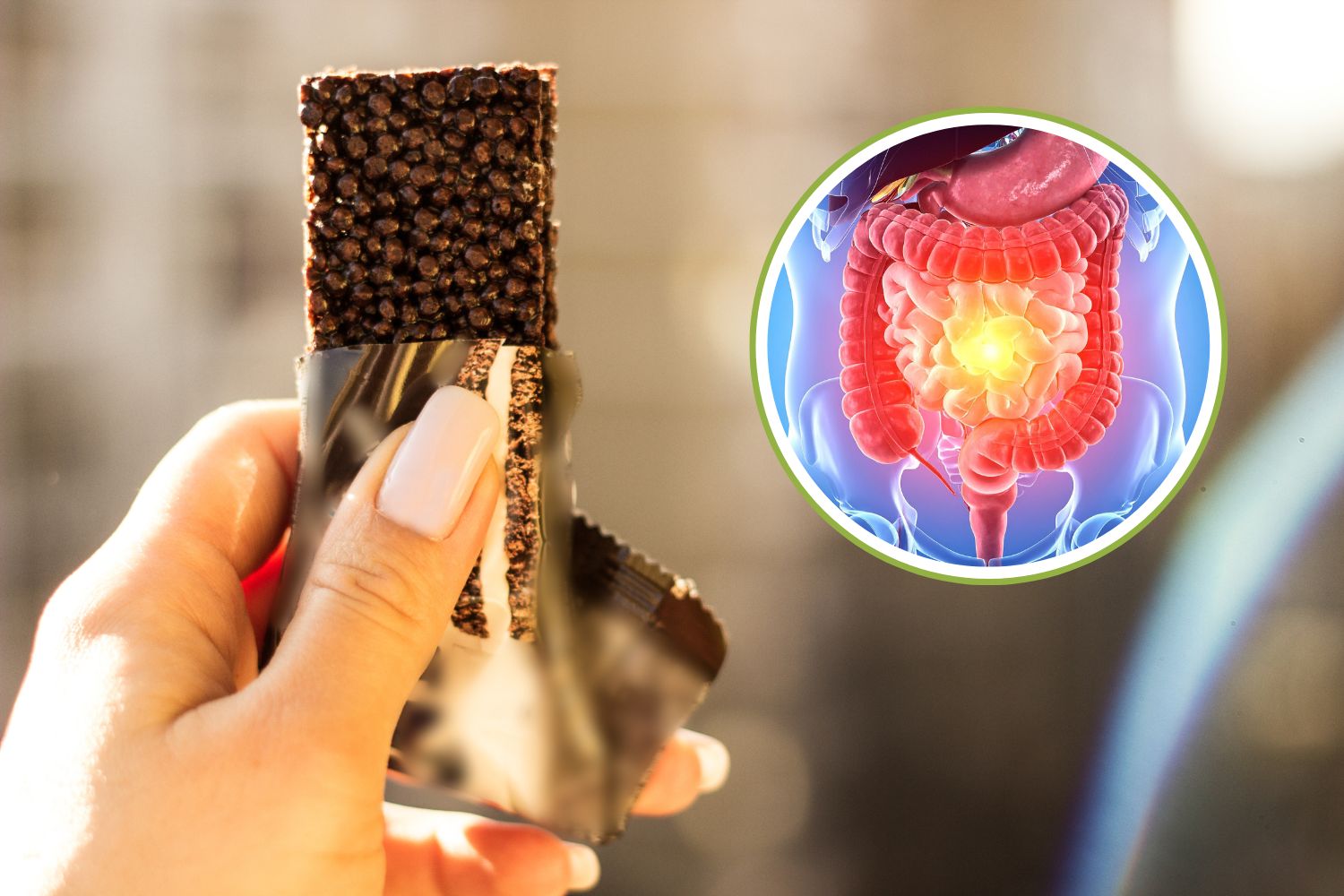
In the documentary Licensed to KillJoe Wicks, together with the doctor and popularizer Chris van Tulleken, showed how many industrial protein bars are far from an idea of natural nutrition.
Additives, sweeteners, emulsifiers and refined oils: ingredients that transform a supposedly healthy snack into an ultra-processed product, similar to a refrigerated dessert.
The point is not to demonize the concept of a “protein bar”, but to understand what we are really eating. And above all: what effect does it have on our body if we consume it every day?
Intestine: when the “fit bar” becomes an endurance test
Many bars contain isolated fiber (like inulin) and alcoholic sugars (like maltitol or sorbitol) that can ferment in the intestines and cause bloating, gas and cramps.
Synthetic emulsifiers, used to give consistency to the product, can also alter the balance of the intestinal microbiota. Some studies in animal models link them to increased intestinal permeability, but human data remains preliminary.
My new documentary Joe Wicks: Licensed to Kill airs on @channel4 Monday 6th October at 8pm. It’s exploring Ultra Processed Foods and the impact they are having on our health. I’ve stepped out of my comfort zone to create something I think is really important and I hope you get to see it
Will you tune in?@channel4documentaries
Posted by The Body Coach on Thursday, September 25, 2025
Even the declared protein quota is not always the one actually absorbed: according to a study published in Health.comthe body uses only between 47% and 81% of the proteins indicated on the label, because fiber, fats and additives hinder digestion.
The “clean” alternatives – bars made from oats, dried fruit or dates – remain the most tolerable. Especially the homemade ones:
Heart: hidden sugars and invisible fats
Many “fit” products contain saturated fats and added sugars which, if consumed regularly, can increase cholesterol and blood sugar levels.
It’s not just a question of calories, but of the quality of the ingredients. Ultra-processed foods are now associated – although for now only correlatively – with a higher risk of cardiovascular and metabolic diseases.
And there is no shortage of cases of contamination: in 2024 some No Cow brand bars were recalled in the USA due to traces of lead and PFAS, the so-called “eternal substances” linked to kidney and heart damage.
Waist size and metabolism: the study that changes perspective
Until recently it was thought that protein bars, thanks to their protein content, could promote the feeling of satiety.
But a clinical study published in 2023 on Journal of Functional Foods (Pang et al.) showed a surprising result: after just one week of daily consumption, participants experienced an average 3% increase in fat mass.
In detail:
Translated: those who include a bar in their diet tend to add calories, not replace them. And this, over time, can encourage a slow increase in weight and fat mass, if not balanced by physical activity or a controlled diet.
How to choose (and use) protein bars without being fooled
Protein bars are not a poison, but they are not a “magic” food either. They can help those who play sports or need a quick protein intake, but if they become a daily habit they can alter metabolism and increase fat mass, as confirmed by the study by Pang and colleagues.
Joe Wicks’ message is clear: the label “protein” is not enough to define a food as healthy. The true form of well-being still comes from what we cook, chew and choose with awareness.
You might also be interested in:
