
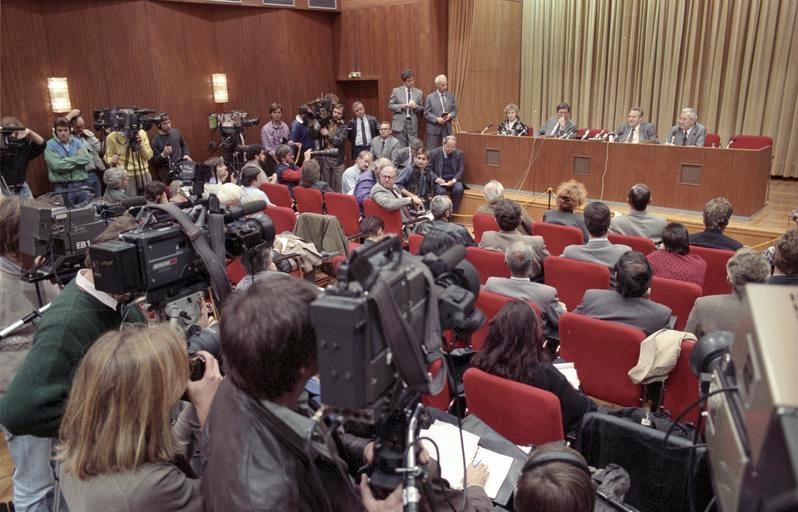
A point-blank question and an answer that left no doubt and which led to the fall of the Berlin Wall. After more than 30 years, he – Riccardo Ehrman – the most attentive remember him like this, in that press conference in which he asked a Guenter Schabowskithen government spokesperson, when the new travel regulations decided by the GDR (East Germany) would come into force.
“Ab wann?“, “Since?“, and the answer changed history in an instant. For some time there had already been talk of allowing the citizens of East Berlin to go to the western part. But the communist leaders of the GDR did not expect it at all in such a hurry.
It all happened exactly 35 years ago, on 9 November 1989, when in front of a room full of journalists, Ehrman asked that decisive question, with his 11 years of Ansa correspondence from East Berlin on his back. A painstaking, exciting and not easy job, monitored as it was night and day:
“The house was a home office and was full of microphones, even in the bathroom, and there were two in the bedroom“,
he will tell the story 25 years later from his home in Madrid.
Riccardo Ehrman, who passed away last year at the age of 92, was of Polish-Jewish origin. At 13 he was locked up in the Ferramonti di Tarsia internment camp, in the province of Cosenza, where he was freed by the English in September ’43. He then became a journalist, traveled the world and was then appointed Germany correspondent for ANSA. At 78 he was awarded the Federal Cross of Merit by the German government.
That day in 1989 Riccardo Ehrmann was 60 years old and due to a combination of random factors he contributed to closing the “Short Century”.
“Ab wann?“, the question that brought down the Berlin Wall
Sitting on the steps under the conference room table Socialist Unity Party of Germany (SED), on 9 November 1989 Riccardo Ehrman arrived there, at the press conference called by the communist leaders of the GDR, last, in the grip of anxiety at not having immediately found a place in the car park.
It was a coincidence that Gunter Schabowski, the spokesman for the GDR government, also arrived late, with little information and a leaflet that he hadn’t even read.
”They told me that (the press conference, ed.) would be important, even from the Foreign Ministry. But I am convinced that none of the East Germans knew what was about to happen. Schabowski himself didn’t understand what was going on. Schabowski had not read the leaflet that Egon Krenz (number one of the party and Honecker’s successor) had given him before the meeting with the journalists, where the facilities were explained”, said Riccardo Ehrman.
At question time, Ehrman turned to Schabowski:
“You talked about mistakes, don’t you think it was a big mistake: announcing a travel law a few weeks ago that wasn’t a law?“, alluding to the fact that the Germans were being made to believe they could emigrate to West Berlin.
Schabowski was clearly in difficulty and unprepared, he had not yet had time to read the leaflet with the instructions that Egon Krenz (number one of the party and Honecker’s successor) had given him:
“East Germans can leave the country without giving reasons“, announcement.
Ehrman, who immediately understood that he had hit Schabowski on a weak point, starts with a second question: “Does this also apply to West Berlin?“.”Yes“, replies the official.
And here is the third and decisive question that has entered history. “Ab wann? (Since when?, ed.)“.”Right away“.
One of the top leaders of the GDR had just said that he was giving everyone the freedom to leave East Berlin and go to West Berlin without a passport or visa. And from that moment it is history that we know.
Yet Ehrman kept a secret for two decades, a sort of backstory that led him on the right track. That morning he had received a prompt from Gunther Potsche (who died in 2008 and with whom the journalist had made a pact of loyalty): the director of the East German information agency revealed to him that a major debate had emerged in the party’s leadership group and that the day before small openings had been decided in the travel law which effectively prevented GDR citizens from leaving the country.
From there it took a moment for Riccardo Ehrman to formulate the question in the right place at the right time.
“My merit, if we can speak of merit, is not so much that I asked the question, but rather that I understood the answer” concludes Ehrman.
With him we re-read the history of Europe in the darkest years and, especially in these days, we try to learn from it so as not to make the same mistakes. Or at least let’s try.
