
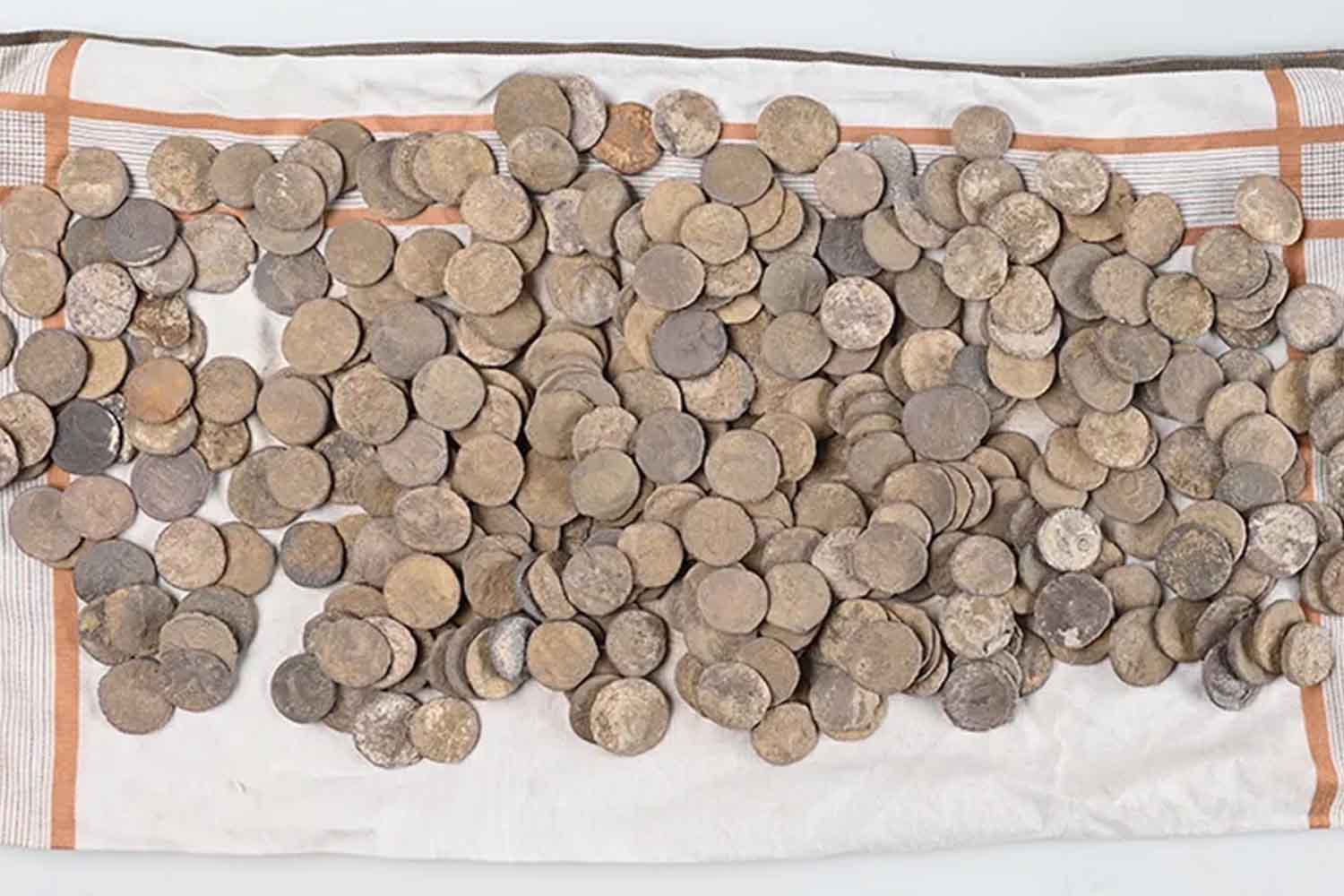
Near the small village of Borsum in the German district of Hildesheim, a Roman treasure of exceptional proportions: more than 450 silver coins, some bars of precious metal, a gold ring and even a very rare aureus. A surprising set in terms of quantity, variety and state of conservation. We are talking about a deposit hidden almost two thousand years ago, at the beginning of the Roman imperial era, one of the most impressive ever found in all of Lower Saxony.
It is not just a fascinating find: it is a window into the past that tells how the territories beyond the Roman limes were anything but isolated.
Archaeologists confirm: it is an intentionally hidden treasure
The story of the discovery begins in 2017, when a hunter without permission—driven by curiosity but not prudence—stumbled upon the first coins. A careless gesture that damages part of the context, a detail that for archeology is almost a scissors strike on the edge of history. But not all is lost: in 2025 an official investigation recovers what remains of the deposit, restoring order to the initial chaos.
The coins found are almost all denarii, the most widespread silver currency in the Roman Empire, used to pay soldiers, buy goods and pay taxes. In the middle of the pile, an aureus stands out, a refined and extremely rare gold coin, an emblem of wealth and rank.
Around the coins, ingots and small metal objects have also re-emerged which seem to come from a single “package of value”: not a random accumulation, but a set of carefully chosen and preserved goods. Why? There are many hypotheses on the table: a nest egg set aside by a Germanic warrior in the service of Rome, a tribute received, a loot, or an emergency deposit hidden in difficult times. Archaeologists do not rule anything out.
Roman money circulated far beyond the borders of the Empire
One thing is certain: Rome reached much further than its paved streets. Coins, objects and precious items crossed borders thanks to exchanges, tributes, military campaigns and relationships with Germanic tribes.
What we call today Roman treasure it could be the concrete trace of a direct contact, perhaps of a warrior enlisted as an auxiliary, or of more complex economic relationships than the history books suggest.
Across the Rhine, coins often changed their function: not only payment, but also ornament, symbol of prestige, and even ritual object in sacred deposits. A buried treasure could represent a personal reserve, a votive act or the hope of a return that never happened.
In Lower Saxony, anyone using a metal detector must comply with the law and obtain a permit. This is not useless bureaucracy: it is a form of protection, especially for delicate finds like this Roman treasure.
The searcher who first spotted it was unauthorized and unintentionally deleted crucial information. The prosecutor’s office closed the case due to expiration of the deadline, but the man followed a course to become a responsible detectorist. Today the material is guarded by state offices, which are managing its study and conservation. A way to ensure that data, objects and context remain together and readable in the future.
The work behind the scenes
The path of the coins does not end with the excavation. Now the more meticulous work begins: cleaning, cataloguing, studying. Under the lens of restorers, every detail can make the difference.
Corrosion removal occurs millimeter by millimeter. The inscriptions, the signs of wear, the tick symbols: everything can tell a piece of history. Numismatists then sort the coins by emperor and place of minting, building a chronology that will allow them to establish when, and perhaps even why, the treasure was buried.
Each coin weighs, tells, testifies. And together they form a fascinating puzzle that can reconstruct a fragment of the relations between Rome and the Germanic world. This finding demonstrates that history does not only belong in manuals, but also in the quietest places. Any field can hold timeless questions: who collected those coins? Whose hands did they pass through? Why were they never recovered?
The Roman treasure of Borsum also reminds us how every modern choice – such as reporting a discovery or protecting a site – can influence what we will know tomorrow. And it brings us, for an instant, closer to the person who buried all that money two millennia ago hoping that no one would find it. Or perhaps hoping to return.
