
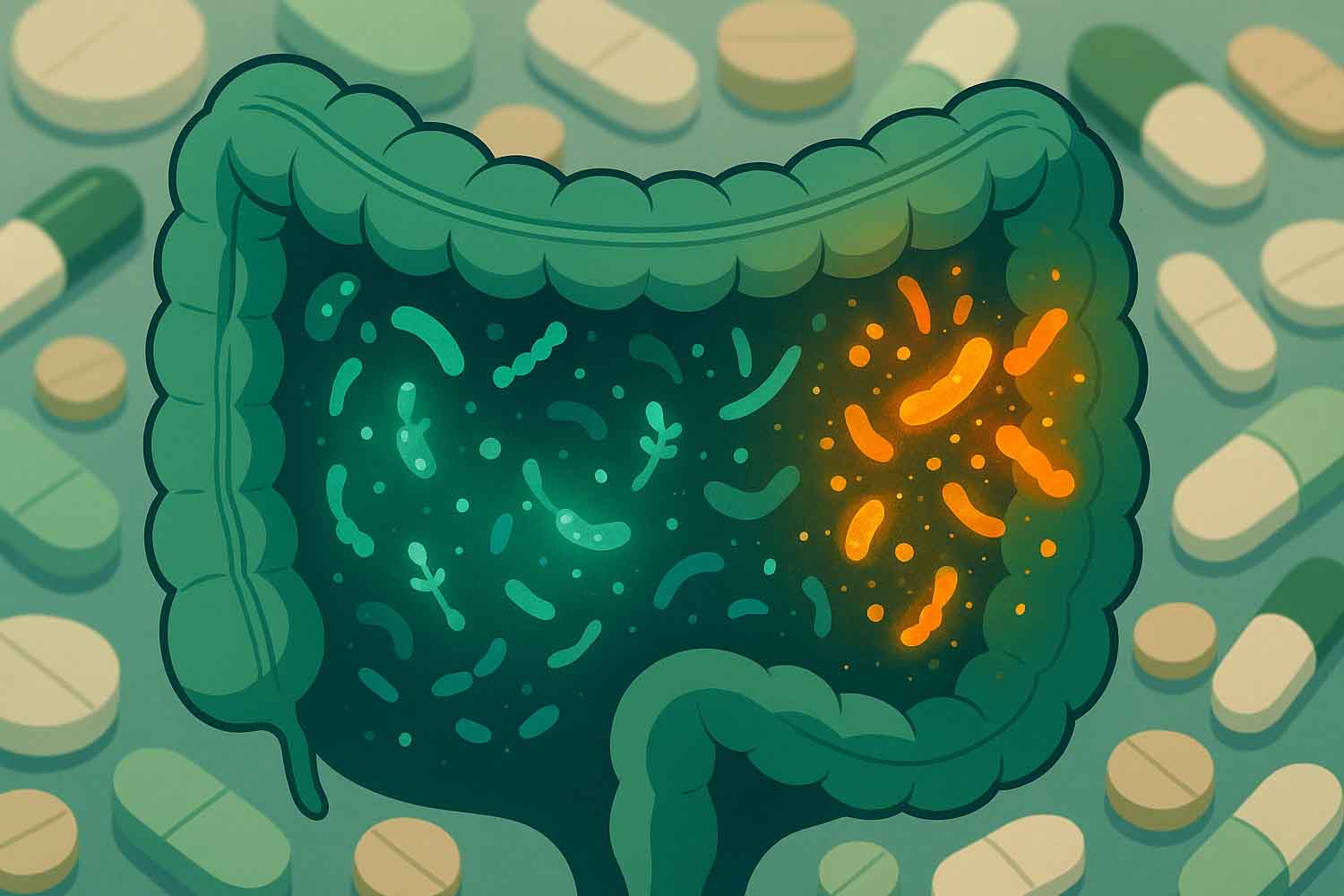
There is a truth that we often ignore: the intestine is not a simple corridor for food, but a metropolis teeming with life. Bacteria, enzymes, molecules: everything moves, communicates, collaborates. Until something, or someone, interrupts the harmony. And according to new research from Stanford University, that “someone” could be closer than we think: over 140 commonly used drugs are capable of turning this complex world upside down.
Scientists have observed a disturbing phenomenon: some medicines do not simply eliminate the bacteria we want to fight. They end up radically changing the rules of the game, leaving an abundance of nutrients in the intestine that were previously consumed by weaker species. At that point, the most resistant strains, often also the most aggressive, find free space to colonize, occupy space, multiply like a conquering army.
And it’s a short step from an unbalanced microbiome to a chronic inflammatory condition. An ideal terrain for cellular alterations and processes that can favor colorectal cancer.
An overturned ecosystem
The researchers tested 707 drugs, one at a time, on bacterial communities built in the laboratory from human fecal samples. It is as if they had observed the reaction of a small world to a sudden chemical bombardment. In more than 140 cases, the bacterial communities never recovered: a definitive imprint remained, a change that does not go back.
Among the most impactful medicines there are 51 antibiotics, as expected, some chemotherapy, various antifungals and even antipsychotics used to treat schizophrenia and bipolar disorder. The point is not to demonize medicine, of course. The point is to understand.
Because when a drug eliminates a microbial population, what is left behind is not a desert, but a buffet: sugars, amino acids, molecules that were previously divided among many. And this surplus attracts more robust bacteria, often those that love inflammation, those capable of producing substances such as colibactin, a toxin linked to DNA damage in colon cells.
In an emblematic case, scientists observed the effect of the antifungal bifonazole: in test tubes some species of Bacteroides they seemed resistant. But not in the real microbiome. Why? Because these species do not find the nutrient they need – the heme group – in their bodies and depend on other species to obtain it. And the drug eliminated precisely those. Result: i Bacteroides they “starved to death,” paving the way for more opportunistic species.
Such a profound imbalance leads to a domino that is difficult to stop: the intestinal mucosa weakens, toxins enter the tissues, inflammation becomes chronic. The ideal terrain for a tumor that in recent years is affecting more and more young people. In the United States, according to the American Cancer Society, diagnoses among ages 45 to 49 are increasing by 12% per year, and among ages 20 to 29 by 2.4%. A growth that cannot be ignored and shows a now frequent reality: no age is truly “too young”.
However, there is good news: this research could change the rules of medicine. Scholars imagine a future in which not only the drug will be evaluated, but also its social impact: what will it do to the microbiome? Who will survive? Who will disappear? What effect will it have on diet, probiotics, inflammation? The day when we choose a therapy taking into account the health of the intestinal ecosystem may not be so far away.
You might also be interested in:
