
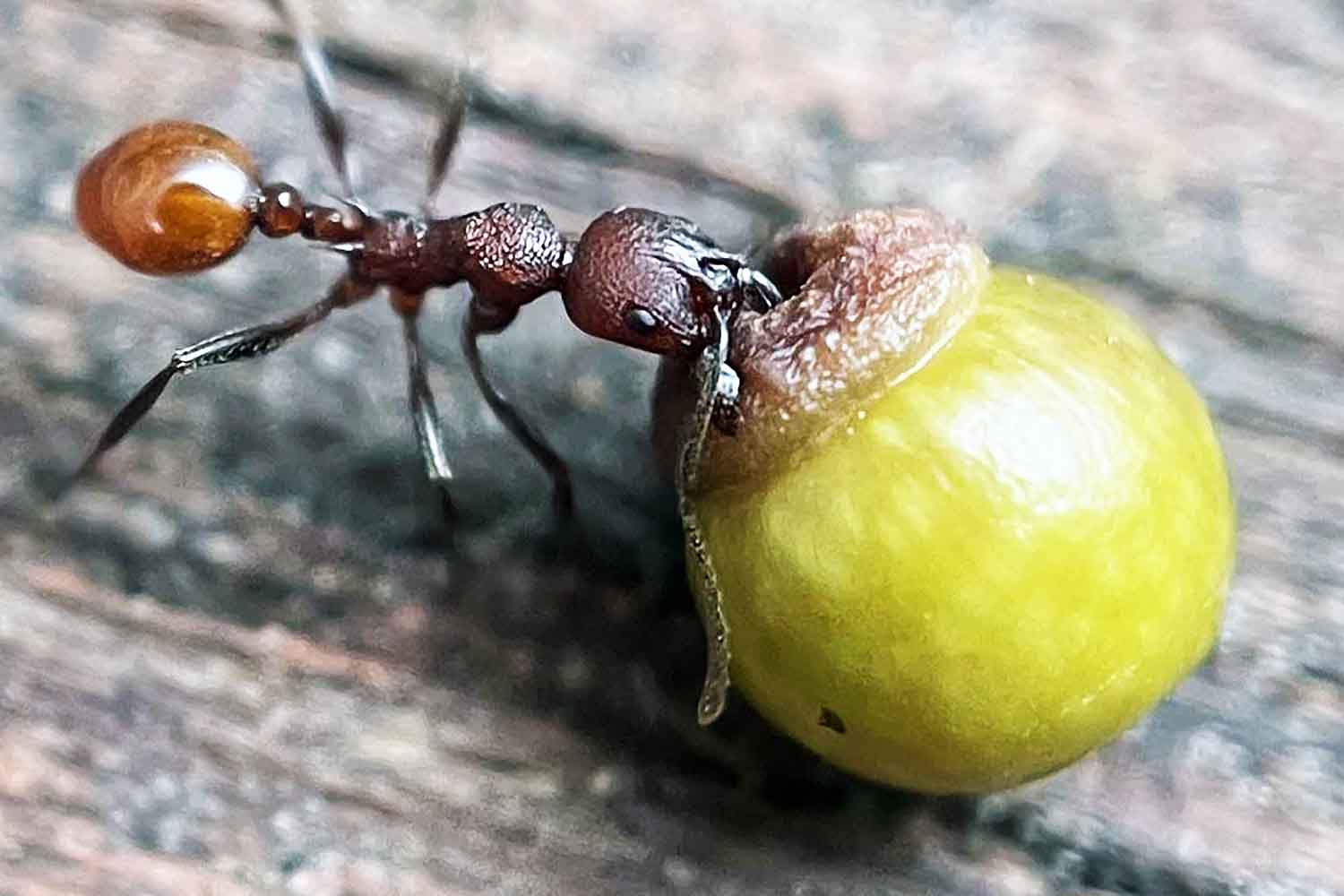
Walking in an oak forest at the end of summer means finding yourself surrounded by those small perfect spheres that dot the leaves: they are galls, tiny plant rooms built by the plant around the larva of a wasp. When the leaves fall, many galls end up on the ground and something happens there that, until yesterday, no one had ever connected to the world of wasps: the ants arrive.
These insects, already known for their ability to move lipid-rich seeds, treat some galls exactly as if they were “paying” seeds. They collect them, keep a small snack for themselves and leave the internal chamber where the larva develops intact. This is how a behavior considered obvious for over a century was transformed into a scientific discovery capable of rewriting an entire chapter of ecology. All starting from the curious eye of a child.
Eight-year-old Hugo Deans was playing in the garden when he noticed a pile of small balls near an anthill. To him they looked like seeds, because they imitated their appearance perfectly. His father, Andrew Deans, a professor of entomology at Penn State, immediately understood that they were oak galls. What he hadn’t guessed – not yet – was why the ants were collecting them.
Hugo asked him with the disarming naturalness of children who don’t know they’ve just poked their finger into an enormous question:
Why do the ants bring these pellets home if they are not seeds?
That question pushed the research team to go beyond simple observation. They understood that the gall was not collected “by mistake”. There was something else.
The gentle deception of kapéllo
The galls produced by two species of wasps, Kokkocynips rileyi And Kokkocynips deciduahave a sort of clear cap on the top. The researchers called it kapéllo, and by observing the ants in field tests they saw that they grasp that very cap, with the same care with which they grasp the elaiosome of seeds.
In the laboratory they verified that kapéllo contains the same fatty acids that attract ants to the seeds. They don’t just resemble each other in shape, but also in chemistry. For ants, which mainly follow odors, kapéllo speaks exactly the same language as seed. It is not surprising, then, that in the tests the ants dragged away galls and seeds with the same speed.
A transport that is not used to travel, but to survive
The surprising part is not just the deception, but the reason. A seed has every interest in being moved: the further it goes, the better. A young wasp, on the other hand, does not need to “go kilometres”, because once an adult it will fly on its own. What he gains is something else: protection.
An ant nest is one of the safest places in the woods. No bird gets there, few rodents risk slipping between stubborn mandibles, and many parasitoid wasps, the real nightmares of the larvae, are completely excluded. Furthermore, the nest environment is rich in antimicrobial substances produced by the ants themselves. In practice, the wasp has found a way to be adopted, at least for a period of growth, by an army of unaware guardians.
A hidden relationship that changes the map of the undergrowth
Galls, unlike seeds, can cover entire forest carpets. This means that the phenomenon could be much more widespread than we think. If ants follow the same molecules on any object that is rich in them, then any organism capable of producing the right signal could get carried away.
And this silent shift changes everything: where nutrients accumulate, where fungi and bacteria are concentrated, where small predators and parasites take refuge. An invisible network that shapes the life of the soil. Everything before our eyes. Yet, for decades, we have ignored it. Sometimes it takes the gaze of a child, closer to the ground than to concepts, to notice what adults have stopped seeing.
You might also be interested in:
