
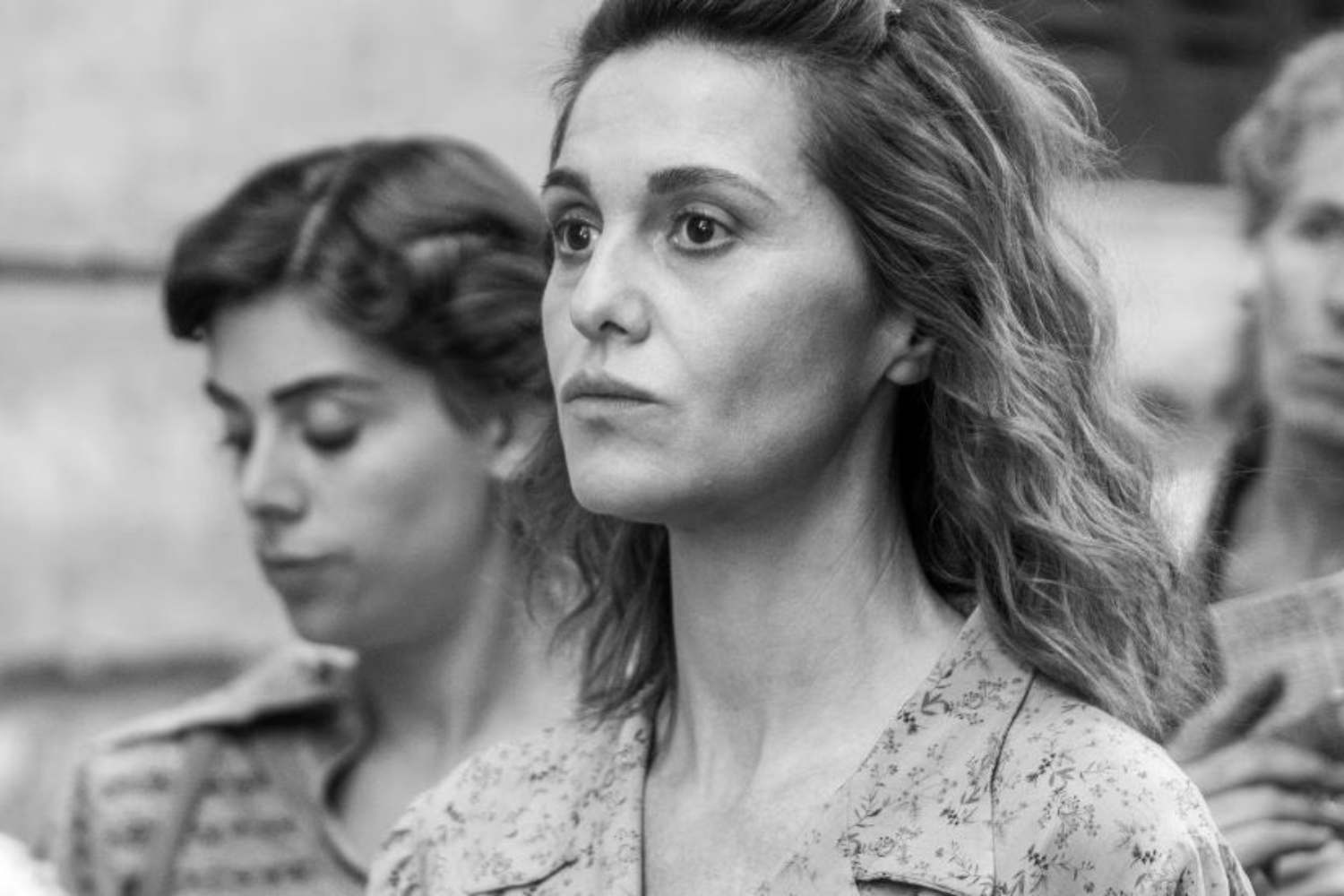
There is a film that has become a manifesto against gender violence: “There’s Still Tomorrow”, the first film directed by the talented Paola Cortellesi which achieved international success. And it’s worth seeing and seeing again on November 25th. In fact, on the occasion of the International Day for the Elimination of Violence against Women, Rai 1 will broadcast “There’s Still Tomorrow” in prime time.
The work, which grossed 49 million dollars worldwide, won between 4 David di Donatello and 3 Nastri d’Argento, but also the Audience Award at the Rome Film Festival, a sign that its strength goes beyond criticism. And it also recently won the title of best foreign film at the Golden Rooster Awards in China, a historic achievement for Italian cinema. These goals are not accidental: the 2023 film managed to build a universal dialogue, which transcends national borders, demonstrating that gender violence affects us all.
A story of daily and systematic violence
Set in post-war Rome, “There’s Still Tomorrow” tells the story of Delia, a woman who, in an era marked by wars and in a daily life full of constant humiliation, finds the strength to rebuild herself and her life. Delia devotedly takes care of her husband Ivano (played by Valeria Mastandrea) and their three children, looks after her sick father-in-law and does her best every day to earn some extra money. She mends and washes linen, fixes umbrellas, gives home injections, but all this earns her less compensation than she would receive if she were a man. Despite her dedication, her social condition reduces her to a silent cog in the family wheel, incapable of expressing her opinion without being scolded or, worse, beaten. Ivano is often irascible and overbearing, but his wife is inclined to justify him (“Eh, he fought in two wars”, “He’s like that”).
Delia’s is a story of emancipation, but not in the conventional sense. She is not a woman waiting for salvation, but a mother struggling to build, piece by piece, a different future for herself and her daughter. Hers is a silent, at times imperceptible, struggle against a world where women are silenced or crushed by men.
The film immediately stands out for its stylistic approach: black and white, a visual language that often refers to an idealized past, here becomes a means of rendering the darkness of the human condition and the light of hope, in a subtle balance that amplifies its emotional power. Cortellesi’s choice to shoot in this format is not only aesthetic, but a symbolic act: the absence of color speaks of the fatigue and scars of the past, but also of the possibility of seeing beyond, of imagining the future.
Paola Cortellesi chooses not to show the physical violence directly, but to make it visible through the eyes of her children, who helplessly observe this spiral of degradation and humiliation. The director emphasizes this anguish with music and dance, a narrative device that allows her to suggest, without ever being too explicit, the intensity of suffering. “It seemed more effective to use songs and dance to underline them” as the artist said.
A hymn to redemption through small and large freedoms
The film is not only a chronicle of violence and suffering, but also a story of redemption, of small gestures which, despite everything, suggest a possibility of hope. Delia finds brief moments of lightheartedness with her friend Marisa, a woman who has a stall at the market and with whom, every now and then, she can share a cigarette and a coffee with lots of sugar. There is also Nino, the mechanic from her town, who loves her and represents a love from the past that has never been forgotten, and an American soldier who offers her concrete help, but who also represents a possibility of escape from her family imprisonment.
However, it is the eldest daughter, Marcella, who represents the key to change. The young woman grows up in an environment marked by violence, yet her attitude towards her mother is complex: she begins to perceive her mother as guilty of her own condition, accusing her of not rebelling against the unsustainable situation. Delia’s engagement to the son of the owner of the town bar becomes a sort of redemption for Delia, a sign that things could improve, that her life and that of her daughter could be different. Delia decides to secretly buy a wedding dress for Marcella, saving the little savings she manages to earn. The mother, although immersed in her misery, makes the sacrifice of giving her daughter a chance that she herself never had. This silent gesture becomes the emblem of his struggle: a dream of redemption, an act of love that wants to overcome violence and humiliation.
Another central element of the film is a mysterious letter that accompanies Delia along her journey. At the beginning of the story, Delia meets Nino, an old suitor who asks her to run away with him, offering her a way out of her imprisonment. Just at that moment a letter comes into his hands, the contents of which are never shown, but which are clearly a symbol of possibility, of hope. Delia keeps it carefully hidden, reads it often, holds it close to her chest, then sometimes throws it on the ground, as if it were a love letter that she doesn’t know whether to accept or throw away. The letter becomes a sign of another world, of a possibility of escape, of a path to freedom that the protagonist is unable to grasp, but which she continues to carry with her, like a promise of the future.
The final scene, very powerful and unexpected, offers us a snapshot of the great mobilization of women who exercised their right to vote for the first time in 1946. Delia therefore becomes a symbol of collective redemption, of a battle won.
