
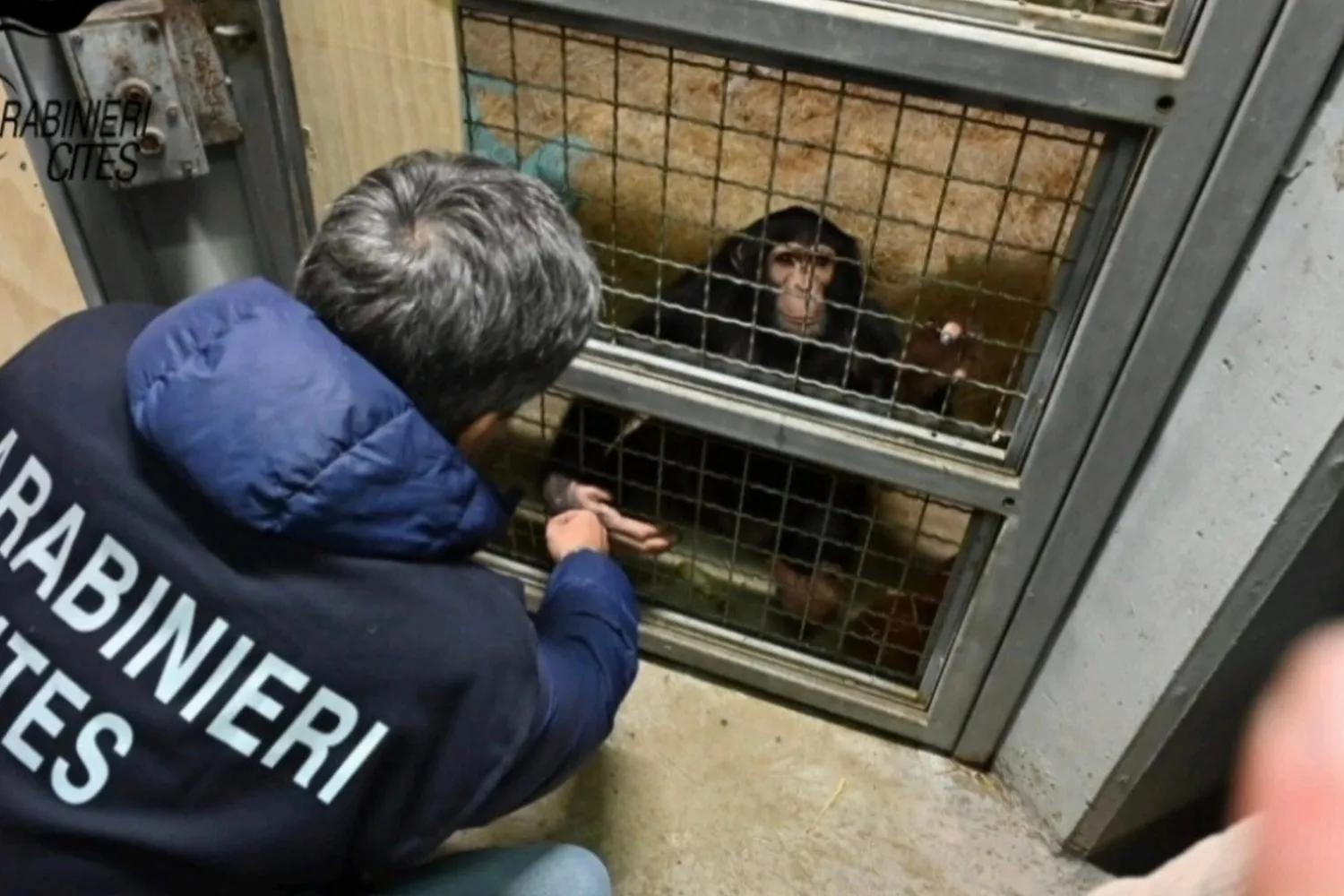
The Carabinieri of the Cites Unit of Catania have brought to light a dramatic situation in a house in Cassibile, in the Syracuse area, where a man of Maltese origin kept a chimpanzee in highly problematic conditions. The animal, a specimen of Pan troglodytes approximately three and a half years old, belongs to a species at high risk of extinction and considered dangerous to public health.
The little primate was immobilized with a chain of about two meters which had caused a clear and painful wound, indicative of a detention incompatible with any ethological requirement. According to what has been ascertained, the animal had been brought from Malta through the channels of the clandestine market, confirming an illicit trafficking which still affects the most vulnerable species today. The military, together with the veterinarians of the ASP of Syracuse, proceeded with the seizure for mistreatment and illicit detention.
The animal transferred to the Bioparco of Rome
Immediately after the operation, the chimpanzee was transferred to the Veterinary Hospital of the University of Messina, where he received the first treatments necessary to stabilize the physical conditions compromised by the chain. His condition highlighted how the constraint had influenced his behavior, pushing him towards unnatural attitudes due to stress and lack of freedom.
Subsequently, thanks to the collaboration of the Operations Department of the Carabinieri Cites Group of Rome, the animal was moved to the Bioparco of Rome, one of the few structures authorized for the detention and recovery of such delicate species. Here he will be followed by a team made up of ethologists and experts, with the aim of building a path that will allow him, in the future, to fit into a group of animals of the same species.
A scenario that we all hope for, in the hope that he will not be forced to move from life in chains to life in a cage. Unfortunately, however, these specimens have a genetic makeup that is very close to that of human beings and are often bred to make them adopt unnatural behaviors. For this reason, it will be difficult for the chimpanzee to readjust to living in freedom in their natural environment away from captivity.
An Eclectus parrot was also found
To make the scenario that the authorities found themselves faced with even more chilling is the fact that during the search of the house the presence of an Eclectus parrot also emerged (Eclectus roratus), without the mandatory Cites documentation. A further sign of the many, too many animals coming from illegal circuits and kept without any competence or authorization.
You might also be interested in:
