
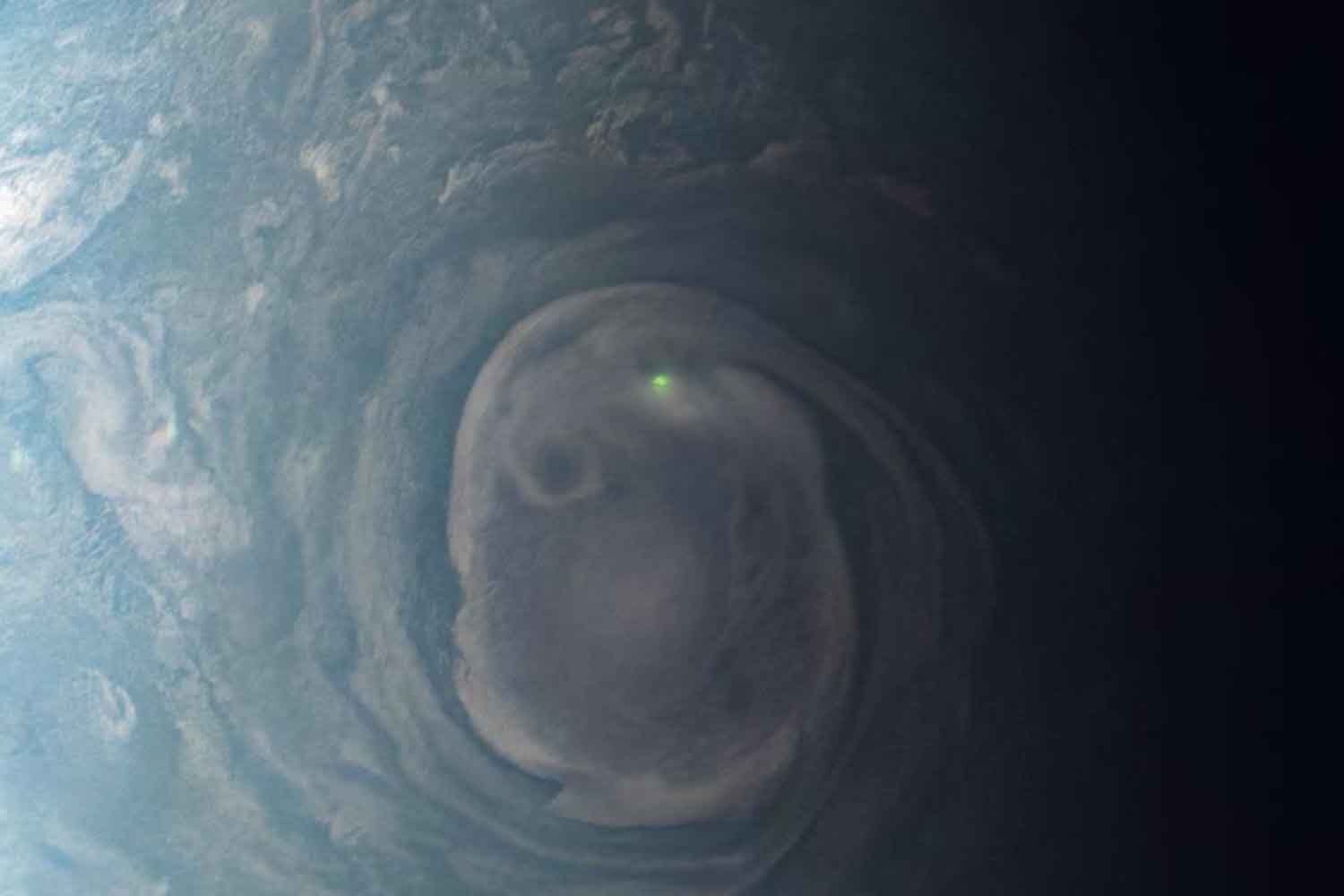
Sometimes Space seems to enjoy surprising us. This time he did it with a green glowa sudden spark that passed through the clouds of Jupiter with the same speed as a shiver. The Juno probe, which has been circling the planet since 2016, managed to immortalize it almost on the fly. A tiny image, yet so powerful that it immediately awakens questions, hypotheses and that sense of wonder that never completely goes to sleep.
NASA confirmed that the shot is authentic: no tricks, no narrative devices. After years of patient observation, Juno recorded a greenish bright spot near the gas giant’s north pole. It was he who gave shape to the image Kevin M. Gillwhich processed the raw data to make it visible to the human eye. He is one of those “science craftsmen” who, with patience and competence, manage to transform numbers and pixels into cosmic stories.
What we know so far about the mysterious green glow
The most immediate explanation refers to jovian lightningphenomena that have nothing in common with those we see on Earth. On Jupiter they are more intense, they are born in an atmosphere dominated by water and ammonia and they move in an environment so unstable that it seems alive. The green could come from the composition of the gases, or from a play of light generated by an atmosphere that has nothing of our predictability. Or, as often happens in deep space, we are faced with something that science has yet to learn to decipher.
The question, however, arises spontaneously: why now? Was it a coincidence? A very rare event? Or has that glow always existed and eluded us for years, running too fast to be caught? Juno will continue to observe it, and each new passage could bring us an additional piece. The research excludes nothing, and this is what makes the discovery so fascinating. It is proof that, even when we think we know the dance of the gas giants, a flash is enough to remind us how fragile our presumption of certainty is.
Every time NASA announces something new, the temptation is the same: to get involved, to ask if it will affect us in some way. In this case, there is no direct effect for the Earth. No risk, no threat. But there’s something more interesting: the green flash reminds us that the nature of the outer planets is more alive and complex than we imagine.
It’s not just science. It is a small emotional shock, a gentle invitation to remind us that the sky is not a ceiling, but an open window. Juno will continue its journey and perhaps, between one orbit and another, it will give us another flash, another light capable of making us stop for an instant. And in that instant, make us feel part of something immensely bigger.
