

Forget the usual crowded Christmas markets and stereotyped postcards. Winter Germany hides destinations capable of offering beautiful experiences, far from mass tourist circuits. From the Bavarian Alps to the Baltic Sea, passing through perfectly preserved medieval villages and spa towns shrouded in snow, the country offers surprising alternatives for those looking for a different trip.
This year the German National Tourist Board is offering seven holiday ideas that combine tradition and discovery, designed for those who want to immerse themselves in the true German atmosphere. Whether sampling gastronomic specialties in an Alpine village, relaxing in historic spas or exploring snowy landscapes where nature still dictates the rules, these destinations promise an unforgettable winter.
Mittenwald: between Alpine legends and designer violins
Nestled in the Bavarian Alps, Mittenwald presents itself as the classic Bavarian mountain village that seems straight out of a fairy tale. The colorful houses with sloping roofs, the snow-capped mountains that close the horizon, the cobbled streets where the sleigh bells still ring: here winter keeps its traditional charm intact.
The famous Bolzano Market, active since the 15th century, represents one of the most authentic Christmas events in Bavaria. No mega-attractions or out-of-scale rides: just wooden stalls where local artisans sell handmade products, from painted pottery to carved wooden toys. The atmosphere is the genuine one of the markets of the past, where you stop to chat in front of a glass of steaming Glühwein and taste the local specialities.
But Mittenwald holds a secret that few know: it is the German capital of violin making. The Luteria Museum recounts this centuries-old tradition, showing how the violins that made the history of European music were born. You will be able to see the ancient instruments, discover the woodworking techniques and, if you are lucky, witness the work of the master luthiers live in their workshops in the historic center. A unique experience for classical music enthusiasts.
During the Christmas period, the Mittenwald market offers typical Bavarian gastronomic products: mountain cheeses, mountain honey, artisanal jams, spicy desserts according to recipes handed down for generations. Among the stalls you can also find Christmas decorations in carved wood and nativity scenes made by local artisans, perfect as authentic souvenirs to take home.
Lüneburg: the charm of the spa
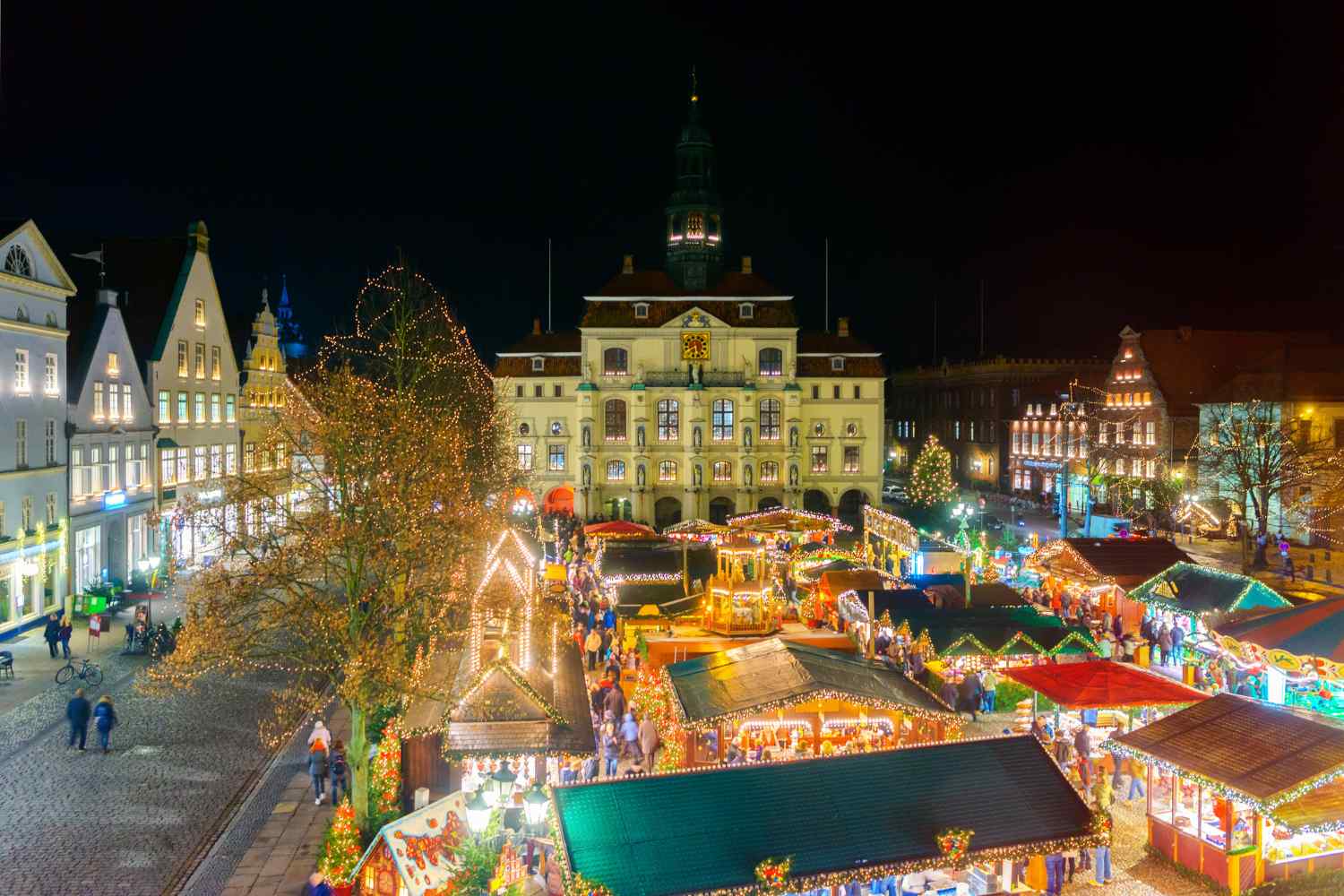
Located in Lower Saxony, Lüneburg is one of those German cities that have survived the centuries while maintaining their medieval appearance intact. Walking in its historic center means taking a step back in time, among colorful half-timbered houses, cobbled alleys and squares overlooked by patrician buildings that tell of the commercial wealth of the Hanseatic past.
The curious pot-bellied facade of one of the historic buildings has become the symbol of the city. This palace with sloping walls bears witness to the subsidence caused by underground salt mines, but rather than being demolished it has been preserved as a monument of local architecture. An oddity that captivates photographers and tells the particular story of this city founded on the “white gold” trade.
The medieval historic center can be easily visited on foot. You can visit the Church of San Nicola with its magnificent Gothic altar, get lost among the artisan shops selling hand-painted ceramics and local products, stop in the historic cafés to taste traditional cakes accompanied by a spiced coffee. During the Christmas period, the city market remains small in size but for this reason it is more welcoming and less chaotic than large tourist events.
Lunemburg salt spa
The real surprise of Lüneburg turns out to be underground. The saline spas exploit the salt water springs that made the city rich in the Middle Ages. Immersing yourself in the hot tubs while it’s snowing outside is a regenerating experience, perfect after a day spent exploring the city. The thermal waters have beneficial properties for the skin and respiratory tract, and the wellness center also offers saunas, massages and relaxing treatments.
For lovers of unusual experiences, Lüneburg offers a visit to Calcostetro, a hidden treasure that extends for 1,800 kilometers of underground tunnels. This ancient chalk mine houses spectacular mineral formations, crystals that shine in the light of lamps and highly evocative underground environments. Guided tours allow you to discover this hidden world in complete safety, with stories that intertwine geology and local history.
Freudenberg
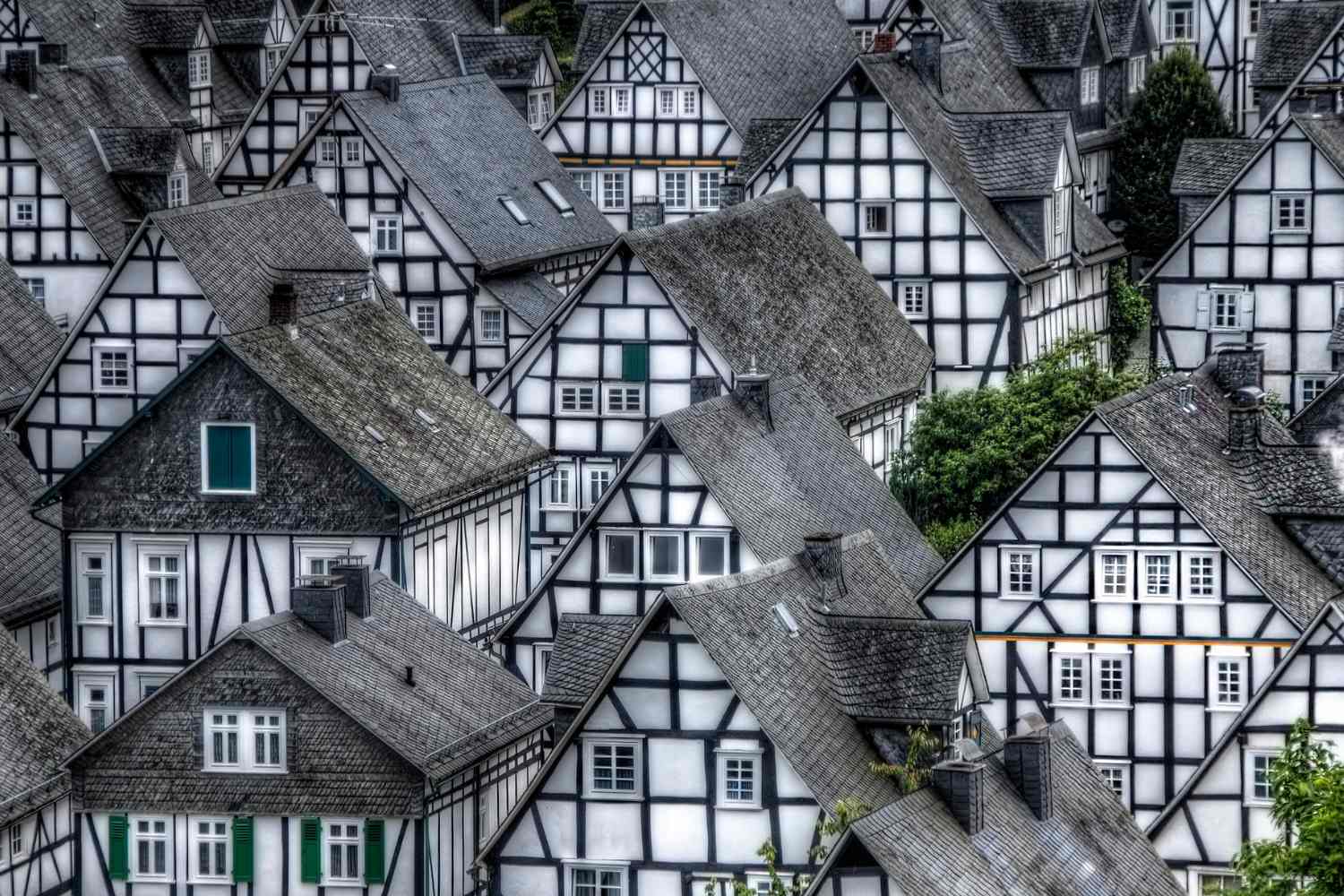
North Rhine-Westphalia hides a village that seems to be the materialization of a Germanic urban archetype. Freudenberg climbs the hillsides arranging its homes according to a vertical choreography that transforms the settlement into scenographic architecture. The half-timbered houses, all rigorously painted in black and white, create an alienating perceptive effect, as if someone had designed the village following aesthetic criteria of geometric perfection.
This chromatic homogeneity does not arise from recent tourist ambitions. Instead, it represents a historical collective choice, an expression of a community aesthetic that favored overall harmony over individualistic singularity. Walking among these perfectly aligned buildings means experiencing an urban dimension where the suggestive contrast between opposite colors generates a suspended, almost dreamy atmosphere, particularly intensified when the snow frames the edges and softens the contours.
The historic center preserves centuries-old architectural stratifications. The half-timbered buildings bear witness to construction techniques that spanned the Middle Ages and the Renaissance without substantial modifications, demonstrating how sometimes technological evolution does not necessarily imply obsolescence of previous solutions. The exposed wooden structure is not an ornament but an intelligent static system, where each beam and each upright performs precise structural functions.
Visiting the Freudenberg Christmas market means entering an almost fairy-tale atmosphere, a term which here recovers its original meaning, both disturbing and wonderful. The atmosphere created by the soft lighting, by the spicy scents that rise from the stalls, by the snow that muffles every noise, generates a total sensorial dimension, an involvement that transcends the mere visual experience to become complete synaesthetic immersion.
The forgotten peninsula: Fischland-Darß-Zingst and the Baltic winter
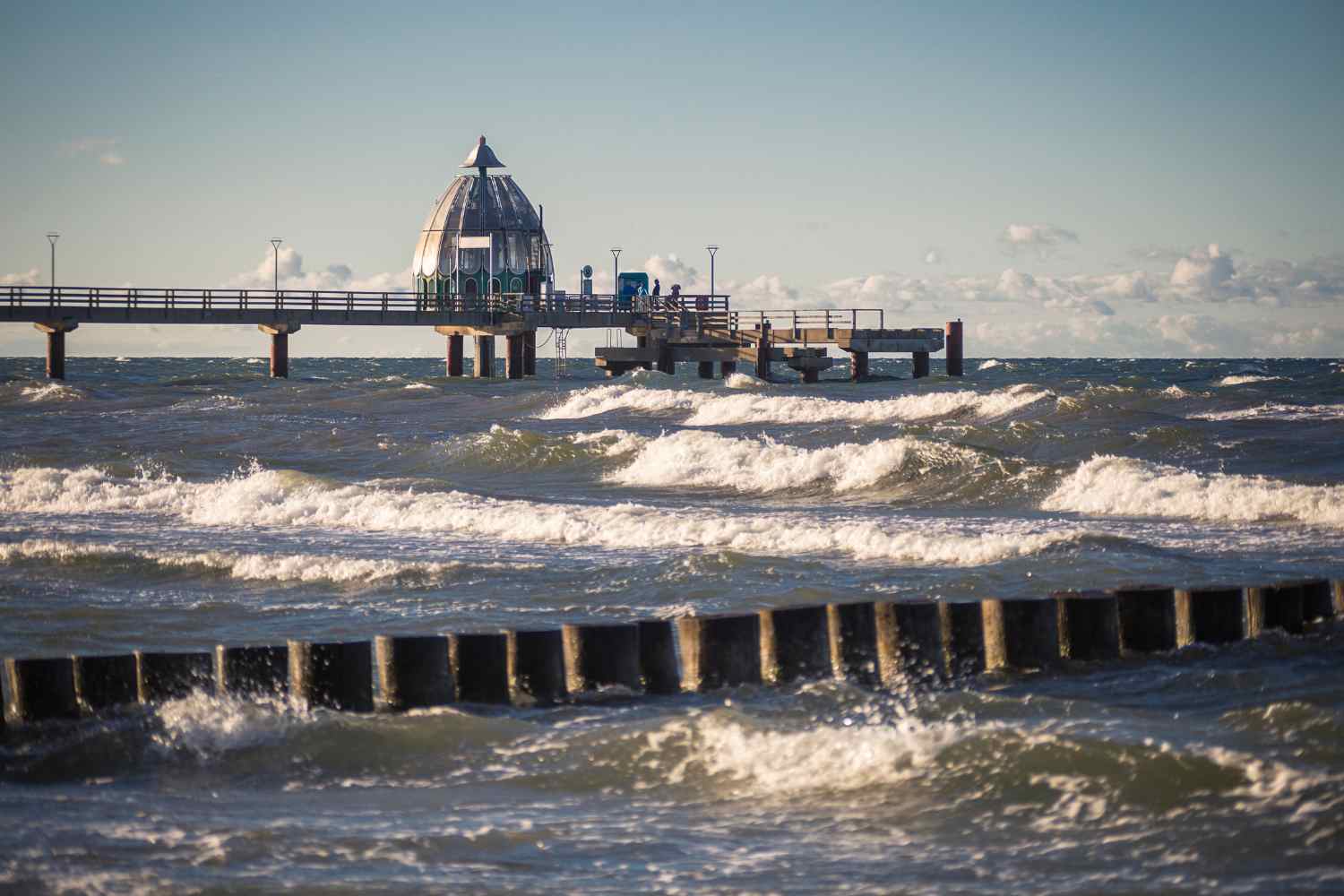
The Baltic coast of Mecklenburg-Vorpommern holds a strip of land that juts out into the northern waters like an accusing finger or abandoned arm. During the winter, when seaside tourism retreats completely, this peninsula reveals its authentic nature: a radical landscape where wind, sand, brackish water continually negotiate territorial boundaries.
The walk along the beaches takes on a meditative, almost penitential character. The icy air that hits your face, the leaden waves that crash onto the shore, the sand hardened by the frost that creaks under your boots create a sensorial experience of elementary purification. Here nature manifests itself stripped of any aesthetic satisfaction, in its essential brutality, and precisely this absence of tourist mediation allows an authentic encounter with forces that precede and transcend the human.
The National Park is home to fragile ecosystems where life persists despite seemingly prohibitive conditions. The coastal forests of beech and oak trees twisted by the sea wind, the lagoons where thousands of aquatic birds stop during their migratory routes, the shifting dunes that change profile with every storm make up a landscape mosaic of extraordinary biological diversity.
Winter sports here take on peculiar variations. Kitesurfing on the frozen surface of the lagoons transforms athletes into abstract figures who slide on the border between solid and liquid, between sky and earth, practicing a dance that challenges gravity and temperature. Observing these evolutions means witnessing a contemporary form of daily heroism, where humans measure their tenacity against indifferent elements.
A mountain sanctuary: the Harz and its stratifications
The Harz massif stands in the geographical soul of Germany as the remnant of ancient geological folds, mountains worn down by eras of erosion that have smoothed out once Alpine peaks, transforming them into soft, wooded reliefs, crossed by crystalline streams. During winter, this region transforms into a sanctuary of silence, where the snow muffles every noise and the fog erases the contours, generating a landscape of pure abstraction.
The hiking trails pass through coniferous forests laden with snow, where the fir trees take on sculptural shapes, vegetal architectures that the storm has modeled according to casual yet perfect geometries. Walking in this almost religious silence means practicing a form of secular contemplation, an experience where the body in movement becomes an instrument of non-intellectual but visceral knowledge of the landscape.
The legends of witches and arcane presences
The Brocken, the highest peak of the massif, retains a mythical dimension that Enlightenment rationality has not completely managed to dissolve. Here, according to tenacious legends, witches gathered during Walpurgis Night, and even today the collective imagination associates this mountain with arcane presences, with forces that precede and exceed the cultural order. Climbing to the top during winter, when the condensed fog generates the Brocken spectrum – that optical phenomenon where the observer’s shadow is projected enlarged onto the surrounding clouds – means crossing that thin threshold that separates physical perception from visionary experience.
The mining villages nestled among the valleys bear witness to a thousand-year-old mining history. Silver, copper and lead were extracted here, fueling the princely economies and European wars. Today these abandoned mines constitute industrial heritage, testimony to how humans have penetrated mountain bowels in search of metallic riches, transforming the landscape into a palimpsest of work and survival.
These seven itineraries – each fragment of a plural Germany, irreducible to unifying stereotypes – make up an archipelago of experiential possibilities that transcend the consumerist concept of holiday. Visiting these places during the winter means accepting a challenge: that of abandoning the air-conditioned security of tourist modernity to expose yourself to a more authentic comparison with landscapes that do not mediate their own harshness, with traditions that do not bend to the expectations of the external spectator, with communities that maintain rhythms and values different from the dominant metropolitan ones.
The German winter, from this perspective, ceases to be a season to be endured to become a privileged condition of experience. The cold that bites the skin, the snow that slows down every movement, the darkness that anticipates and prolongs the nights do not constitute inconveniences but constitutive elements of a dimension of the journey where discomfort itself becomes a cognitive tool, where exposure to natural elements reminds the body of its own vulnerability, of its belonging to biological cycles broader than individual will.
These places do not promise comfort or pre-packaged entertainment. Instead, they offer the possibility of authentic encounters: with landscapes that retain a wild dimension, with communities that maintain long memories, with artisanal traditions where the human hand still leaves a personal trace on the objects produced. In an era where the tourist experience tends towards global standardization, towards the serial reproduction of indistinguishable environments and services, these fragments of alternative Germany represent precious resistances, pockets of otherness that remind us how travel can still take the form of a transformative practice rather than the mere consumption of images and sensations.
