
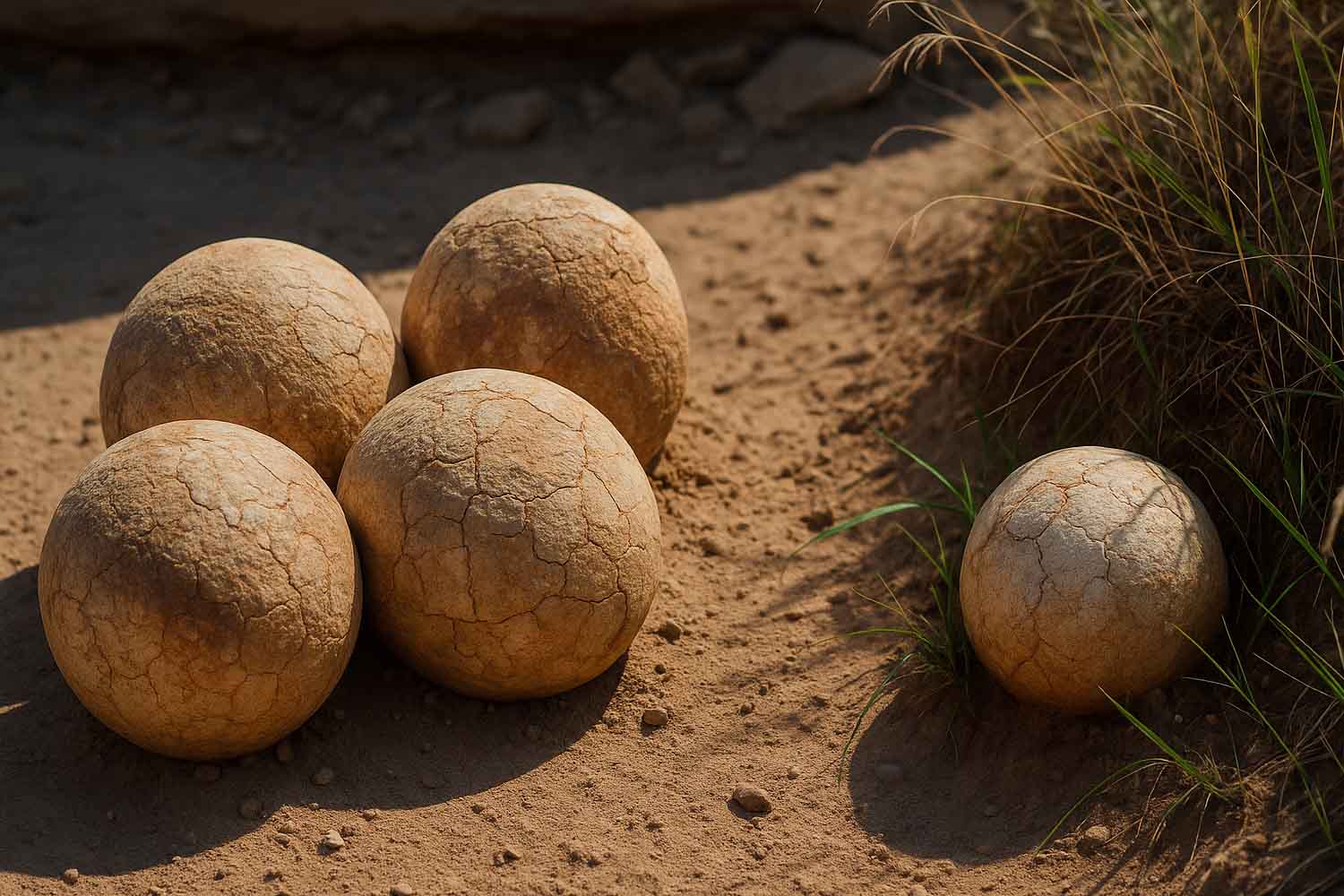
It rarely happens, in scientific research, that a material considered for years a simple peripheral detail suddenly transforms into an absolute protagonist. This is what is happening with i dinosaur egg shellsnow at the center of a dating technique that promises to change modern paleontology.
An international group of researchers has presented a technique capable of attributing a precise age to fossils thanks to dinosaur egg shells fossilized, transforming what until now was only a fragment of prehistoric life into a true geological archive. The study, published on Communications Earth & Environmentopens a new perspective on a problem that has held scientists back for decades: the difficulty of establishing when, exactly, certain species inhabited the Earth.
To understand the significance of the step forward, just think of how many fossil sites in the world do not have volcanic layers useful for traditional dating. In those cases, scholars were forced to work “blindly”, limiting themselves to imprecise estimates. With this method, however, the chronology of the lost eras finally becomes clearer.
Why dinosaur eggshells work like a geological clock
The team led by Ryan Tucker, from Stellenbosch University, exploited the combination of the uranium-lead (U-Pb) technique and high-resolution elemental mapping. The shells, composed of calcite, conserve very small quantities of uranium and lead which, over time, transform following constant and measurable rhythms. It is this transformation that functions as a true geological clock, capable of indicating the moment in which the egg was buried and, consequently, the antiquity of the site.
For paleontologists it is a concrete revolution. It is no longer necessary to hope to find minerals such as zirconium or apatite – elements often absent in sedimentary soils – because the shell itself provides the measure of time. And the results are even more stable than those obtained from dating volcanic ash: tests conducted on samples from Utah and the Gobi Desert recorded a five percent higher accuracy.
Precisely in Mongolia, thanks to this methodology, it was possible for the first time to attribute a direct and reliable age – approximately 75 million years – to an area rich in fossilized nests and eggs. A fact that reorganizes the time frame of many species that populated that region.
The versatility of calcite and the impact for evolutionary studies
Tucker called egg calcite “extraordinarily versatile,” noting how it allows time to be told in places where classical techniques don’t work. The value of this approach is not limited to precision: it also allows us to reconstruct, with continuity and reliability, entire passages of the evolutionary history of dinosaurs, filling those temporal gaps that for years have hindered the understanding of their origins, their migrations and their local extinctions.
Lindsay Zanno, of North Carolina State University, explained it in simple but incisive words: for paleontologists, being able to directly date fossils has always been a dream. A dream that now becomes reality, and which will allow us to tackle mysteries that have remained unsolved for generations.
Imagining that a simple fossilized shell, often treated as a marginal detail, can rewrite entire chronologies is fascinating. Today those fragments speak again, telling not only how life unfolded, but also when that life appeared. And, thanks to this new look, the past of the dinosaurs appears a little less distant.
New findings that broaden the evolutionary picture
Their importance also becomes crucial because, right now, scientists have found a way to read the past thanks to dinosaur egg shells with a precision never achieved before. And the new findings that are emerging around the world make it even more evident how much this revolution was long awaited. In China, for example, a nest of extraordinarily preserved eggs is pushing paleontologists to review many certainties that seemed consolidated by now. Not only did the eggs remain intact after two hundred million years, but three adult skeletons of a previously unknown species, Qianlong shouhu, were also found next to them: a familiar picture that tells of much more complex social dynamics than imagined so far.
From the soft Qianlong shouhu eggs to the secrets of growth
The most surprising detail concerns the nature of the eggs themselves: not rigid, calcified shells like those we associate with the most advanced dinosaurs, but leathery, robust and slightly flexible membranes. A characteristic that brings the Qianlong shouhu closer to modern reptiles and even mammals such as the platypus. The exceptional preservation of the shells has allowed us to study internal microstructures that confirm the existence of two distinct layers – mammillary and continuous – a combination that recalls the eggs of much later dinosaurs.
The exception doesn’t end there. Embryos show different body proportions from adults: more pronounced forelimbs, elongated skulls, probably quadrupedal movements at birth, with a transition to a bipedal posture only in mature age. A radical transformation, which recounts a growth that is anything but linear and reveals a biological plasticity that experts had not yet identified so clearly.
Five distinct groups of nests emerged around the eggs, clustered in a narrow radius and in close correlation with the adult skeletons. The evidence suggests collective behavior: a shared nesting area, perhaps a very early form of group protection. There is no definitive confirmation yet, but the arrangement of the remains paints a picture of cooperation that anticipates behaviors observed in much more recent dinosaurs. It is precisely in these nuances that paleontology is changing pace: what until yesterday seemed the result of hypotheses is now slowly transforming into an increasingly documented story.
From China to Spain, a global mosaic of discoveries
Thousands of kilometers away, in the Spanish province of Guadalajara, another discovery is capturing the attention of the global scientific community. Four titanosaur eggs, preserved with near-perfect integrity, are offering new insights into the reproductive strategies of the last Cretaceous giants. The reddish color of the shells, the surprisingly intact microstructure and the presence of two types of ootaxa in the same stratigraphic level paint a very rare scene: different species nesting in the same place, perhaps at the same time. A precious photograph of the last million years before extinction.
Microstructures that tell of a lost world
The studies conducted by the MUPA revealed very clear microscopic differences between the categories of eggs found: different thicknesses, more or less pronounced ornamentations, variable porosity. Elements that not only distinguish one taxon from another, but also speak of environmental adaptations, evolutionary strategies and ecological pressures of time. In this scenario full of complexity, the possibility of directly dating i dinosaur egg shells with the U-Pb technique it comes as the last missing piece. Transform these findings from splendid museum exhibits into instruments capable of measuring time with scientific reliability.
Looking at these eggs means observing the exact point where life was preparing to emerge. And learning to read their shells as geological archives today allows us to unite what was fragmented until now: social behaviors, bodily transformations, migrations, habitat cloning. It is the demonstration that every new method capable of extracting time from matter can change the way we imagine evolution itself.
