
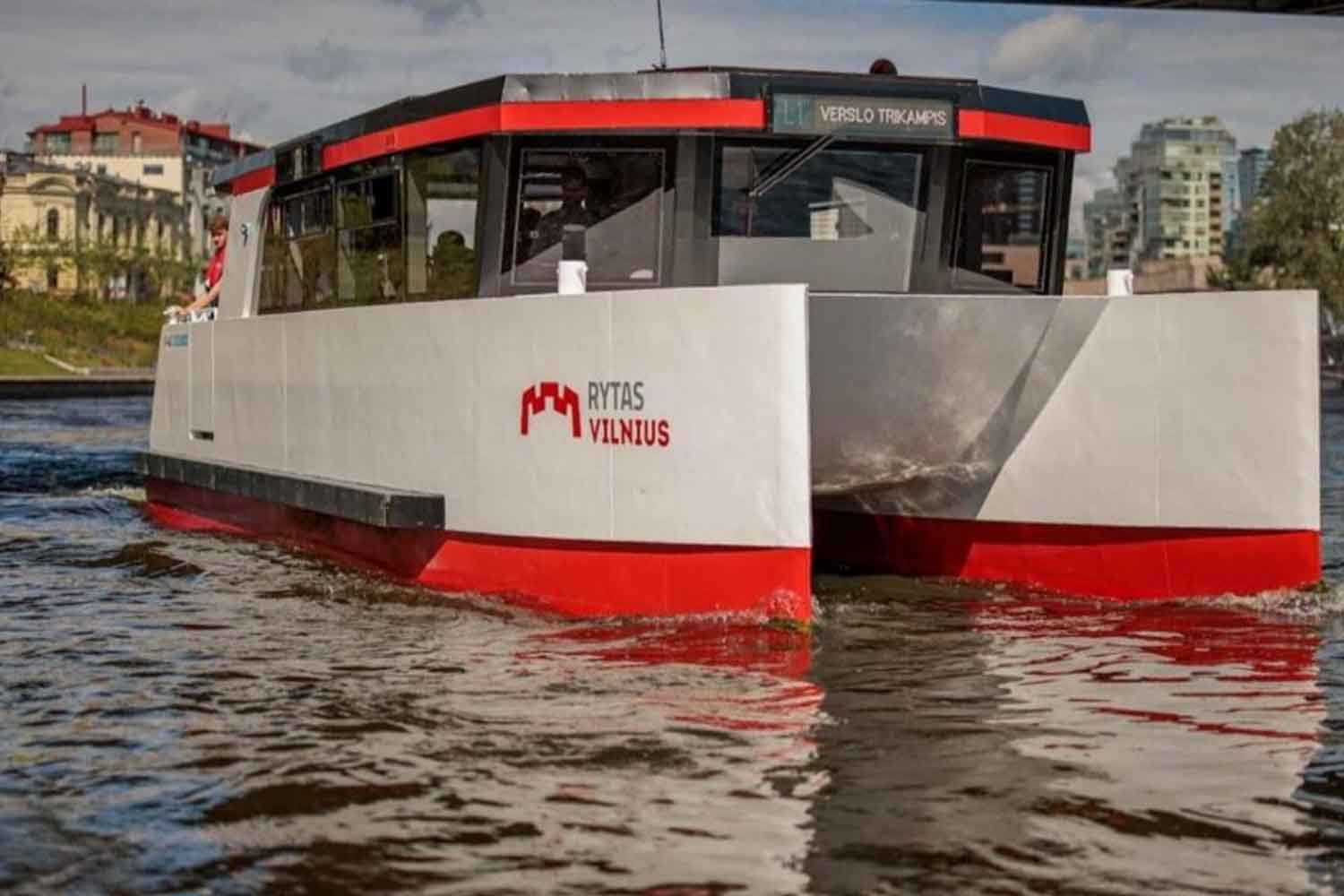
In Vilnius, the capital of Lithuania, you travel on water in a silent, sustainable and… almost poetic way. Lašiša, a fully electric ferry, powered largely by solar panels, designed to connect the city’s neighborhoods along the Neris River, has just come into operation. It is the new face of urban mobility: zero emissions, accessible tickets and a route that passes through the most beautiful and symbolic places in the city.
A concrete initiative that is part of the environmental plan with which Vilnius was named Green Capital of Europe 2025. No distant promise, but a project completed in just seven months, and already active.
Few places, no noise and free Wi-Fi
Thirty-two seats, moderate speed and a compact design designed to consume the bare minimum: the ferry does not “float”, but literally cuts through the water, saving energy on each route. 80% of the surface is covered with solar panels, which power the electric motor. There’s also free Wi-Fi on board, for those who want to stay connected even while crossing the city on the water.
The ticket costs 3 euros if purchased online or via app, or 4 euros directly on board. The route connects the residential areas with the commercial ones, also stopping near the main historical and cultural places of the city. Not just a means of transport, therefore, but also a new way of experiencing Vilnius — and seeing it from a different perspective.
And if anyone turns up their noses at the maximum speed of 7.5 km/h, reduced in some areas to 5 km/h to avoid waves, it should be remembered that the Lašiša is not designed for those in a hurry. It is an urban vehicle, yes, but also an opportunity to slow down and look around. And many have already understood it, as Polina Ruginiene, a resident of Vilnius, told Euro News:
If you live downtown and work nearby, in my opinion it’s perfect. Maybe it may seem slow to some, but for me it’s almost romantic… A nice way to start or end the day.
The launch of Lašiša is not an isolated case. The Municipality’s objective is clear: to expand the service. Two more electric ferries are already under construction in Latvia, ready to join the fleet and cover new routes.
The project was carried out by JUDU, the body that manages transport and mobility in Vilnius. The CEO, Loreta Levulytė-Staškevičienė, explained that building the ferry in less than seven months was a big challenge, but necessary to demonstrate the city’s commitment to a more sustainable and accessible mobility model.
There was no shortage of controversy, especially from the former transport minister, who accused JUDU of not having been completely transparent about the slowness of the vehicle. But the Municipality responded with data in hand, underlining that Lašiša is faster than other similar ferries in European cities such as Hamburg or Copenhagen.
You might also be interested in:
