
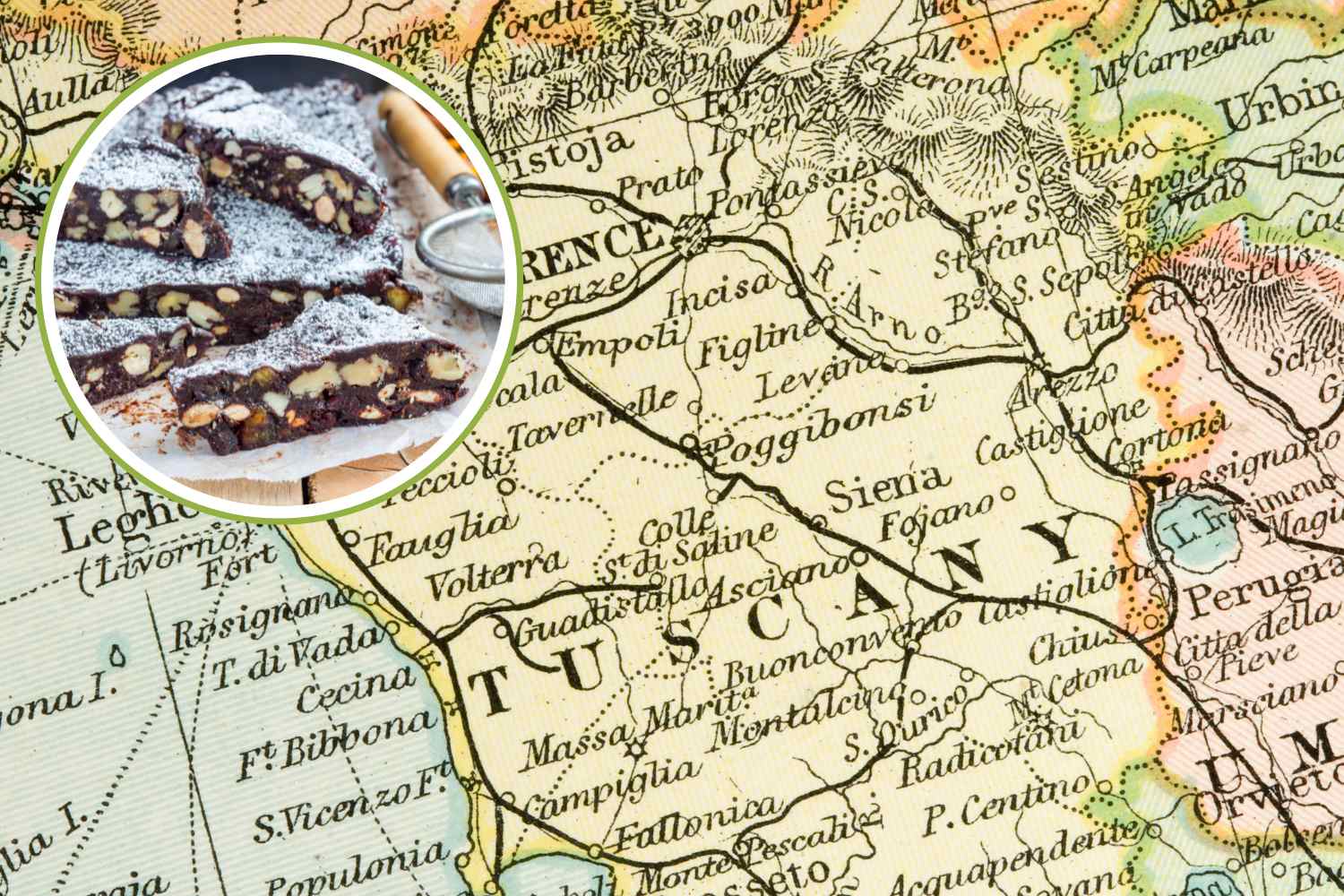
Tuscany, at Christmas, is not limited to panettone, which is not even the typical dessert. Here the holidays smell of almonds, honey, spices and ancient stories. From the ovens of Siena to the kitchens of the islands, each dessert tells of centuries of tradition. Here are the absolute protagonists of Tuscan Christmas tables.
Ricciarelli of Siena
The ricciarelli are The Christmas dessert par excellence. Soft, intensely scented with almonds and covered with a light dusting of icing sugar, they are born from a simple but noble mixture: almonds, sugar and egg white.
Their origin is lost in legend: it is said that they were introduced into Tuscany by the knight Ricciardetto Della Gherardesca upon his return from the Crusades. Between biscuit and pastry, they are an unmistakable signature of Siena.
Tradition dictates that they should be enjoyed with a glass of Vin Santodry and uncompromising combination.
Ingredients
(for 25-30 ricciarelli)
Procedure
To prepare the ricciarelli, start by mixing the almond flour, icing sugar, 00 flour, yeast, grated orange zest and vanillin in a bowl. In a separate bowl, lightly whip the egg whites until they are frothy but not stiff, then add the honey and mix briefly. Incorporate the egg white and honey mixture into the dry ingredients, working until you obtain a soft and slightly sticky dough. Let the dough rest in the refrigerator for 1 hour. Once the resting time has passed, take small portions of dough, roll them in icing sugar and shape the classic slightly flattened oval shape typical of ricciarelli. Arrange the cakes on a baking tray lined with baking paper, spacing them apart. Cook in a preheated oven at 160°C for 14-16 minutes: the ricciarelli must remain light, just golden on the bottom. When they come out of the oven they will be soft but will harden as they cool completely. Once cool, dust them with plenty of icing sugar before serving.
Panforte di Siena
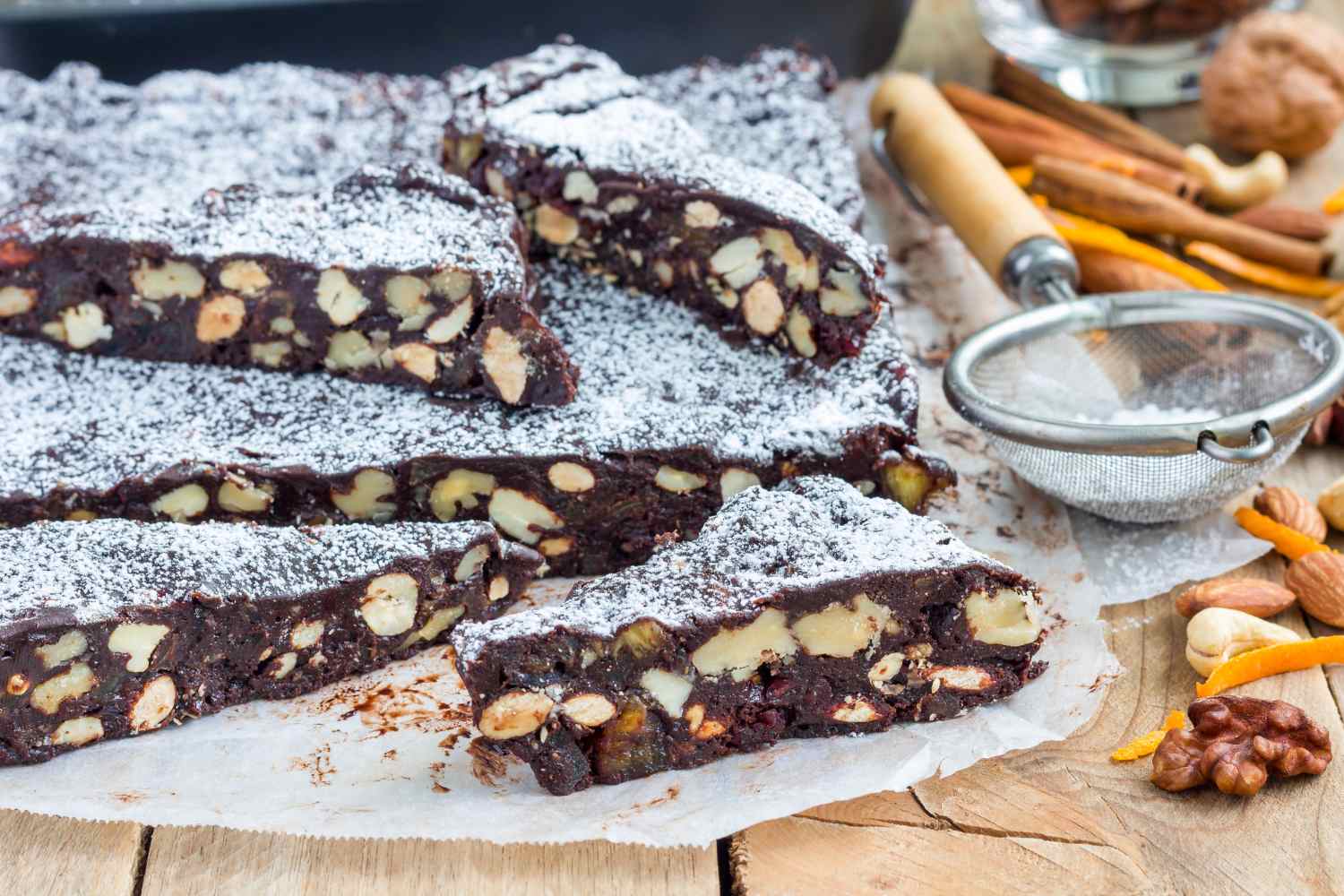
Also from Siena comes another holiday giant: panforte. Its roots date back to the year 1000. Honey, spices, candied fruit and dried fruit give life to a compact, intense dessert, with a persistent aftertaste of almonds and citrus fruits.
The first written testimonies date back to 1205, when it was offered to the nuns of the Montecelso Abbey. Born as bread enriched with honey and pepper, over the centuries it has become a specialty of noble tables. In the nineteenth century he gained international fame, so much so that he was cited by Pellegrino Artusi.
Panforte Margherita was born in 1879, a more delicate and less spicy version, created in honor of the Queen of Italy. Today panforte is a timeless symbol: Christmas by vocation, but present all year round in Sienese pastry shops.
Ingredients
(for 18-20 cm mould)
Procedure
To prepare the panforte, collect the dried fruit, diced candied fruit, flour and mixed spices in a large bowl. Mix with a spoon to mix all the ingredients well and set aside. In a small bowl, mix the honey with the sugar and water, then heat them in the microwave or on a very low heat to make the honey completely fluid. Add the hot honey mixture to the dried fruit mixture and mix vigorously to incorporate it well. The dough will be ready when it is shiny, compact and mouldable, without traces of excess flour. Butter an openable mold of 18-20 cm in diameter, place the wafer sheet on the bottom (alternatively you can simply use baking paper) and distribute the mixture evenly. Level the surface well with the back of a spoon to obtain a uniform thickness of approximately 2-3 cm. Bake the panforte in a preheated oven at 180°C for 20 minutes. Once cooked, take it out of the oven and let it cool completely before turning it out. Finally decorate with plenty of sifted icing sugar on the surface.
Cavallucci of Siena
Ancient and rough, seahorses were already widespread at the time of Lorenzo the Magnificent. The name derives from travelers on horseback who consumed them in taverns as an energetic dessert.
Rich in spices and nuts, without eggs, they have a particular consistency and a strong taste. They are not parlor biscuits: they are rustic, perfect with sweet or fortified wines. Every bite is a dive into Renaissance Siena.
View this post on Instagram
Ingredients
Procedure
To prepare the Cavallucci di Siena, start by mixing the flour in a large bowl with the previously crushed anise seeds, the coarsely chopped walnuts, the candied orange cut into small cubes, a teaspoon of ground cinnamon and half a teaspoon of bicarbonate of soda. In a saucepan, melt the sugar with the honey and 50 g of water over medium heat, leaving to cook until it is completely dissolved and begins to string together forming a thick syrup. Pour the hot syrup into the bowl with the flour and mix all the ingredients well with a wooden spoon until you obtain a smooth mixture. With lightly floured hands, form 12 slightly flattened and irregularly shaped balls, approximately 5 cm in diameter and 2-2.5 cm thick. Place the balls on a baking tray lined with baking paper, spacing them apart, and dust them with a little flour. Bake in a preheated static oven at 150-160°C for about 20 minutes, until the cavallucci are slightly golden and crispy on the outside but still soft on the inside.
Sienese copate
View this post on Instagram
Little known but surprising, the copate (or cupate, from Arabic qubbiat“mandorlato”) are an ancient Sienese specialty. A brittle of honey, walnuts and anise, light or dark with chocolate, enclosed between two thin wafers.
They were once reserved for the most refined pastry shops and served to nobles and popes. Today they remain a discreet jewel of the Tuscan Christmas tradition.
Befanini
View this post on Instagram
Befanini are Epiphany biscuits, very common in Lucca, Versilia and Garfagnana, but loved throughout the region. Fragrant, scented with citrus fruits and vanilla, decorated with colored sprinkles, they recall the figure of the Befana and the family atmosphere of the holidays.
Preparing them is a collective ritual: floured hands, molds, laughter. They are enjoyed as a snack with tea or hot chocolate, but they also compare very well with a glass of Vin Santo.
Ingredients
(for about 35 biscuits)
For the shortcrust pastry:
To decorate:
Procedure
To prepare the befanini, pour the flour, icing sugar, yeast and salt into the mixer, then add the grated orange zest, always choosing untreated citrus fruits with edible peel. Also add the butter in pieces, the aniseed liqueur and the eggs, then blend everything for a few moments until the mixture acquires consistency. Transfer the dough to the work surface and work it briefly just long enough to make it uniform.
Alternatively, you can knead the pastry by placing the flour in a mound on the surface, adding the other ingredients to the center and kneading quickly with your hands until a uniform dough is formed.
Wrap the dough in cling film and leave to rest in the refrigerator for 30 minutes. Once the necessary time has passed, roll out the dough on a floured surface using a rolling pin until it is about 3 mm thick. Cut out the chosen shapes with cookie cutters and knead the leftover scraps again to roll them out again.
Place the befanini on a baking tray lined with baking paper, spacing them a few centimeters because they will expand slightly during cooking. Brush the surface with the beaten egg and decorate them as desired with sprinkles and colored sprinkles. Bake the befanini in a preheated oven at 180°C for about 15 minutes, then take them out of the oven and let them cool completely before enjoying or storing them.
Ricciolina from Monte Amiata
View this post on Instagram
Typical of the Monte Amiata area, ricciolina is a dessert for special occasions. It has a circular shape, a dry crust and a soft interior, with clear flavors of chocolate and almonds.
Born at the beginning of the twentieth century as a reworking of a recipe cited by Pellegrino Artusi, it is due – according to tradition – to the inventiveness of a pastry chef from Abbadia San Salvatore, Beppa, who with some friends created the characteristic “curl” meringue-based covering. Nothing was thrown away, not even egg whites.
It is produced all year round, but becomes the protagonist at Christmas and Easter. There remains only one pairing: Vin Santo.
Ingredients
(for 8 portions)
For the shortcrust pastry:
For the filling:
For coverage:
Procedure
Start preparing the Monte Amiata ricciolina cake with the shortcrust pastry: in the planetary mixer, with the K-shaped whisk fitted, mix the sugar with the diced butter, then add the egg, the egg yolks and a pinch of salt, followed by the flour and the yeast. Knead quickly until you obtain a smooth dough, shape it into a loaf, wrap it in cling film and place in the fridge for at least 30 minutes.
In the meantime, dedicate yourself to the filling: in a saucepan, mix the egg, sugar and flour with a whisk, then gradually add the milk brought to the boiling point, making sure that no lumps form. Place on a low heat and cook, stirring continuously until the cream has thickened.
Transfer the cream into a bowl and let it cool, then add the chocolate cream and the coarsely chopped dried fruit, mixing until the mixture is well blended.
Take the shortcrust pastry and roll out half of it with a rolling pin on a lightly floured pastry board until it is about 5 mm thick, then transfer it into a buttered and floured 22 cm diameter springform pan. Trim the edges so that they are about 4 cm high and prick the base, then spread the chocolate and dried fruit cream on top and level.
Roll out the remaining pastry to the same thickness and cover the filling, sealing the edges well, then trim the circumference of the cake again. Bake the cake in a preheated oven at 180°C for 40 minutes or until the surface is just golden. Remove the cake from the oven and let it cool completely before delicately removing it from the mold.
When the cake is now cold, whip the egg whites with the sugar using an electric mixer until the mixture is shiny and puffy, then spread it over the surface of the cake and decorate with melted chocolate dripped in thin threads. Place the Monte Amiata ricciolina cake back in the oven at 200°C for 1 minute, then remove from the oven, leave to cool and serve.
Panficato of Giglio Island
View this post on Instagram
Panficato is the identity dessert ofGiglio Island. A sweet, dark loaf made with dried figs, walnuts, almonds, raisins, honey and wine. Soft, substantial, it is traditionally prepared from Christmas to Easter.
Its history is marked by the tragedy of 1544, when the pirate Barbarossa sacked the island. Subsequently, the arrival of populations from the Siena area may have influenced the recipe, which recalls panforte but uses only what the island offered.
A dessert born out of necessity, today a local pride, to be enjoyed with Passito del Giglio or Ansonica.
Ingredients
Procedure
To prepare the fig bread, start by cleaning the dried figs from the stem, cut them and leave them to soak in water for 2 days, then chop them finely. In a large bowl, combine the chopped figs with all the other ingredients: the chopped walnuts, the almonds, the pine nuts, the orange zest, the apples and pears cut into small pieces and previously soaked in the liqueur, the chopped dark chocolate, the bitter cocoa, the cinnamon, the sugar, the dried grapes and the flour.
Add the grape jam in the quantity necessary to mix the mixture well and knead vigorously with your hands until you obtain a homogeneous and compact mixture. Form round loaves and place them on a baking tray lined with baking paper. Bake in a preheated oven at 180°C for 40 minutes. Once cooked, take the fig loaves out of the oven and let them cool completely before serving, preferably accompanied by a good glass of Ansonica.
