
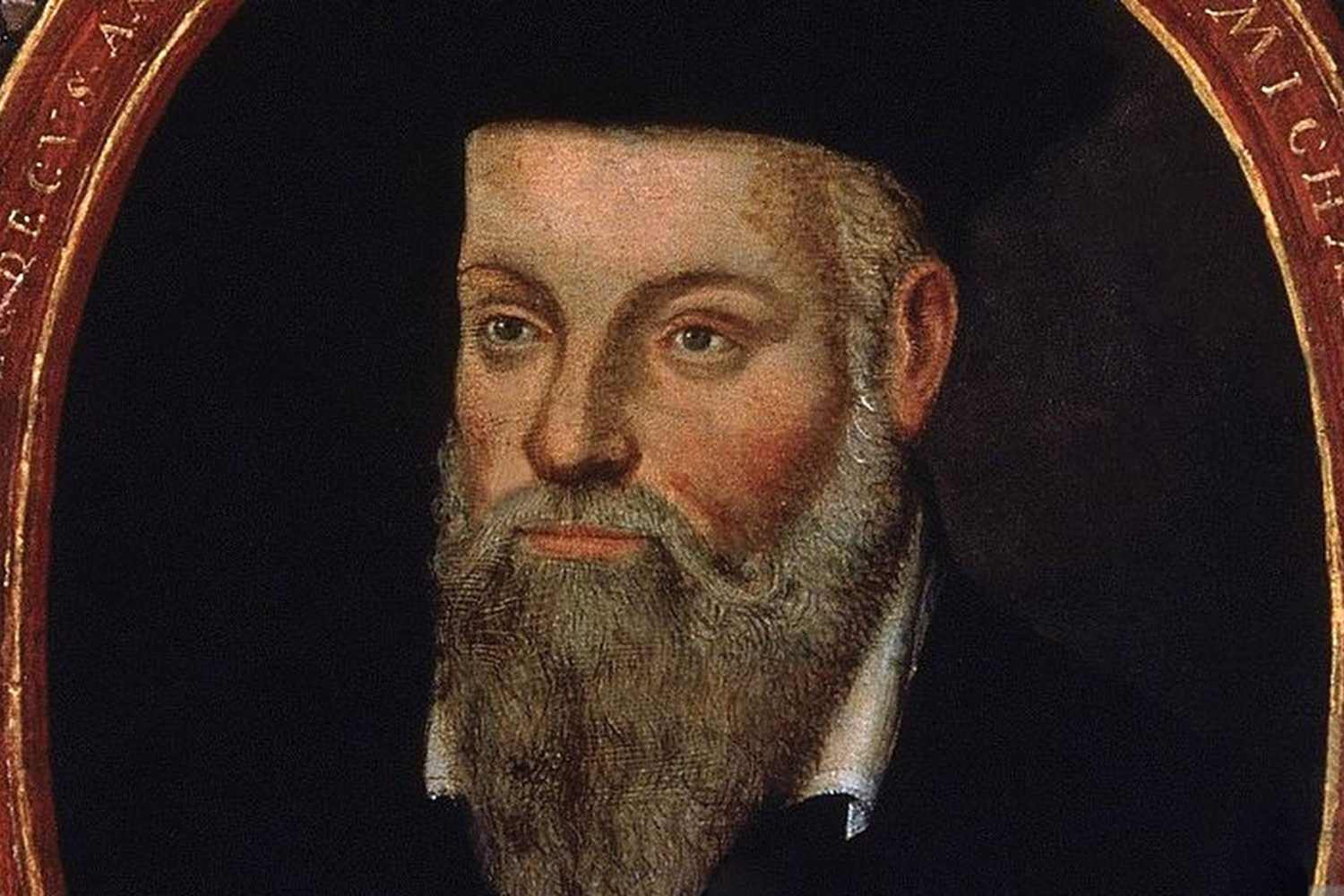
Like a Swiss watch that marks the passage of time, every end of the year it brings Michel de Nostredame’s mysterious quatrains back to the fore. The French seer of the sixteenth century, better known as Nostradamus, continues to exert a magnetic fascination on our era, just as he did on his contemporaries. Its 942 quatrains, first published in 1555 in an enigmatic mix of archaic Latin and medieval French, now return to be anxiously scrutinized in view of 2026, a year that according to some interpreters could prove particularly turbulent.
A rare eclipse
2026 brings with it an astronomical event of rare beauty: the first total solar eclipse over Europe in twenty-seven years. It is precisely this celestial phenomenon that offers fans of the seer a concrete link to link his prophecies to the year to come. Nostradamus, after all, was also an astrologer, and references to darkened moons, retrograding planets and fires from the sky abound in his verses. Whether it’s coincidences or something more, the eclipse has rekindled interest in those passages of the Prophecies that speak of disturbing celestial phenomena.
Seven months of great war
“Seven months of great war, people dead from evil”
reads one of the most cited quatrains in recent weeks. The reference to Rouen and Évreux, French cities already relevant at the time of Nostradamus, is today reinterpreted in light of contemporary geopolitical tensions. With the conflict between Russia and Ukraine still unresolved and international friction growing, this verse once again resonates with a particularly sinister echo. Modern interpreters are divided between those who read an allusion to the Ukrainian president Zelensky and those who instead glimpse the figure of Donald Trump, provocatively renamed “King Donald” in some speculative readings.
The great swarm emerging from the darkness
One of the most powerful images evoked by Nostradamus is that of the “great swarm of bees” rising from the night. An ancient symbol of power and organization – it is no coincidence that Napoleon adopted it as an imperial emblem centuries later – the swarm is today interpreted as a metaphor for charismatic and controversial leaders. Putin and Trump, dominant figures on the international scene, could be the protagonists of this “swarm”, according to those who try to decipher the cryptic language of the seer. The quatrain suggests unexpected victories or bold maneuvers, perhaps new balances in the Middle East or decisive turning points in the Ukrainian conflict.
The blood that will flood Ticino
Particularly disturbing is the reference to the Swiss canton of Ticino, which according to Nostradamus will be “flooded with blood”. Switzerland, a symbol of neutrality and stability in the heart of Europe, becomes in this reading the theater of violence or conflict. Analysts prefer to interpret the verse in a symbolic way: not necessarily a war on Swiss territory, but rather the spread of tensions along the European corridors, already crossed by military mobilizations and political concerns. Ticino, on the border with Italy, would thus represent a focal point of a larger crisis.
Mars rules and the West loses its light
When the Roman god of war “steers his path among the stars,” Nostradamus writes, blood “will sprinkle the sanctuary.” It is one of the most apocalyptic passages, interpreted as a harbinger of an intensification of global conflicts that could involve both Western Europe and the Asian powers.
But there is more: the verse that speaks of “three fires rising from the eastern sides, while the West loses its light in silence” is read as a prophecy of a shift in the world balance of power. The East emerges, the West declines – a narrative that resonates with contemporary anxieties about the decline of Western hegemony.
Artificial intelligence in sixteenth-century prophecies?
Perhaps the boldest interpretation concerns artificial intelligence. According to some modern readers, when Nostradamus talks about the West losing its “light in silence,” he may be metaphorically referring to the technological advances made by China, Japan, and other Eastern countries in the field of AI.
The economic disruption caused by automation would challenge Western labor markets, altering global economic trajectories. It is an interpretation that says much more about the fears of our time than about the real intentions of a man who lived in the sixteenth century, when the most advanced technology was probably movable type printing.
The dangerous game of numerology
Nostradamus enthusiasts love playing with numbers. The quatrains numbered ’26’ must necessarily refer to 2026, some argue. It’s an intellectually questionable but fascinating operation. The first quatrain number 26 speaks of a swarm of bees, the second of the bloody Ticino. None explicitly contains references to 2026, but the numerical assonance is too tempting to be ignored by those seeking confirmation in the mists of the future.
Between natural disasters and financial crises
The interpretations for 2026 do not even spare the economy and the environment. Symbols such as “fire from the sky” are linked to the extreme climatic events that already characterize our era. Other verses mentioning “corrupt currencies” and “restless markets” are read as harbingers of a new financial crisis. In a world already marked by inflation and economic instability, these prophecies find fertile ground in collective anxieties.
The light after the darkness
Yet, in the midst of so much catastrophism, Nostradamus also offers a glimmer of hope.
“The shadows will fall, but the man of light will rise”
it is the verse with which many interpretations end. A message of collective renewal, perhaps the arrival of a new visionary leader, a social change that will favor human relationships over technology. It is the classic happy ending that every apocalyptic prophecy seems to require, the promise that after the storm calm will come.
We see what we want to see
But how much truth is there in all this? The most prudent scholars recall that Nostradamus’ verses are deliberately ambiguous, written in a language that mixes metaphors, astrological references and Renaissance symbolism. The very existence of multiple manuscripts, with different spellings and translations, makes it possible to adapt virtually any quatrain to any historical event. It’s the phenomenon known as “confirmation bias”: we assign meaning to a prediction only after the event has occurred.
Nostradamus lived in an era of deep social divisions and political uncertainty, not too different from our own. The invention of the printing press allowed ideas to spread quickly, much like social media does today. His prophecies work because they speak of universal themes: wars, economic crises, natural disasters, changes in power. These are concerns that span the centuries and that each generation recognizes as its own.
The charm of the unknown
Whether Nostradamus was a prophetic genius or simply a skilled manipulator of ambiguous symbols, his enduring success reveals something profound about human nature. We need to believe that the future can be known, that the signs are there to be deciphered by those who know how to look. In an increasingly complex and unpredictable world, the French seer’s quatrains offer the illusion of control, the sensation that someone, in some way, has already seen what is about to happen.
Will 2026 bring with it wars, crises, technological revolutions? Maybe yes, maybe no. But one thing is certain: when the year is over, someone will find a way to prove that Nostradamus was right, as always, after all.
