
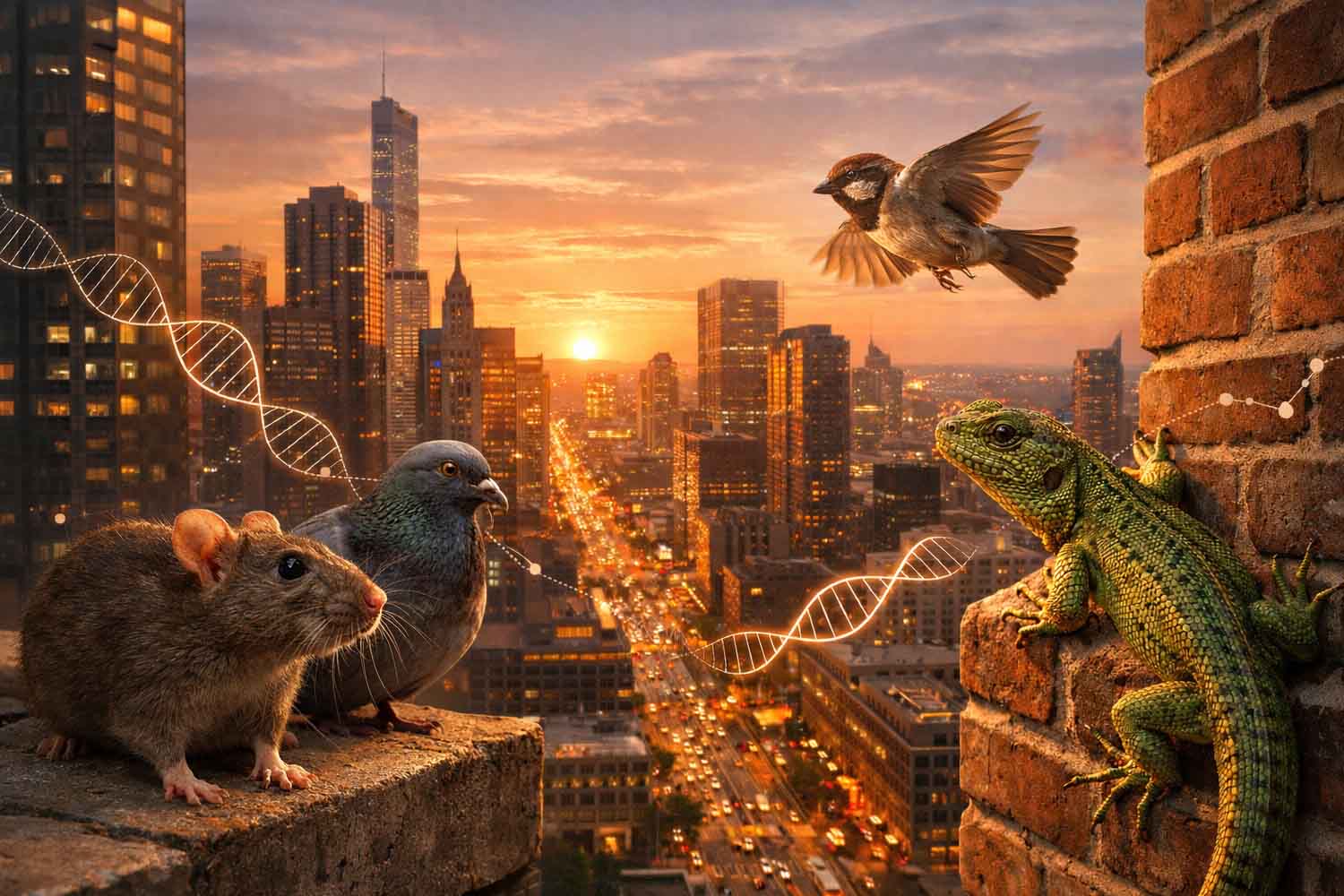
There is a reassuring, almost romantic idea that “true” nature lives elsewhere: in the woods, in the mountains, in parks far from the houses. Cities, on the contrary, are often perceived as neutral spaces, if not openly hostile to non-human life. Yet science tells another story, much more interesting and, at times, surprising. Right between asphalt, traffic and buildings, animals are changing on a genetic level, adapting to an environment that we built, but which is no longer just ours.
Over half of the world’s population lives in urban areas. This data, which we usually read from a social or economic perspective, also has profound consequences for the rest of the species. Cities are not just noisy and polluted: they are open-air evolutionary laboratories, where natural selection accelerates and works in real time. Not in millennia, but now.
Biologists who deal with urban evolutionary ecology observe animals that, within a few generations, become different from their rural “relatives”. Metabolism changes, body shape changes, even some behavioral traits change. Not because nature “wants” to adapt, but because those who cannot simply disappear.
The white-footed mice of Manhattan
One of the first studies on the rapid evolution of the DNA of animals in the city he focused on the white-footed mouse ( Peromyscus leucopus ) of New York CityBecause living in large city parks they no longer move as they would in a natural environment. The streets and skyscrapers have isolated them from an evolutionary point of view as would happen in a real island. or like islands in the middle of concrete. This isolation has produced genetically distinct populations, with mutations that help them better digest human food and tolerate toxic substances found in urban soil. In practice, their organism has become more efficient at managing a diet and an environment that, for other mice, would be unsustainable.
The Puerto Rican anole lizard
Thousands of kilometers away, in San Juan, Puerto Rico, some lizards have followed a different but equally surprising path. Accustomed for centuries to living in trees, in the city they found themselves running on smooth walls, metal fences and hot sidewalks. Variations linked to the development of limbs and skin have been identified in their DNA: longer legs, more adhesive “fingers”, greater resistance to heat. It’s not just a question of individual ability: it’s a heritable adaptation, written in the genes.
Mosquitoes in the London Underground
Even stories that seemed already closed, like that of the famous London Underground mosquito (( Culex pipiens forma molestus )today they are reread with different eyes. For years it has been described as a perfect example of recent urban evolution. The most in-depth genetic analyzes suggest that this mosquito did not evolve in London, but probably differentiated from other mosquitoes between 1,000 and 10,000 years ago in the Mediterranean (probably in Ancient Egypt), living alongside the first agricultural humans. When the tunnels were built, all she did was move. A detail that reminds us how ancient and intertwined the relationship between humans and other species is, even when we believe we are the ones dictating the rules. An important lesson in how ancient human history continues to shape modern urban ecology, and a reminder of how difficult it is to study urban adaptations.
Raccoons are getting cuter
Then there are the raccoons of North American cities, increasingly at ease among dumpsters and courtyards. Recent studies show that their snouts are getting shorter than those of rural specimens, a change that recalls dynamics similar to those observed in domestic animals. Less aggressive individuals, more tolerant towards human presence, have a greater chance of surviving and reproducing. Without meaning to, we are selecting for physical and behavioral traits.
Swallows evolve to dodge trucks
Even birds, which we imagine to be free by definition, respond to the rules of the city. In some areas of the United States, rock swallows that nest under highway bridges have shorter wings than they used to. It is no coincidence: more compact wings allow rapid take-offs and sudden maneuvers, essential for avoiding trucks and cars. Those with longer, less agile wings simply disappeared over time.
Even the plants are no different
And it’s not just the animals that are changing. Even urban plants are rewriting their survival strategy. White clover, for example, naturally produces a toxic substance to defend itself from herbivores. In the city, where cows and deer do not graze, this defense becomes an unnecessary cost. In many urban areas, clover has stopped producing it, making it also more resistant to the cold. A silent but effective evolutionary choice.
All this forces us to review a deep-rooted idea: cities are not ecological voids. They are complex, harsh, sometimes extreme environments, but capable of generating new forms of life. Studying these changes isn’t just about better understanding the animals that live alongside us. It can help us imagine how species, including ourselves, will respond to an increasingly warm and urbanized world.
The question, at this point, arises almost spontaneously. If mice, lizards, birds and plants are changing so quickly to adapt to urban life, what kind of pressure does the city put on us, day after day? The answer, perhaps, is already written in the streets we travel every morning. You just need to learn to look at them with a little more careful eyes.
You might also be interested in:
