
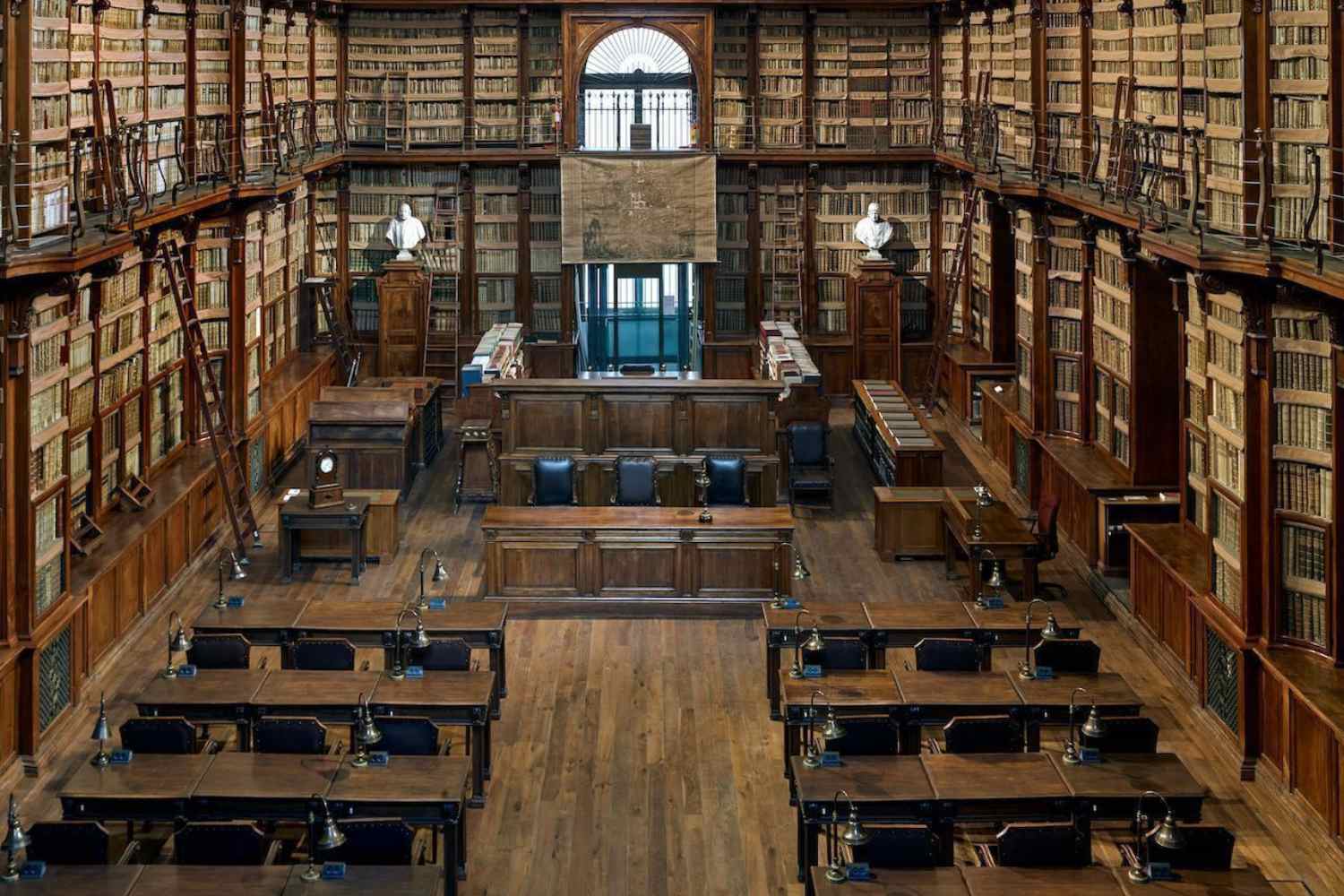
The oldest public library in Rome
The Angelica Library is the oldest public library in Rome and, together with the Ambrosiana in Milan and the Bodleian Library in Oxford, one of the first in Europe. Founded in 1604, it takes its name from the Augustinian bishop Angelo Rocca (1546-1620), an erudite writer and passionate collector of valuable editions, responsible for the Vatican Printing Office during the pontificate of Sixtus V. In the last years of the 16th century, Rocca entrusted his book collection of around 20,000 volumes to the friars of the convent of Sant’Agostino in Rome.
A revolutionary institution: open to all
Angelo Rocca gave the new library a suitable location, its own income and its own regulations. Above all, he wanted it to be open to all, without limits of status and wealth. The absolute novelty of the institution aroused the interest of an ever-growing public and the fame of the library soon spread among scholars. Over the previous centuries, the library had been enriched with precious manuscripts, gifts from Roman nobles or transcribed by the friars themselves who had left them as a legacy to the convent upon their death.
The collections that made history
In 1661 Lukas Holste (1596-1661), custodian of the Vatican Library, left his precious collection of printed volumes to the Augustinian friars. In the first half of the eighteenth century, the Roman convent and its library were the backdrop to the religious controversies of the time: in Angelica there are editions of prohibited texts that are still fundamental today for studies and research on the Reformation and Counter-Reformation period. The Library had obtained special authorization to possess prohibited books and this exemption from censorship allowed it to conserve the volumes of the library of the Augustinian bishop Henry Norris (1631-1704).
The big leap: the Passionei acquisition
In 1762, the very rich library of Cardinal Domenico Passionei (1682-1761) was purchased, which doubled the Angelica’s assets. In these same years the friars commissioned the architect Luigi Vanvitelli to renovate the convent and he completed the construction of the current hall in 1765.
From the Napoleonic occupations to the Italian state
In the 19th century the history of the Angelica was marked by the historical events that affected the city of Rome: from the invasion of the French to the proclamation of the Mazzinian republic in 1849. The Augustinians left the Angelica in 1873 with the passage of the library to the Italian State.
Secular management and new purchases
The first decades of the secular management of the library were marked by important purchases that significantly increased its book heritage: among these a part of the library that belonged to the Massimo princes, an important collection of works published by Giambattista Bodoni which was added to the Bodoni editions already owned and a curious collection of 18th and 19th century opera librettos, coming from the minister Nicola Santangelo. Since 1940 it has kept approximately 10,000 volumes owned by the Arcadia Literary Academy in storage.
The acquisitions of the twentieth century
Between 1944 and 1952, the Angelica Library worked to acquire the ten volumes of Luigi Zanazzo’s autographs, containing unpublished compositions and collections of Roman proverbs, plays and songs. He also received the donation of documents relating to the poetic and literary activity of Domenico Gnoli (1838-1915) and the correspondence of the archaeologist Felice Barnabei (1842-1922).
In 1975 the Angelica Library welcomed the library of the literary critic Arnaldo Bocelli (1900-1974) which includes texts of twentieth-century Italian literature. In 2005, the Cardone Fund was received as a gift, consisting of volumes of Italian and French literature from the last years of the 19th century, while in 2009, the book collection of Professor Achille Tartaro was acquired as a gift, with works mostly of literary criticism.
An extraordinary heritage
Angelica owns and protects approximately 200,000 volumes of which more than 100,000, published from the 15th to the 19th century, constitute the ancient collection of the Library. The manuscript collection consists of approximately 3,000 volumes divided into three collections based on writing (Latin, Greek and Oriental) and approximately 24,000 loose documents, including the Barnabei, Bocelli, Gnoli correspondence and the Zanazzo autographs. The incunabula are more than 1,100 and the sixteenth century approximately 20,000. The engravings, drawings and maps consist of approximately 10,000 specimens. There are 640 periodicals, of which 150 are current.
Hidden treasures
Among the most precious pieces for antiquity and artistic value are a 9th century manuscript containing the Free memorialis of the Abbey of Remiremont, a finely illuminated codex of the Divine Comedy from the 14th century, a delightful Book of Hours with stupendous miniatures by Flemish hand from the 14th century, the De Balneis Puteolanis of the 13th century with admirable miniatures of the Sicilian school.
Among the incunabula we should mention the De Oratorethe first book printed in Italy in Subiaco in 1465, the De Civitate Deialso from Sublacense, and a copy of the first edition of the Divine Comedy printed in Foligno in 1472. For the sixteenth century, the first edition of theOrlando furiouspublished in Ferrara in 1521. As regards drawings, prints and geographical maps, of particular interest are a collection of drawings of city views of southern Italy from the end of the 16th century, as well as numerous atlases and 85 nautical charts from the 18th century of Dutch origin.
Library specializations
The richest sectors, which are still increased today based on purchases and donations, include works on Augustinian studies, the history of the Reformation and Counter-Reformation, texts on Italian literature and theater from the 15th to the 18th century, rare editions, works on Rome, Italian and foreign periodicals from the 17th-18th centuries.
Practical information for the visit
Opening hours:
It is recommended to check the notices for any changes in service times.
Visit to the Salone Vanvitelliano: it is possible to access the magnificent Salone Vanvitelliano during the opening hours of the Library, remaining close to the entrance door and without disturbing readers. Entrance is free.
