
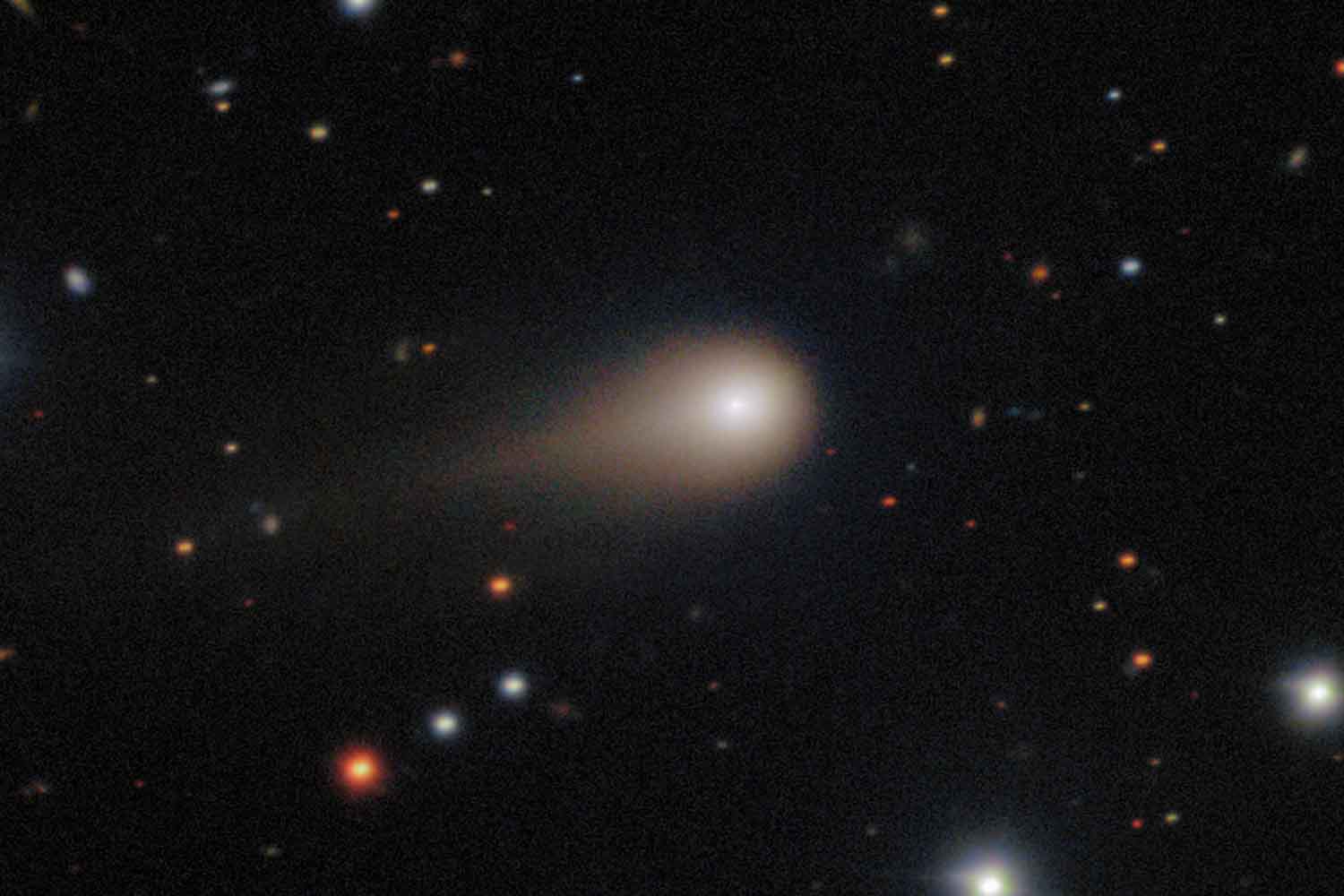
In the last few days the name 3I/ATLAS it began to circulate insistently even outside the scientific circuits, fueling doubts, sensationalist headlines and inevitable theories. It all stems from an official response from CIA who, when asked about this interstellar object, chose not to confirm or deny the existence of any documents in her possession. A well-known bureaucratic formula, but which had the effect of rekindling collective curiosity. It’s really worth stopping for a moment and understanding what we know, without chasing suggestions.
Why did the CIA’s response on 3I/ATLAS make noise?
The response provided by the US agency falls within the so-called Glomar responsea practice used when a public body believes that even just admitting the existence or non-existence of information could affect sensitive areas. It is important to clarify this immediately: it is not a statement on the origin of 3I/ATLAS, nor even a confirmation of extraterrestrial hypotheses. It’s “we can’t say”, not “there’s something to hide”.
The position of the intervenes to make the picture clearer NASAwhich since the discovery of the object, which took place in the summer of 2025, has continuously spoken of one natural interstellar comet. An icy body, rich in gas and dust, which crosses the Solar System following a hyperbolic trajectory, as has already happened in the past with other cosmic visitors coming from outside.
What we know about 3I/ATLAS and why it is not an “alien spacecraft”
Observations collected so far indicate that 3I/ATLAS exhibits behavior compatible with that of comets: an active coma, gas emissions and a structure that reacts to solar heat. Some details, such as a sort of “antitail”, i.e. a light trail oriented in an unusual way, have attracted attention, but are part of phenomena already known and studied in astronomy.
The Harvard astrophysicist also supported a more critical reading Avi Loebwho urged us not to dismiss some anomalies too quickly. His approach, however, remains a minority voice within the scientific community and is not supported, at present, by evidence indicating an artificial nature of the object.
Meanwhile, independent projects have searched for radio signals or emissions compatible with advanced technologies. The results, so far, have not revealed anything anomalous. No messages, no trace of intelligent activity, just the deep silence of space.
Why the 3I/ATLAS case fascinates us so much, even without aliens
There is something deeply human in the way we look at 3I/ATLAS. An object arriving from another star system brings with it the idea of travel, of the unknown, of distant worlds that touch ours for a moment and then disappear. It’s understandable that the silence of an agency like the CIA is interpreted as a mystery, but the reality is often less cinematic and much more interesting.
Studying these bodies means better understanding how planetary systems are born, how materials are distributed in space and what invisible ties unite stars. In this sense, 3I/ATLAS remains a precious guest, even if it does not carry with it any secret message.
The 3I/ATLAS case does not tell of a conspiracy, but of the way in which science proceeds, between data, hypotheses and continuous checks. The CIA’s silence does not change the substance: for the scientific community we are faced with a natural interstellar comet, fascinating precisely because it is real. And perhaps, in an era of screaming news, this is already enough.
