
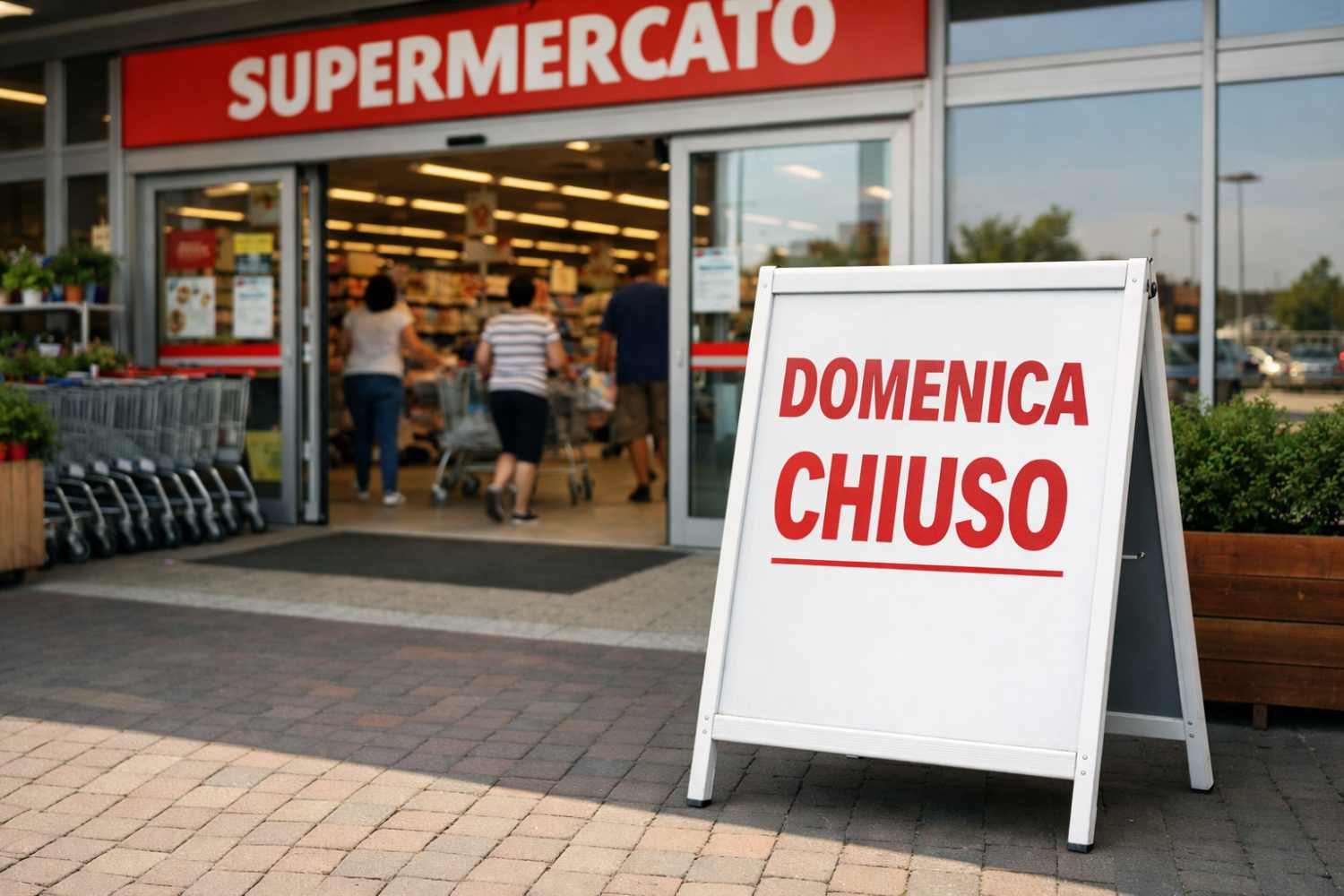
For years in Italy there has been a heated debate on the possible Sunday and holiday closures of supermarkets, supported by some unions, consumer associations and citizens who ask for more protection for workers, with the aim of guaranteeing them a real day of rest to spend with their family. A request that has remained unheard over the years, especially after the liberalization of timetables introduced by the Save Italy decree.
Now, however, the topic is back at the center of the debate. And this time it is one of the main Italian large-scale retail chains that raises it: Coop. But the push does not arise so much from social reasons or work-life balance, but from a much more concrete need, that of cutting costs.
The Coop hypothesis: six days of opening instead of seven
Ernesto Dalle Rive, president of Ancc-Coop explained to Il Sole 24 Ore that the Coop system is seriously considering closing supermarkets on Sundays. Ancc-Coop represents 72 consumer cooperatives, with over 2,200 sales points and more than 57 thousand employees.
According to Dalle Rive, 2026 promises to be a difficult year: economic growth close to zero, weak household consumption and margins increasingly under pressure for large-scale distribution. After 2025 already marked by a decline in sales volumes, the priority therefore becomes reducing costs and recovering efficiency.
As Coop we are making a reflection that we would like to share with the large-scale retail system: the closure of supermarkets on Sundays – he explains – to reach a shared drop point which could include 6 days of store opening.
Why closing on Sunday is convenient for companies
The main motivation is economic. Working on Sundays involves higher labor costs: salary increases are at least 30% more than on weekdays. According to estimates by the Coop research office, a generalized Sunday closure could generate a recovery in productivity and efficiency of between 2.3 and 2.6 billion euros for the entire Italian large-scale retail trade system.
Resources which, according to Coop, could be reinvested in promotions and lower prices for consumers. Furthermore, internal investigations indicate that a significant part of purchases would simply be moved to the other days of the week, already today around one in three Italians does not shop on Sundays.
And the workers?
In Dalle Rive’s words, the theme of employees also emerges: “Many no longer want the commitment of Sunday work“A statement that intercepts a historic request from those who work in large-scale retail trade, often forced to work holiday shifts that make family and social life difficult.
However, the difference compared to the battles carried out over the years by unions and associations is evident. In this case, the possible return to Sunday closing does not arise as a conquest of rights, but as a consequence of a cost containment strategy in an increasingly uncertain economic context.
The scenario outlined by Coop is that of families with a spending capacity compressed by the so-called “obligatory expenses”: bills, health, essential goods. Six out of ten Italians say they feel worried and uncertain about the future, also due to international geopolitical tensions.
More and more private label products are entering the shopping cart, while attention is growing towards foods considered healthier, those with less sugar, less fat, fewer additives.
A choice that opens the debate
Coop’s proposal could reopen a broader discussion on the consumption model and trading hours in Italy. But if Sunday closing really does become a reality, will it be a temporary choice dictated by the crisis or an opportunity to rethink work in large-scale retail trade in a more sustainable way?
For now, rather than a victory in the historic battles for the right to Sunday rest, it seems like another side effect of an economy that is slowing down and forcing even the distribution giants to review their certainties.
