
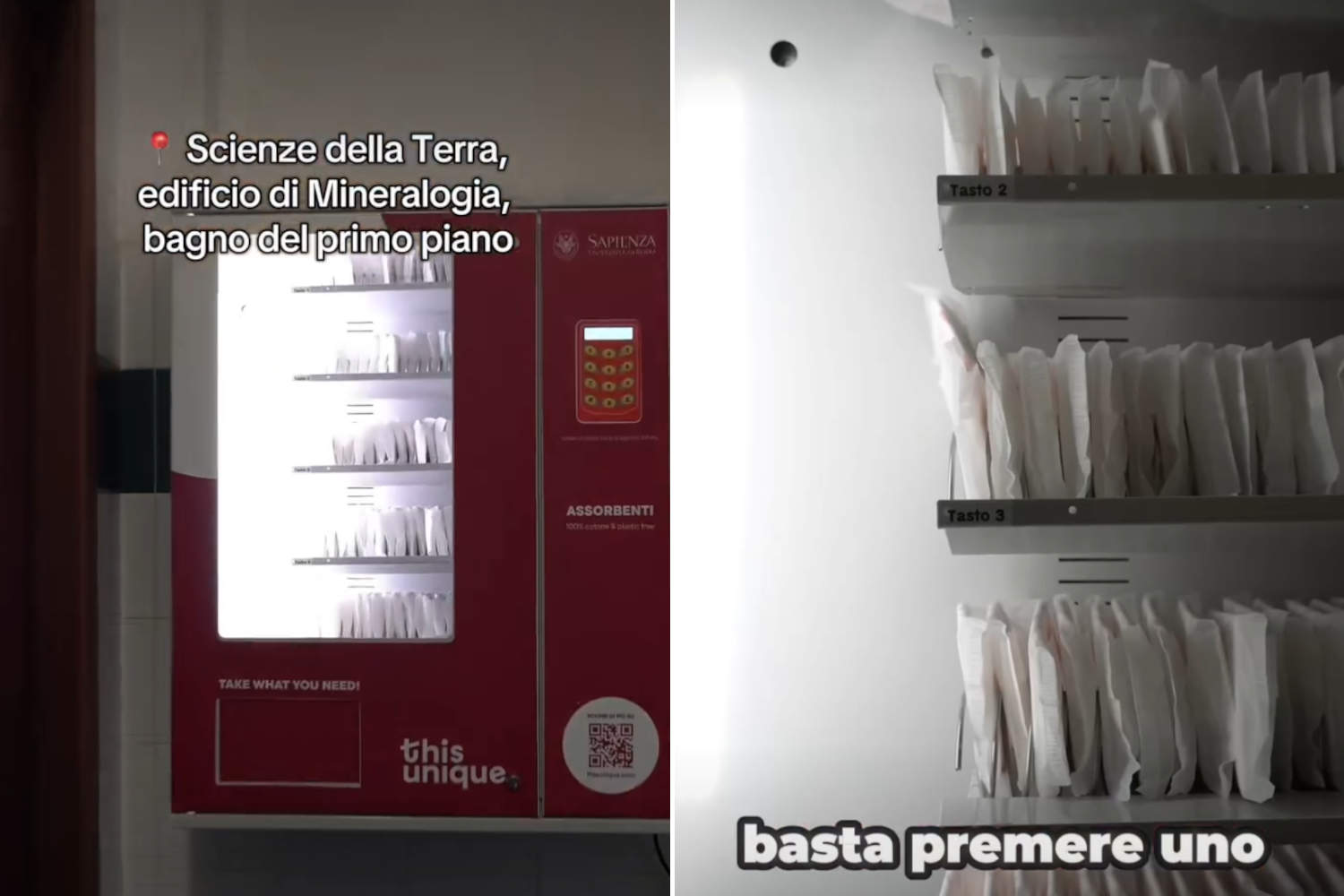
Excellent news comes from La Sapienza University of Rome which has started the installation of tampon boxes, automatic dispensers of free sanitary pads within some faculties. The initiative was born from the will of the university governance, in collaboration with student representatives, and represents a tangible signal of attention, care and closeness towards female students and all women in the university community. A project that directly addresses a real, often underestimated need linked to daily well-being.
What are tampon boxes and how do they work
Tampon boxes are simple and intuitive dispensers: just press a button to receive one or more tampons, without using cards, badges or registrations. The service is completely free and designed to be accessible immediately, especially in situations of sudden need. This first phase also has a listening and monitoring function, useful for understanding how the service is perceived and used, with the explicit invitation to use it responsibly and based on real needs.
Where the first machines were installed
Currently tampon boxes are present in some strategic buildings of the university. They are found, among other spaces, in the Faculty of Letters and Philosophy, in the Department of Earth Sciences, in that of Physiology and Pharmacology and in the Department of Information Engineering, Electronics and Telecommunications. Other installations also involved faculties such as Economics and Law, marking the beginning of a gradual diffusion that aims to progressively cover the entire university.
A project that looks at sustainability
One of the most relevant aspects of the initiative concerns its strong environmental footprint. The sanitary pads distributed are produced in Italy, made of organic cotton, biodegradable in approximately three months and compostable. The choice fits fully into Sapienza’s sustainability objectives, combining social inclusion and respect for the environment. A virtuous model that demonstrates how even small interventions can generate a concrete positive impact.
An example that can teach
After an experimental phase, the declared objective is to extend the project to all faculties and departments. Sapienza thus positions itself as a trailblazer in the Italian university landscape, sending a clear message: dignity, equity and access to essential goods must be part of academic life. In a national context where the issue of the tampon tax remains open, initiatives like this represent a strong and necessary cultural signal.
View this post on Instagram
You might also be interested in:
