
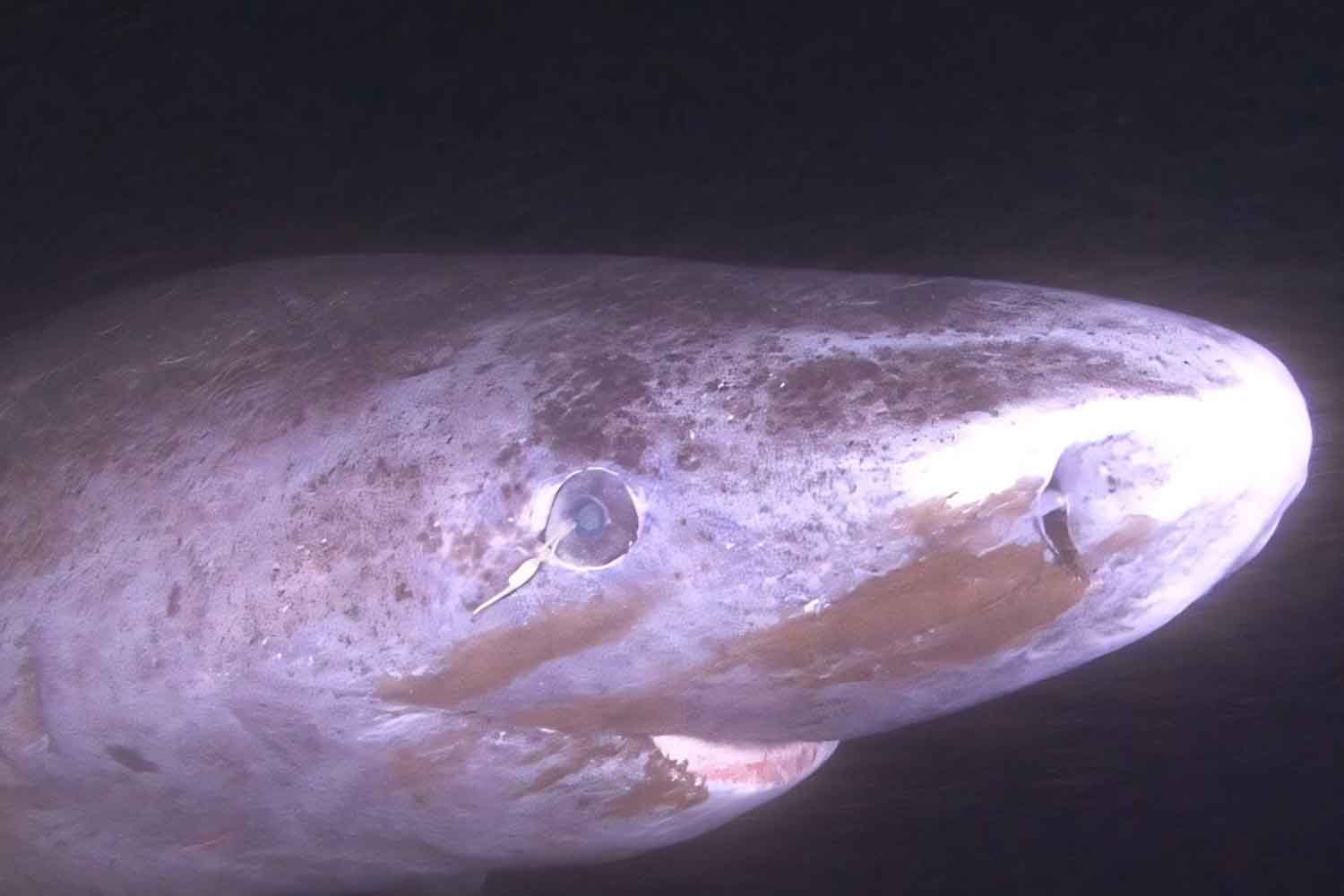
For years we imagined him as a slow, almost blind giant, groping his way through the dark waters of the Arctic. The Greenland shark, among the longest-lived vertebrates on the planet, seemed the perfect symbol of a life that goes on despite everything, even without really seeing the world around it. But no. Science, once again, forces us to review (it is appropriate to say) even our certainties.
In the depths where this shark lives, light is little and often absent. To complicate matters, there is a parasite that attaches itself to the eyes, making them dull and seemingly useless. For this reason, for decades, it was almost taken for granted that sight was an expendable sense, not very useful in such an extreme environment.
This idea was overturned by Dorota Skowronska-Krawczyk, professor of physiology and biophysics at the University of California, Irvine. Watching some underwater videos, he noticed a detail that didn’t add up: the shark moved its eyes following the light. It wasn’t a random reflex, but a real visual behavior. From there began research that is now causing discussion in the scientific community.
Eyes hundreds of years old and no signs of degeneration
The study, published in Nature Communications and carried out in collaboration with the University of Basel, analyzed the eyes of sharks caught between 2020 and 2024 off the coast of Greenland. Some of these animals were estimated to be over 200 years old, others may have lived close to 400.
Yet, when looking at the ocular tissues under a microscope, the researchers found no traces of retinal degeneration. The cells were intact, active, functional. A surprising result, especially when compared with what happens in humans, where vision tends to worsen after just a few decades.
The key point appears to be a particularly effective DNA repair mechanism. In practice, the Greenland shark manages to “repair” cellular damage before it accumulates, keeping the eyes healthy for centuries. Even rhodopsin, the protein that allows us to see in low light conditions, is fully functional and specialized in capturing blue light, the only one that can penetrate deep into the ocean.
From shark to man
In the laboratory, those who worked on these samples describe an almost surreal experience. Emily Tom, a doctoral student on Skowronska-Krawczyk’s team, came across a baseball-sized eyeball from a two-century-old shark. Despite their age, the fabrics were surprisingly “youthful”.
It is here that the story of the Greenland shark stops being just a zoological curiosity and becomes something that concerns us closely. Understanding how this animal manages to maintain its sight for so long could offer new ideas for combating age-related eye diseases, such as macular degeneration or glaucoma. Studying those who age slowly, and do it well, is one of the most effective ways to understand what isn’t working in our body.
For years it was thought that, in extreme environments, evolution pushed us to eliminate what is not needed. This research suggests the opposite: even where there is little light, sight can remain a fundamental sense. And it can do so for hundreds of years.
The Greenland shark, silent inhabitant of the abyss, reminds us that nature finds solutions that we often don’t imagine. And that, perhaps, to understand how to age better, we should look more often at those who live longer than us.
You might also be interested in:
